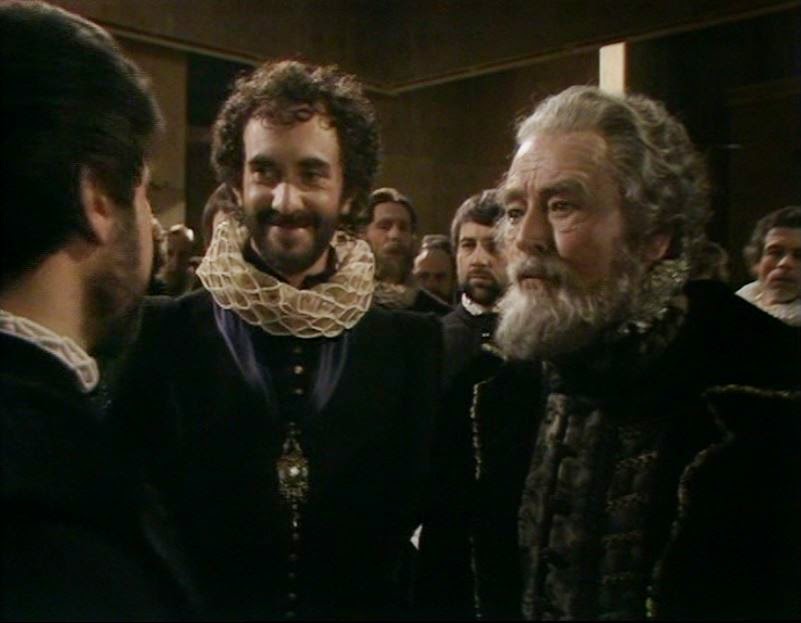
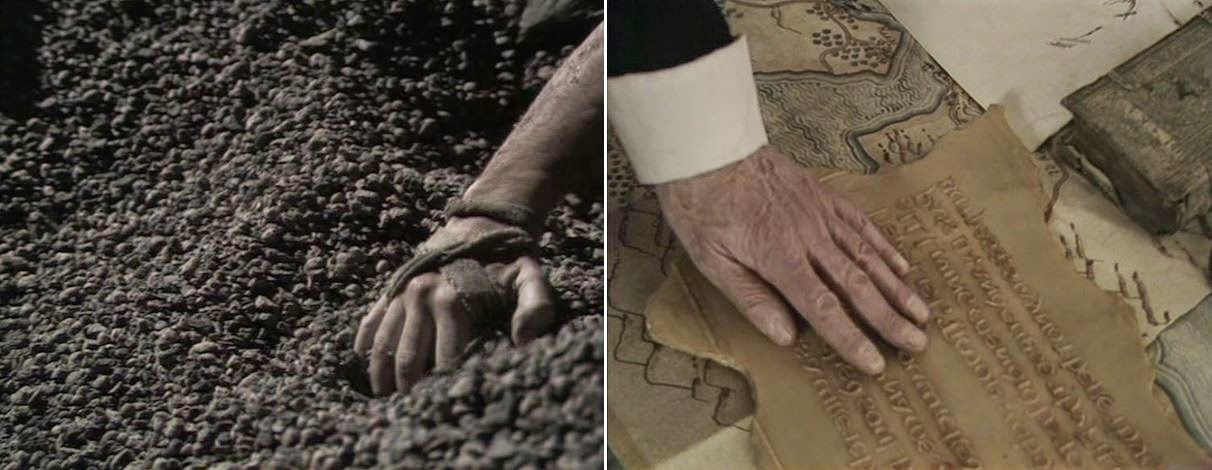
First transmitted 10th July 1983
 |
Helen Mirren sleeps unaware of Robert Lindsay's presence |
Director: Elijah Moshinsky
 If you fancy an amusing few minutes, try sitting someone
down and explaining the plot of Cymbeline
to them. I guarantee, not only will you not be able to do it in less than 10-15
(long) sentences, but at the end of it the person you are describing it to will
pull a face and say “What?”. Their second reaction will probably be “Perhaps
I’ll give that one a miss then”. Which to be honest is probably a pretty fair
reaction. Cymbeline is, to say the
least, a bonkers, poorly structured play in which the words ‘problem’ or
‘obscure’, used often to describe its place in the Shakespeare canon, might as
well be a euphemism for ‘bollocks’.
If you fancy an amusing few minutes, try sitting someone
down and explaining the plot of Cymbeline
to them. I guarantee, not only will you not be able to do it in less than 10-15
(long) sentences, but at the end of it the person you are describing it to will
pull a face and say “What?”. Their second reaction will probably be “Perhaps
I’ll give that one a miss then”. Which to be honest is probably a pretty fair
reaction. Cymbeline is, to say the
least, a bonkers, poorly structured play in which the words ‘problem’ or
‘obscure’, used often to describe its place in the Shakespeare canon, might as
well be a euphemism for ‘bollocks’. As a play it should really work – it’s practically a menage
of all Shakespeare’s comedy plots featuring, as it does, lovers divided by a
lie told by a bad man, a girl disguised as a boy, separated siblings, servants
caught between loyalties, a distant father whose heart is softened by events
etc. Throw in a few tropes from the tragedies – confusion over the death of a
key character, a poison that is actually a sleeping draft, an uncaring central
female figure, a battle that happens largely off-stage, an overcooked murder
plan – and you end up with something that should be really entertaining, but is
actually a bewildering mess.
As a play it should really work – it’s practically a menage
of all Shakespeare’s comedy plots featuring, as it does, lovers divided by a
lie told by a bad man, a girl disguised as a boy, separated siblings, servants
caught between loyalties, a distant father whose heart is softened by events
etc. Throw in a few tropes from the tragedies – confusion over the death of a
key character, a poison that is actually a sleeping draft, an uncaring central
female figure, a battle that happens largely off-stage, an overcooked murder
plan – and you end up with something that should be really entertaining, but is
actually a bewildering mess.
Difficult to follow and to engage with (lacking both
characters you can really invest in and a dynamic plot you can really get
behind) it’s pretty hard not to come out of the play without a meh feeling. This feeling isn’t helped
by this production of the play, which is possibly the driest and (whisper it)
dullest of the series so far. It may well be a matter of personal taste, but
what really strikes me about this film (particularly after the high-octane and
dynamic history cycle) is how static and flat the camerawork is, with many
scenes told with a simple single shot with minimal actor movement. This has often
been the Moshinsky approach, with an approach heavily inspired by paintings –
but this production lacks the visual strengths of All’s Well That Ends Well or the reinterpretative imagination of A Midsummer Night’s Dream.
 What it does offer is a rather cold and impersonal
interpretation. Part of this is intentional – Britain is deliberately framed as
a cold and wintery place, to contrast with a steamier Rome, but this chill
hangs over the whole play with many of the performances themselves taken a
softly-spoken, hard-faced approach that largely fails to engage the audience in
the story and the emotions of the characters. Despite the supposed high-stakes
for many of the characters (if you can work them out) there never seems to be
any urgency or intensity behind the actions in the play. Instead the action
plays out over a series of still, painterly images – you could watch much of
this play in fast forward and have no trouble following the visual storytelling
– with too many scenes delivered at a meditative, lingering pace. This is
despite the efforts of an all-star cast, some of whom are only partly
successful in getting any audience investment in their characters.
What it does offer is a rather cold and impersonal
interpretation. Part of this is intentional – Britain is deliberately framed as
a cold and wintery place, to contrast with a steamier Rome, but this chill
hangs over the whole play with many of the performances themselves taken a
softly-spoken, hard-faced approach that largely fails to engage the audience in
the story and the emotions of the characters. Despite the supposed high-stakes
for many of the characters (if you can work them out) there never seems to be
any urgency or intensity behind the actions in the play. Instead the action
plays out over a series of still, painterly images – you could watch much of
this play in fast forward and have no trouble following the visual storytelling
– with too many scenes delivered at a meditative, lingering pace. This is
despite the efforts of an all-star cast, some of whom are only partly
successful in getting any audience investment in their characters.
In fact the slow pace of this play is particularly striking,
when you consider how much has been cut-out or rearranged by Moshinsky. Two
scenes, both revolving around the Roman-Britain war (and sadly including the
crucial battle scene) have been cut, along with several large speeches; and a
number of scenes have ten or so lines trimmed from them, usually around the
transition. In all, this is probably the most heavily cut production so far –
which then makes the fact that the bloody thing still runs for almost three
hours even more inexplicable. Now there are obvious reasons why some actors
take their time – Robert Lindsay’s lingering appreciation of a sleeping Imogen does
at least make sense character-wise – but too many scenes elsewhere are
delivered without pace or urgency (Michael Pennington is particularly guilty of
this). Combine this with the general coldness of the production and it makes it
even harder to focus on the characters, while you worry about the numbing of
your posterior.
 Moshinsky does throw in a few flourishes, not all of which
are completely successful. He gets a fair bit of play around using mirrors in
conversations (the camera trains on one person, while the person they are
talking to is seen in reflection in a mirror alongside them) although I’m not
clear what this is supposed to contribute to interpretation, other than offering
a neat visual trick. Similarly, a number of scenes are set around tables with
characters lounging or sitting straight backed in chairs at the end of tables,
behind tables, while the tables themselves host private discussions, formal
negotiations, intense chess matches… Whether this is supposed to be some
comment on the general themes in the play of an oppressive culture and a
feeling of observation and spying trapping people in place, or just a neat echo
of some of the Dutch masters (in particular Rembrandt), leaves me rather
non-plussed though. The less said about super-imposed hawks duelling in the
skies while Cloten and Guiderius fight to the death the better (terrible
memories of Winter’s Tale’s Bear come
storming back).
Moshinsky does throw in a few flourishes, not all of which
are completely successful. He gets a fair bit of play around using mirrors in
conversations (the camera trains on one person, while the person they are
talking to is seen in reflection in a mirror alongside them) although I’m not
clear what this is supposed to contribute to interpretation, other than offering
a neat visual trick. Similarly, a number of scenes are set around tables with
characters lounging or sitting straight backed in chairs at the end of tables,
behind tables, while the tables themselves host private discussions, formal
negotiations, intense chess matches… Whether this is supposed to be some
comment on the general themes in the play of an oppressive culture and a
feeling of observation and spying trapping people in place, or just a neat echo
of some of the Dutch masters (in particular Rembrandt), leaves me rather
non-plussed though. The less said about super-imposed hawks duelling in the
skies while Cloten and Guiderius fight to the death the better (terrible
memories of Winter’s Tale’s Bear come
storming back).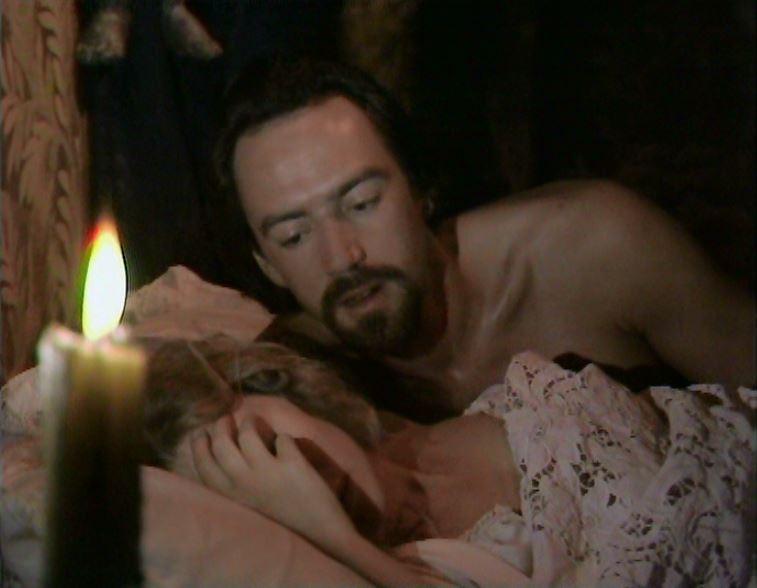
The sequence that works by far the best is Iachimo’s
lecherous observation of the sleeping Imogen. Not only does Robert Lindsay land
his performance just the right side of over-zealous panting pervert, but the
camerawork adds a sensual steaminess and illicit naughtiness to the scene, as
it gets in close to Iachimo looming (topless) over Imogen, the camera finally
moving position to roam with Iachimo over the room and body. The glowing yellow
light over the scene helps add in this sense of twisted eroticism. Moshinsky
then effectively mirrors the scene later (this time replaying the scene as
nightmare) with Imogen awaking with Cloten’s headless body, the camerawork
being remarkably similar (starting with the same shot) and following Imogen’s inspection
of Cloten’s corpse (which for reasons too obscure to explain she believes to be
that of Posthumus) her heart-broken tenderness and trauma contrasted with
Iachimo’s earlier lip-smacking enjoyment. They are two sequences that do offer
something new – and do make a clear link between the two scenes, centering Imogen’s
experience and helping to turn the atmosphere of this bizarre play into
something resembling a twisted dream by its heroine.
 But it still doesn’t redeem the production, which is cursed
with less than completely successful performances in crucial roles. Michael
Pennington, an intelligent and profound actor, does everything he can with
Posthumus but plays the part so straight laced, brooding and with a dark
intensity that not only do you find it hard to interest yourself in the part, it’s
even a little unclear at several points what emotion he is going for (his A5 S1
speech is a perfect example of this – the growth of his guilt is rather hard to
make out unless you actually read along with what he is saying). Helen Mirren
really does her best with, in truth, a rather ropey role as Imogen, a character
who keeps threatening to burst into life as a true heroine but consistently
fails to do so. Mirren gives her a great deal of dignity and moral force, but
also shades it with a hint of corruption – she is clearly tempted briefly by
Iachimo – and far from a doormat, she explodes with anger at first when Pisano
reveals Posthumus’ suspicious of her conduct, before a melodramatic pleading
for death. Her later pain when she believes him killed is moving. But she
hasn’t much to work with. Robert Lindsay excels in the bedroom scene as
Iachimo, but outside of that offers little other than scowls and leers like a
low-rent Iago.
But it still doesn’t redeem the production, which is cursed
with less than completely successful performances in crucial roles. Michael
Pennington, an intelligent and profound actor, does everything he can with
Posthumus but plays the part so straight laced, brooding and with a dark
intensity that not only do you find it hard to interest yourself in the part, it’s
even a little unclear at several points what emotion he is going for (his A5 S1
speech is a perfect example of this – the growth of his guilt is rather hard to
make out unless you actually read along with what he is saying). Helen Mirren
really does her best with, in truth, a rather ropey role as Imogen, a character
who keeps threatening to burst into life as a true heroine but consistently
fails to do so. Mirren gives her a great deal of dignity and moral force, but
also shades it with a hint of corruption – she is clearly tempted briefly by
Iachimo – and far from a doormat, she explodes with anger at first when Pisano
reveals Posthumus’ suspicious of her conduct, before a melodramatic pleading
for death. Her later pain when she believes him killed is moving. But she
hasn’t much to work with. Robert Lindsay excels in the bedroom scene as
Iachimo, but outside of that offers little other than scowls and leers like a
low-rent Iago. Richard Johnson makes some small impact as gruff, bear-like
Cymbeline – in fact his reading is enjoyable enough that it hammers home how
little he is in the play. Claire Bloom does her best with the one-dimensional
Queen (famously described as so thinly sketched she doesn’t even merit a name),
although her brooding under-playing and softly spoken scheming does detract
from her position as the play’s villain. Hugh Thomas’ Cornelius makes a good
impression as an observant and arch doctor and Michael Horden and Marius Goring
pop up for some stirring Shakespearean style cameos as the God Jupiter and a
Ghost respectively (don’t even ask). Graham Crowden makes a nice impression as
Luscius while John Kane does some sterling work as the loyal Pisanio. Geoffrey
Burridge and David Creedon, however, make little or no impression as Guiderius
and Arviragus (two characters so loosely defined by Shakespeare that I can’t
really tell them apart).
Richard Johnson makes some small impact as gruff, bear-like
Cymbeline – in fact his reading is enjoyable enough that it hammers home how
little he is in the play. Claire Bloom does her best with the one-dimensional
Queen (famously described as so thinly sketched she doesn’t even merit a name),
although her brooding under-playing and softly spoken scheming does detract
from her position as the play’s villain. Hugh Thomas’ Cornelius makes a good
impression as an observant and arch doctor and Michael Horden and Marius Goring
pop up for some stirring Shakespearean style cameos as the God Jupiter and a
Ghost respectively (don’t even ask). Graham Crowden makes a nice impression as
Luscius while John Kane does some sterling work as the loyal Pisanio. Geoffrey
Burridge and David Creedon, however, make little or no impression as Guiderius
and Arviragus (two characters so loosely defined by Shakespeare that I can’t
really tell them apart). The best performances though come from Paul Jesson and
Michael Gough. Jesson adds a lovely comic touch as the arrogant, campy and
self-obsessed Cloten, his pomposity and grandiosity forever undermined by a
rhoticism. Constantly seen preening himself, out of his depth in the real world
and a hopelessly incompetent wooer and fighter, he lights up a number of scenes
by bringing a real comic energy and engagement to the production. At the other
end of the scale, Michael Gough’s Belarius is not only brilliantly spoken but
Gough brings a world-weary, pained expression to all his delivery, with hints
of guilt at his stealing of Cymbeline’s sons, matched with a touch of anger at
his betrayal. Of all the characters with sustained speeches, it’s his that
really capture the imagination and Gough is the one who creates a character
that feels real, with genuine emotions and motivations and a feeling of an
internal life. It’s a performance that actually deserves to sit in a better
play, never mind production – what would he have done with a Malvolio, Polonius
or Gloucester? A real shame that this was his only outing in the series.
The best performances though come from Paul Jesson and
Michael Gough. Jesson adds a lovely comic touch as the arrogant, campy and
self-obsessed Cloten, his pomposity and grandiosity forever undermined by a
rhoticism. Constantly seen preening himself, out of his depth in the real world
and a hopelessly incompetent wooer and fighter, he lights up a number of scenes
by bringing a real comic energy and engagement to the production. At the other
end of the scale, Michael Gough’s Belarius is not only brilliantly spoken but
Gough brings a world-weary, pained expression to all his delivery, with hints
of guilt at his stealing of Cymbeline’s sons, matched with a touch of anger at
his betrayal. Of all the characters with sustained speeches, it’s his that
really capture the imagination and Gough is the one who creates a character
that feels real, with genuine emotions and motivations and a feeling of an
internal life. It’s a performance that actually deserves to sit in a better
play, never mind production – what would he have done with a Malvolio, Polonius
or Gloucester? A real shame that this was his only outing in the series.
These good touches however are few and far between in what
is a desperately disappointing production, dry, dull and flat and largely not
worth the three hours of your time. After the history cycle it also seems a
chronic step back, lacking in visual and filmic ambition. After the work
Moshinsky had done on previous productions I expected a lot better of this
production. Part of that though I am willing to chalk up to the play itself, up
there now with Merry Wives as perhaps
one of the worst (and certainly hardest to perform) in the canon. A lot of
people claim that there are a number of parallels between the events in this
play and the life of Edward de Vere, making it a strong part of the argument
that the Earl wrote the plays. Well, as far as I’m concerned, he can have this
one.

Conclusion
The play itself is a mess, but that doesn’t
excuse what is a rather flat, dull and boring production, slow paced and
generally lacking creative imagination or visual interest. With a cold and dry
mood and an overwhelming running time, there isn’t much to grab the viewer’s
interest, let alone keep it. Pity poor Helen Mirren that two out of three of
her offerings were this and the appalling As
You Like It. Not one for the desert island.