First Transmitted 8th December 1984
 |
Mike Gwilym and Amanda Redman are lost in the Mediterranean in Shakespeare's rambling epic |
Director: David Jones
Cast: Mike Gwilym (Pericles), Edward Petherbridge (Gower),
Juliet Stevenson (Thaisa), Amanda Redman (Marina), Norman Rodway (Cleon),
Annette Crosbie (Dionyza), Patrick Godfrey (Helicanus), Patrick Ryecart
(Lysimachus), Patrick Allen (Simonides), Clive Swift (Cerimon), Trevor Peacock
(Boult), Toby Salamn (Pandar), Lula Kaye (Bawd), Nick Brimble (Leonine), John
Woodvine (Antiochus), Edita Brychta (Antiochus’ daughter), Gordon Gostelow
(Fisherman), John Bardon (Lord/Fisherman/Sailor), Christopher Ravenscroft
(Knight/Gentleman)
 With this adaptation of Pericles,
the series moves well and truly into the ephemera of the completed works. Pericles is now widely accepted as a
collaboration between Shakespeare and the pamphleteer George Wilkins. Wilkins
contributed large chunks of the first two acts, with Shakespeare believed to
have polished those and written the remaining three acts. This makes it rather
like reading a book written in collaboration by John Grisham and Salman Rushdie.
With this adaptation of Pericles,
the series moves well and truly into the ephemera of the completed works. Pericles is now widely accepted as a
collaboration between Shakespeare and the pamphleteer George Wilkins. Wilkins
contributed large chunks of the first two acts, with Shakespeare believed to
have polished those and written the remaining three acts. This makes it rather
like reading a book written in collaboration by John Grisham and Salman Rushdie.
 Acts 1 and 2 meander from episodic adventure to episodic
adventure, with Pericles visiting a dizzying array of different locations
around the Mediterranean. The opening acts concern his unearthing incest in
Antioch, returning to Tyre only to flee assassins, then sailing to Tarsus where
he saves a city from starvation. He is then shipwrecked on Pentapolis where (disguised
as a penniless knight) he wins a joust, the respect of King Simonedes and the
love of his daughter Thaisa. Written out like that it should be compelling, but
(certainly in the production) the action is terminally dull. Poorly shaped
characters speak at each other rather than engaging in active conversation, and
the constant switches of location and story line prevent us from growing
attached to the characters or interested in their fates. Similarly, Jones
introduces far too many minute-filling interpolations, including a never-ending
dance at Pentapolis. The Antioch scenes do use slow zooms and long shots well
to demonstrate both the isolation of Pericles and his danger from the
incestuous King and his daughter, but this isn’t enough to make it dynamic or
especially interesting.
Acts 1 and 2 meander from episodic adventure to episodic
adventure, with Pericles visiting a dizzying array of different locations
around the Mediterranean. The opening acts concern his unearthing incest in
Antioch, returning to Tyre only to flee assassins, then sailing to Tarsus where
he saves a city from starvation. He is then shipwrecked on Pentapolis where (disguised
as a penniless knight) he wins a joust, the respect of King Simonedes and the
love of his daughter Thaisa. Written out like that it should be compelling, but
(certainly in the production) the action is terminally dull. Poorly shaped
characters speak at each other rather than engaging in active conversation, and
the constant switches of location and story line prevent us from growing
attached to the characters or interested in their fates. Similarly, Jones
introduces far too many minute-filling interpolations, including a never-ending
dance at Pentapolis. The Antioch scenes do use slow zooms and long shots well
to demonstrate both the isolation of Pericles and his danger from the
incestuous King and his daughter, but this isn’t enough to make it dynamic or
especially interesting.
 By contrast, the second half of the production (and I felt
this even before checking who wrote what!) is both far pacier and much more
focused. Thaisa is presumed to have died in childbirth while at sea and her
tomb cast into the sea (it washes up on Ephesus and luckily she turns out to be
fine!). Pericles leaves his newborn daughter Marina in Tarsus (for reasons
never really explained) and doesn’t see her for 16 years. After that time,
Dionyza (wife of the ruler of Tarsus) arranges for Marina to be murdered – but
she is kidnapped by pirates before the deed is done and sold to a brothel in
Mytilene. There she keeps her purity by the virtue of her virtue and becomes
famous. Pericles, believing her dead, eventually arrives in Mytilene and there
is a great reconciliation, before a vision sends him to Ephesus for a second
reconciliation with his wife. Far from the bitty and uninvolving events of Acts 1 and 2,
with their constantly revolving series of characters and locations, the second
half of the show introduces a consistent set of characters and four clear
locations, each with a distinctive purpose.
By contrast, the second half of the production (and I felt
this even before checking who wrote what!) is both far pacier and much more
focused. Thaisa is presumed to have died in childbirth while at sea and her
tomb cast into the sea (it washes up on Ephesus and luckily she turns out to be
fine!). Pericles leaves his newborn daughter Marina in Tarsus (for reasons
never really explained) and doesn’t see her for 16 years. After that time,
Dionyza (wife of the ruler of Tarsus) arranges for Marina to be murdered – but
she is kidnapped by pirates before the deed is done and sold to a brothel in
Mytilene. There she keeps her purity by the virtue of her virtue and becomes
famous. Pericles, believing her dead, eventually arrives in Mytilene and there
is a great reconciliation, before a vision sends him to Ephesus for a second
reconciliation with his wife. Far from the bitty and uninvolving events of Acts 1 and 2,
with their constantly revolving series of characters and locations, the second
half of the show introduces a consistent set of characters and four clear
locations, each with a distinctive purpose.
 So this is a production that inherits and falls victim to
the weaknesses of the original material. Jones’ direction also declines to
introduce much pace to the production. We’ve already mentioned the long dance
scene, but that’s not even the worst offender. A good ten minutes is given over
to Cerimon’s waking of Thaisa from the dead – a prolonged wordless sequence
largely spent watching Cerimon rub Thaisa’s wrists. Any sense of urgency about
saving a life is missing completely. Too often, the pace drains out of the
production. This also isn’t helped by Edward Petherbridge’s sing-song
performance as the narrator Gower – beautifully spoken as the semi-Irish lilt
Petherbridge chooses might be, it lacks a real dynamism, meaning Gower’s
regular interpolations frequently slow the production down. It’s a shame as,
when the plot really gets going, and particularly once Amanda Redman’s Marina
arrives, – there is a lot of merit and interest here – it just consistently
seems to get lost.
So this is a production that inherits and falls victim to
the weaknesses of the original material. Jones’ direction also declines to
introduce much pace to the production. We’ve already mentioned the long dance
scene, but that’s not even the worst offender. A good ten minutes is given over
to Cerimon’s waking of Thaisa from the dead – a prolonged wordless sequence
largely spent watching Cerimon rub Thaisa’s wrists. Any sense of urgency about
saving a life is missing completely. Too often, the pace drains out of the
production. This also isn’t helped by Edward Petherbridge’s sing-song
performance as the narrator Gower – beautifully spoken as the semi-Irish lilt
Petherbridge chooses might be, it lacks a real dynamism, meaning Gower’s
regular interpolations frequently slow the production down. It’s a shame as,
when the plot really gets going, and particularly once Amanda Redman’s Marina
arrives, – there is a lot of merit and interest here – it just consistently
seems to get lost.

 The Gower narrative sections are also skilfully illustrated
to add a bit of visual interest . Petherbridge’s delivery may not be the most
lively or engaging, but the events he relates are frequently played out behind
him in delicately staged dumb shows by the actors. This instantly makes
sections of the play that could otherwise be quite dry into something a little
more dynamic and interesting to watch. Petherbridge is also often introduced into
the scenes immediately before his narrative, in the background of the shot, to
tie Gower a bit more into the action as an omniscient chorus or narrator. But
too often these Gower interludes only really slow down the action rather than
enlighten it (at one point the character even apologises for speaking at such
great length) – and I’m not sure the production gets around this much.
The Gower narrative sections are also skilfully illustrated
to add a bit of visual interest . Petherbridge’s delivery may not be the most
lively or engaging, but the events he relates are frequently played out behind
him in delicately staged dumb shows by the actors. This instantly makes
sections of the play that could otherwise be quite dry into something a little
more dynamic and interesting to watch. Petherbridge is also often introduced into
the scenes immediately before his narrative, in the background of the shot, to
tie Gower a bit more into the action as an omniscient chorus or narrator. But
too often these Gower interludes only really slow down the action rather than
enlighten it (at one point the character even apologises for speaking at such
great length) – and I’m not sure the production gets around this much.
 When the production allows its narrative to have a bit more
momentum, it also manages to carry an impressive amount of emotional heft. The
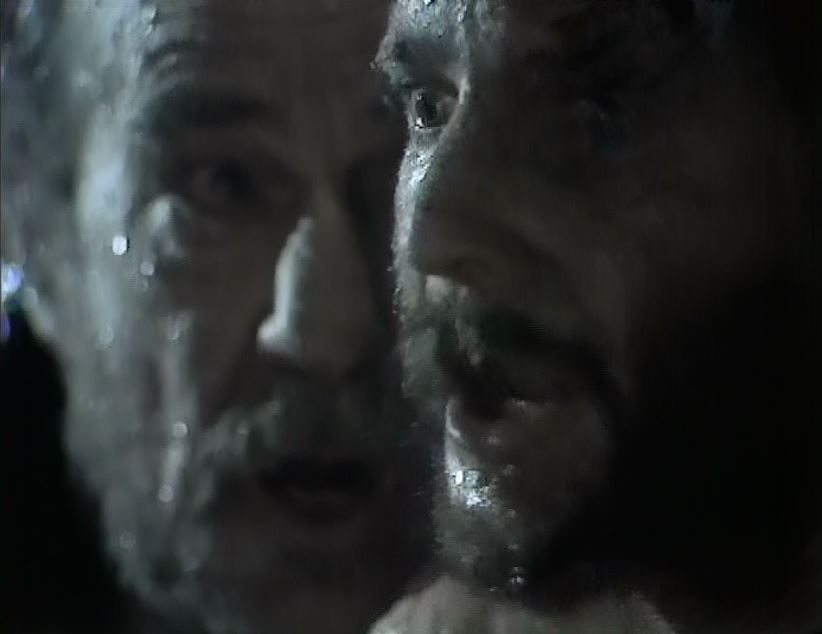
imagined death of Thaisa in a storm at sea is movingly presented and draws some
fine performances – it’s easily Mike Gwilym’s most effective moment. Similarly
the build towards the reunion between Marina and Pericles is both very well
staged – an effective intermixing of POV shots and close-ups – and draws the
viewer into the relationship between the two characters. The second reunion
between Pericles and Thaisa carries slightly less weight – but this is largely
the fault of the play rather than the production.
When the production allows its narrative to have a bit more
momentum, it also manages to carry an impressive amount of emotional heft. The
imagined death of Thaisa in a storm at sea is movingly presented and draws some
fine performances – it’s easily Mike Gwilym’s most effective moment. Similarly
the build towards the reunion between Marina and Pericles is both very well
staged – an effective intermixing of POV shots and close-ups – and draws the
viewer into the relationship between the two characters. The second reunion
between Pericles and Thaisa carries slightly less weight – but this is largely
the fault of the play rather than the production.
 In fact the plotline following the adult Marina is very well
done indeed. This is also in large measure due to Amanda Redman’s excellent
performance in the role. Marina is a very difficult part to play – a woman so
pure, innocent and perfect that even in the role of prostitute she is able to
persuade men to renounce lechery. On paper, it’s a character largely devoid of
dramatic interest or tension. However, Redman brings a great deal of
intelligence, determination and cunning to the role: Marina has a huge strength
of character and is never the victim in the play. She understands the situation
she is in, and Redman plays her as a woman with a shrewd and fast judge of
character, swiftly able to identify strengths and weaknesses of the person she
is talking to and to adjust her approach to manipulate them effectively. Far
from a sweet flowery innocence, you get a sense of a woman who understands the
world extremely well and how to get what she wants out of it. Redman turns a
reactive near-victim into the most effective and proactive character in the
play.
In fact the plotline following the adult Marina is very well
done indeed. This is also in large measure due to Amanda Redman’s excellent
performance in the role. Marina is a very difficult part to play – a woman so
pure, innocent and perfect that even in the role of prostitute she is able to
persuade men to renounce lechery. On paper, it’s a character largely devoid of
dramatic interest or tension. However, Redman brings a great deal of
intelligence, determination and cunning to the role: Marina has a huge strength
of character and is never the victim in the play. She understands the situation
she is in, and Redman plays her as a woman with a shrewd and fast judge of
character, swiftly able to identify strengths and weaknesses of the person she
is talking to and to adjust her approach to manipulate them effectively. Far
from a sweet flowery innocence, you get a sense of a woman who understands the
world extremely well and how to get what she wants out of it. Redman turns a
reactive near-victim into the most effective and proactive character in the
play.
 It’s a performance that really motors the play – and it
fills a void that Mike Gwilym isn’t quite able to do in the first half.
Pericles is part wanderer, part romantic maverick – Gwilyn doesn’t quite have
the charisma and dynamism as a performer that the part demands. As an actor he
is very well spoken and fiercely intelligent; he makes Pericles instantly
believable as the strong king and decisive ruler, but he doesn’t quite convince
as the swaggering adventurer who can win Thaisa’s heart, or the chance taker
who inadvertently unmasks covert incest in the Antioch plotline. Gwilym just
isn’t quite magnetic enough as a leading man to carry the first half of the
drama – you keep wanting a little more life and energy from him. His line
readings are beautiful, but he’s not the romantic lead the part needs to be.
It’s a performance that really motors the play – and it
fills a void that Mike Gwilym isn’t quite able to do in the first half.
Pericles is part wanderer, part romantic maverick – Gwilyn doesn’t quite have
the charisma and dynamism as a performer that the part demands. As an actor he
is very well spoken and fiercely intelligent; he makes Pericles instantly
believable as the strong king and decisive ruler, but he doesn’t quite convince
as the swaggering adventurer who can win Thaisa’s heart, or the chance taker
who inadvertently unmasks covert incest in the Antioch plotline. Gwilym just
isn’t quite magnetic enough as a leading man to carry the first half of the
drama – you keep wanting a little more life and energy from him. His line
readings are beautiful, but he’s not the romantic lead the part needs to be.

 The rest of the cast is a wonderful who’s-who of players
from earlier in the series – it’s actually very nice to see them all again!
Most of them are in cameo roles but produce excellent work. Norman Rodway
brings a sharpness and animation to Cleon – later collapsing into a sense of
being trapped and powerless after his wife’s actions. Annette Crosbie as his
wife Dionyza manages to make the character’s bizarre sudden transformation from
caring mother to murderous evil aunt fairly logical – she creates a decent
spark of bitterness and a clear sign of insecurity early in Dionyza. Patrick
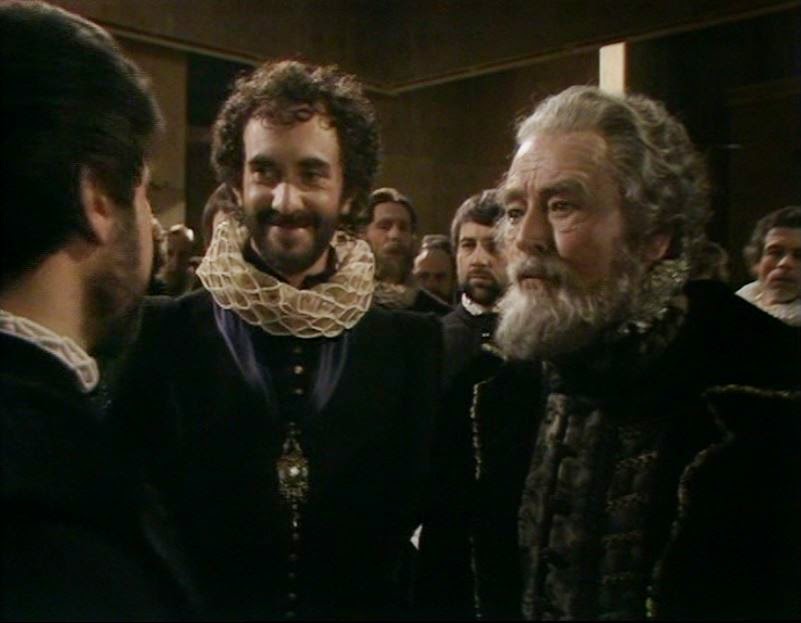
Godfrey makes Helicanus a stand-up guy. Patrick Allen is a playfully gruff
Simonedes. Trevor Peacock is surprisingly quite funny (considering the series’
track record with comedy) as whorehouse employee Boult. Clive Swift is saddled
with the worst part as Cerimon, but does a decent job. Special mention must
also be made of Patrick Ryecart, here cast much more effectively as the rakish
Lysimachus than he ever was as Romeo.
The rest of the cast is a wonderful who’s-who of players
from earlier in the series – it’s actually very nice to see them all again!
Most of them are in cameo roles but produce excellent work. Norman Rodway
brings a sharpness and animation to Cleon – later collapsing into a sense of
being trapped and powerless after his wife’s actions. Annette Crosbie as his
wife Dionyza manages to make the character’s bizarre sudden transformation from
caring mother to murderous evil aunt fairly logical – she creates a decent
spark of bitterness and a clear sign of insecurity early in Dionyza. Patrick
Godfrey makes Helicanus a stand-up guy. Patrick Allen is a playfully gruff
Simonedes. Trevor Peacock is surprisingly quite funny (considering the series’
track record with comedy) as whorehouse employee Boult. Clive Swift is saddled
with the worst part as Cerimon, but does a decent job. Special mention must
also be made of Patrick Ryecart, here cast much more effectively as the rakish
Lysimachus than he ever was as Romeo.


Pericles itself is
a rather strange play and I’m not sure this, at times painfully long,
adaptation completely gets to grips with it. Again, completeness is probably
the enemy here: a braver production would have hacked much of Acts 1 and 2,
especially as the story (proper) doesn’t actually begin until Act 3. The
downside of this is that it would have reduced Pericles himself into a
Cymbeline-like character, but as he is hardly the most enthralling personality
ever shown on the stage, this arguably would have been no great loss.
 Acts 1 and 2 meander from episodic adventure to episodic
adventure, with Pericles visiting a dizzying array of different locations
around the Mediterranean. The opening acts concern his unearthing incest in
Antioch, returning to Tyre only to flee assassins, then sailing to Tarsus where
he saves a city from starvation. He is then shipwrecked on Pentapolis where (disguised
as a penniless knight) he wins a joust, the respect of King Simonedes and the
love of his daughter Thaisa. Written out like that it should be compelling, but
(certainly in the production) the action is terminally dull. Poorly shaped
characters speak at each other rather than engaging in active conversation, and
the constant switches of location and story line prevent us from growing
attached to the characters or interested in their fates. Similarly, Jones
introduces far too many minute-filling interpolations, including a never-ending
dance at Pentapolis. The Antioch scenes do use slow zooms and long shots well
to demonstrate both the isolation of Pericles and his danger from the
incestuous King and his daughter, but this isn’t enough to make it dynamic or
especially interesting.
Acts 1 and 2 meander from episodic adventure to episodic
adventure, with Pericles visiting a dizzying array of different locations
around the Mediterranean. The opening acts concern his unearthing incest in
Antioch, returning to Tyre only to flee assassins, then sailing to Tarsus where
he saves a city from starvation. He is then shipwrecked on Pentapolis where (disguised
as a penniless knight) he wins a joust, the respect of King Simonedes and the
love of his daughter Thaisa. Written out like that it should be compelling, but
(certainly in the production) the action is terminally dull. Poorly shaped
characters speak at each other rather than engaging in active conversation, and
the constant switches of location and story line prevent us from growing
attached to the characters or interested in their fates. Similarly, Jones
introduces far too many minute-filling interpolations, including a never-ending
dance at Pentapolis. The Antioch scenes do use slow zooms and long shots well
to demonstrate both the isolation of Pericles and his danger from the
incestuous King and his daughter, but this isn’t enough to make it dynamic or
especially interesting. By contrast, the second half of the production (and I felt
this even before checking who wrote what!) is both far pacier and much more
focused. Thaisa is presumed to have died in childbirth while at sea and her
tomb cast into the sea (it washes up on Ephesus and luckily she turns out to be
fine!). Pericles leaves his newborn daughter Marina in Tarsus (for reasons
never really explained) and doesn’t see her for 16 years. After that time,
Dionyza (wife of the ruler of Tarsus) arranges for Marina to be murdered – but
she is kidnapped by pirates before the deed is done and sold to a brothel in
Mytilene. There she keeps her purity by the virtue of her virtue and becomes
famous. Pericles, believing her dead, eventually arrives in Mytilene and there
is a great reconciliation, before a vision sends him to Ephesus for a second
reconciliation with his wife. Far from the bitty and uninvolving events of Acts 1 and 2,
with their constantly revolving series of characters and locations, the second
half of the show introduces a consistent set of characters and four clear
locations, each with a distinctive purpose.
By contrast, the second half of the production (and I felt
this even before checking who wrote what!) is both far pacier and much more
focused. Thaisa is presumed to have died in childbirth while at sea and her
tomb cast into the sea (it washes up on Ephesus and luckily she turns out to be
fine!). Pericles leaves his newborn daughter Marina in Tarsus (for reasons
never really explained) and doesn’t see her for 16 years. After that time,
Dionyza (wife of the ruler of Tarsus) arranges for Marina to be murdered – but
she is kidnapped by pirates before the deed is done and sold to a brothel in
Mytilene. There she keeps her purity by the virtue of her virtue and becomes
famous. Pericles, believing her dead, eventually arrives in Mytilene and there
is a great reconciliation, before a vision sends him to Ephesus for a second
reconciliation with his wife. Far from the bitty and uninvolving events of Acts 1 and 2,
with their constantly revolving series of characters and locations, the second
half of the show introduces a consistent set of characters and four clear
locations, each with a distinctive purpose.

What Jones and his design team do do well is to make each of
the play’s myriad locations visually distinctive. Each location has its own
style and colour scheme, meaning that, in those parts of the play that move
swiftly from place to place, the viewer always knows where they are and where
the characters we’re watching are from. Tyre, Pericles’s home, uses cooler
blues and marbled, dark hallways. Antioch is a sandy, robed, yellowing place
with shady glens. Tarsus has classic Eastern architecture with white robes.
Pentapolis is a grand Greek interior. Ephesus has a real sense of heat, sandy
and white. Mytiline a more brownstone residential city. The visuals of each
location, and the clothing of its inhabitants, makes each immediately clear –
despite the whirligig plot you are never confused by it.
 |
| Our six locations (from top left): Antioch, Tyre, Tarsus, Pentapolis, Ephesus and Mytilene |


A young Juliet Stevenson is impressive as the naïve and
tender Thaisa, her intelligence as an actor (similar to Redman) adding a
confidence and sexiness to a character who, on paper, is potentially quite
bland. Stevenson has a real breathless quality in her performance. Jones and
his designers work hard to give her and Pericles a complementary appearance
late on. She is saddled with the dull staging of her recovery-from-illness
scene, but brings her now-established
excellence as a performer. A large part of the impact of the final resolution
comes from her quiet emotion.


For the new cast, there are fewer standouts. John Woodvine
makes a good impression as the regal, cruel and controlling Antiochus – these
scenes have some decent tension in them, drily handled as the Antioch section
of the production is. Nick Brimble gives a decent turn as reluctant assassin
Leonine. For the rest of the production, a number of the supporting roles use a
small company of 5-6 actors. This makes for an interesting rotation of actors
but I’m not quite sure if there is any particular reason for it within the
world of the production, in the way that (say) the Henry VI productions used doubling. Here I suspect it was to cut a
few costs, but when you have a decent-enough company it’s nice to see them
rotating through various lords, fishermen, knights and gentlemen.

David Jones draws out some good performances in some decent
settings, to create a version of the play that (eventually) has a real sense of
story and a genuine emotional force to it. The problem is that he is hamstrung
for too long with the flaws of the actual play. He often fails to make
strengths out of the play’s itinerant structure, at some points making it worse
by allowing the pace to drop and introducing overlong sequences, such as dances
or medical cures. But when the production reaches a single consistent story –
and introduces and explores its principal characters – it starts to come to
life. It takes too long to get there, but it handles some of the play’s
problems well and although it fails to bring the first half to life it still
manages to create some emotional force and engagement by its end.
Conclusion
Conclusion
This is a decent production of a very difficult play, with
some very strong moments and some good performances, in particular from Amanda
Redman who steals the show as Marina. However, there are some weaknesses, often
in the pacing which too frequently slows down to accommodate time-consuming
“set piece” moments that add very little indeed to the plot. Mike Gwilym also
lacks a certain charisma that the title role needs in order to really bring the
character (and the play) to life. But despite some flaws, the second half effectively
stages the story of the play and eventually lead to a reconciliation scene that
is quite moving. Some moments of wit and humour lighten the tone as well. While
this is not a perfect production, it’s not a perfect play – and this is a
pretty good stab at bringing it to life, far superior to Jones’ previous
offering in the series, The Merry Wives
of Windsor.
NEXT TIME: Robert Lindsay and Cheri Lunghi bicker and fall in love in Much Ado About Nothing.
NEXT TIME: Robert Lindsay and Cheri Lunghi bicker and fall in love in Much Ado About Nothing.