Showing posts with label Robert Lindsay. Show all posts

Tuesday, 26 January 2016

Cymbeline (Series 6 Episode 1)

First transmitted 10th July 1983

Helen Mirren sleeps unaware of Robert Lindsay's presence

Cast: Helen Mirren (Imogen), Michael Pennington (Posthumus), Robert Lindsay (Iachimo), Richard Johnson (Cymbeline), Michael Gough (Belarius), Paul Jesson (Cloten), Claire Bloom (Queen), Graham Crowden (Caius Lucius), John Kane (Pisanio), Hugh Thomas (Cornelius), Geoffrey Lumsden (Philario), Geoffrey Burridge (Guiderius), David Creedon (Arviragus), Patricia Hayes (Soothsayer), Marius Goring (Sicilius Leonatus), Michael Hordern (Jupiter)
Director: Elijah Moshinsky

If you fancy an amusing few minutes, try sitting someone down and explaining the plot of Cymbeline to them. I guarantee, not only will you not be able to do it in less than 10-15 (long) sentences, but at the end of it the person you are describing it to will pull a face and say “What?”. Their second reaction will probably be “Perhaps I’ll give that one a miss then”. Which to be honest is probably a pretty fair reaction. Cymbeline is, to say the least, a bonkers, poorly structured play in which the words ‘problem’ or ‘obscure’, used often to describe its place in the Shakespeare canon, might as well be a euphemism for ‘bollocks’.

As a play it should really work – it’s practically a menage of all Shakespeare’s comedy plots featuring, as it does, lovers divided by a lie told by a bad man, a girl disguised as a boy, separated siblings, servants caught between loyalties, a distant father whose heart is softened by events etc. Throw in a few tropes from the tragedies – confusion over the death of a key character, a poison that is actually a sleeping draft, an uncaring central female figure, a battle that happens largely off-stage, an overcooked murder plan – and you end up with something that should be really entertaining, but is actually a bewildering mess.

Difficult to follow and to engage with (lacking both characters you can really invest in and a dynamic plot you can really get behind) it’s pretty hard not to come out of the play without a meh feeling. This feeling isn’t helped by this production of the play, which is possibly the driest and (whisper it) dullest of the series so far. It may well be a matter of personal taste, but what really strikes me about this film (particularly after the high-octane and dynamic history cycle) is how static and flat the camerawork is, with many scenes told with a simple single shot with minimal actor movement. This has often been the Moshinsky approach, with an approach heavily inspired by paintings – but this production lacks the visual strengths of All’s Well That Ends Well or the reinterpretative imagination of A Midsummer Night’s Dream.

What it does offer is a rather cold and impersonal interpretation. Part of this is intentional – Britain is deliberately framed as a cold and wintery place, to contrast with a steamier Rome, but this chill hangs over the whole play with many of the performances themselves taken a softly-spoken, hard-faced approach that largely fails to engage the audience in the story and the emotions of the characters. Despite the supposed high-stakes for many of the characters (if you can work them out) there never seems to be any urgency or intensity behind the actions in the play. Instead the action plays out over a series of still, painterly images – you could watch much of this play in fast forward and have no trouble following the visual storytelling – with too many scenes delivered at a meditative, lingering pace. This is despite the efforts of an all-star cast, some of whom are only partly successful in getting any audience investment in their characters.

In fact the slow pace of this play is particularly striking, when you consider how much has been cut-out or rearranged by Moshinsky. Two scenes, both revolving around the Roman-Britain war (and sadly including the crucial battle scene) have been cut, along with several large speeches; and a number of scenes have ten or so lines trimmed from them, usually around the transition. In all, this is probably the most heavily cut production so far – which then makes the fact that the bloody thing still runs for almost three hours even more inexplicable. Now there are obvious reasons why some actors take their time – Robert Lindsay’s lingering appreciation of a sleeping Imogen does at least make sense character-wise – but too many scenes elsewhere are delivered without pace or urgency (Michael Pennington is particularly guilty of this). Combine this with the general coldness of the production and it makes it even harder to focus on the characters, while you worry about the numbing of your posterior.

Moshinsky does throw in a few flourishes, not all of which are completely successful. He gets a fair bit of play around using mirrors in conversations (the camera trains on one person, while the person they are talking to is seen in reflection in a mirror alongside them) although I’m not clear what this is supposed to contribute to interpretation, other than offering a neat visual trick. Similarly, a number of scenes are set around tables with characters lounging or sitting straight backed in chairs at the end of tables, behind tables, while the tables themselves host private discussions, formal negotiations, intense chess matches… Whether this is supposed to be some comment on the general themes in the play of an oppressive culture and a feeling of observation and spying trapping people in place, or just a neat echo of some of the Dutch masters (in particular Rembrandt), leaves me rather non-plussed though. The less said about super-imposed hawks duelling in the skies while Cloten and Guiderius fight to the death the better (terrible memories of Winter’s Tale’s Bear come storming back).
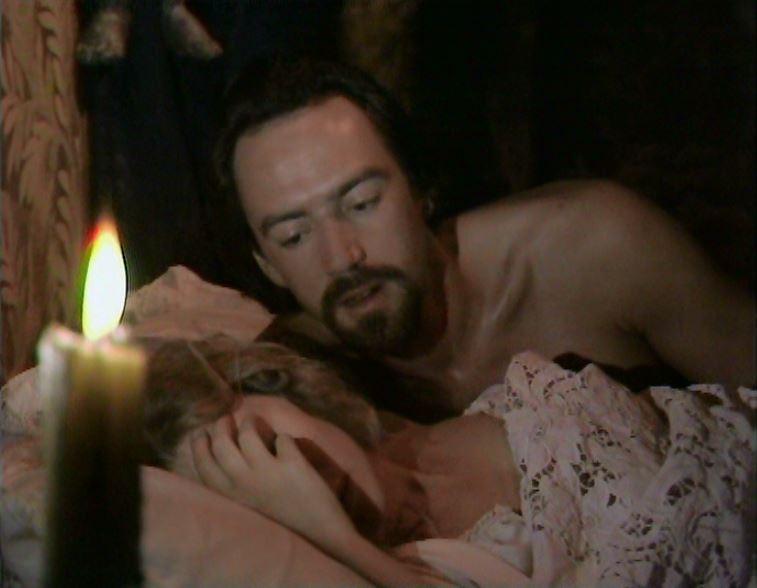
The sequence that works by far the best is Iachimo’s lecherous observation of the sleeping Imogen. Not only does Robert Lindsay land his performance just the right side of over-zealous panting pervert, but the camerawork adds a sensual steaminess and illicit naughtiness to the scene, as it gets in close to Iachimo looming (topless) over Imogen, the camera finally moving position to roam with Iachimo over the room and body. The glowing yellow light over the scene helps add in this sense of twisted eroticism. Moshinsky then effectively mirrors the scene later (this time replaying the scene as nightmare) with Imogen awaking with Cloten’s headless body, the camerawork being remarkably similar (starting with the same shot) and following Imogen’s inspection of Cloten’s corpse (which for reasons too obscure to explain she believes to be that of Posthumus) her heart-broken tenderness and trauma contrasted with Iachimo’s earlier lip-smacking enjoyment. They are two sequences that do offer something new – and do make a clear link between the two scenes, centering Imogen’s experience and helping to turn the atmosphere of this bizarre play into something resembling a twisted dream by its heroine.

But it still doesn’t redeem the production, which is cursed with less than completely successful performances in crucial roles. Michael Pennington, an intelligent and profound actor, does everything he can with Posthumus but plays the part so straight laced, brooding and with a dark intensity that not only do you find it hard to interest yourself in the part, it’s even a little unclear at several points what emotion he is going for (his A5 S1 speech is a perfect example of this – the growth of his guilt is rather hard to make out unless you actually read along with what he is saying). Helen Mirren really does her best with, in truth, a rather ropey role as Imogen, a character who keeps threatening to burst into life as a true heroine but consistently fails to do so. Mirren gives her a great deal of dignity and moral force, but also shades it with a hint of corruption – she is clearly tempted briefly by Iachimo – and far from a doormat, she explodes with anger at first when Pisano reveals Posthumus’ suspicious of her conduct, before a melodramatic pleading for death. Her later pain when she believes him killed is moving. But she hasn’t much to work with. Robert Lindsay excels in the bedroom scene as Iachimo, but outside of that offers little other than scowls and leers like a low-rent Iago.

Richard Johnson makes some small impact as gruff, bear-like Cymbeline – in fact his reading is enjoyable enough that it hammers home how little he is in the play. Claire Bloom does her best with the one-dimensional Queen (famously described as so thinly sketched she doesn’t even merit a name), although her brooding under-playing and softly spoken scheming does detract from her position as the play’s villain. Hugh Thomas’ Cornelius makes a good impression as an observant and arch doctor and Michael Horden and Marius Goring pop up for some stirring Shakespearean style cameos as the God Jupiter and a Ghost respectively (don’t even ask). Graham Crowden makes a nice impression as Luscius while John Kane does some sterling work as the loyal Pisanio. Geoffrey Burridge and David Creedon, however, make little or no impression as Guiderius and Arviragus (two characters so loosely defined by Shakespeare that I can’t really tell them apart).

The best performances though come from Paul Jesson and Michael Gough. Jesson adds a lovely comic touch as the arrogant, campy and self-obsessed Cloten, his pomposity and grandiosity forever undermined by a rhoticism. Constantly seen preening himself, out of his depth in the real world and a hopelessly incompetent wooer and fighter, he lights up a number of scenes by bringing a real comic energy and engagement to the production. At the other end of the scale, Michael Gough’s Belarius is not only brilliantly spoken but Gough brings a world-weary, pained expression to all his delivery, with hints of guilt at his stealing of Cymbeline’s sons, matched with a touch of anger at his betrayal. Of all the characters with sustained speeches, it’s his that really capture the imagination and Gough is the one who creates a character that feels real, with genuine emotions and motivations and a feeling of an internal life. It’s a performance that actually deserves to sit in a better play, never mind production – what would he have done with a Malvolio, Polonius or Gloucester? A real shame that this was his only outing in the series.

These good touches however are few and far between in what is a desperately disappointing production, dry, dull and flat and largely not worth the three hours of your time. After the history cycle it also seems a chronic step back, lacking in visual and filmic ambition. After the work Moshinsky had done on previous productions I expected a lot better of this production. Part of that though I am willing to chalk up to the play itself, up there now with Merry Wives as perhaps one of the worst (and certainly hardest to perform) in the canon. A lot of people claim that there are a number of parallels between the events in this play and the life of Edward de Vere, making it a strong part of the argument that the Earl wrote the plays. Well, as far as I’m concerned, he can have this one.

Conclusion
The play itself is a mess, but that doesn’t excuse what is a rather flat, dull and boring production, slow paced and generally lacking creative imagination or visual interest. With a cold and dry mood and an overwhelming running time, there isn’t much to grab the viewer’s interest, let alone keep it. Pity poor Helen Mirren that two out of three of her offerings were this and the appalling As You Like It. Not one for the desert island.

Sunday, 7 December 2014

A Midsummer Night's Dream (Series 4 Episode 3)

First Transmitted 13th December 1981

Helen Mirren dreams of a donkey headed Brian Glover

Cast: Helen Mirren (Titania), Peter McEnery (Oberon), Brian Glover (Bottom), Phil Daniels (Puck), Robert Lindsay (Lysander), Pippa Guard (Hermia), Nicky Henson (Demetrius), Cherith Mellor (Helena), Nigel Davenport (Theseus), Estelle Kohler (Hippolyta), Geoffrey Palmer (Peter Quince), Don Estelle (Robin Starveling), Geoffrey Lumden (Egeus), Hugh Quashie (Philostrate)Director: Elijah Moshinsky
Well the series has certainly come a long way since we last saw Helen Mirren in one of these productions. Back then was of course As You Like It, one of the worst films ever made of a Shakespeare play, totally devoid of imagination, interpretation or film-making finesse. That’s certainly not the case in this production of Shakespeare’s lost classic, A Midsummer Night’s Nightmare.

Or at least that feels like what you’re watching. I certainly had trouble reconciling this production with any other version of the play I’d seen or been in. Moshinsky has already shown in this series that he has a strong visual sense and brings a fresh imagination to productions. Both come to the fore here, where Athens is a staid, strait-laced place sharply contrasted with the dark skies, brooding clouds and manic energy of the fairies in the forest. Far from a jaunt in the wood, here the lovers’ exploits seem more like a stroll through the outer reaches of Hell, with Puck as a punkish ringmaster and Oberon as a Heathcliffian bully.

In many ways, this dark, brooding take on a play usually performed as a straightforward crowd-pleasing comedy is a success. It’s certainly not what most people expect when they come to Dream – there can surely never have been a production of this play where there was less focus on comedy and laughs. At times, this has unfortunate consequences (bless ‘em, even the Mechanicals aren’t particularly amusing – more on them later) but elsewhere it works as a bold and refreshing new take on a familiar story, and an antidote to the saccharine interpretations many productions follow. Moshinsky’s main concept is to draw a very sharp division between the court of Athens and the chaos in the woods: one vibrant and alive, the other staid and stuffy.

Throughout the first scenes of the play, Athens is presented as a formal and structured society, in which talk and emotions are restrained and characters seem strapped into their formal roles. This all stems from the top, with Nigel Davenport’s Theseus a polite, authoritative and controlled ruler, like an army colonel ready to shoot anyone found guilty of shouting in the mess. Moshinsky’s only major hint of division is the formal division between him and Estelle Kohler’s prowling Hippolyta, Moshinsky framing their first scene with both on the opposite sides of the frame.

The lovers are similarly restrained, keeping their emotions in sharp check while in Athens. Lysander and Demetrius communicate their rivalry only with glances (or lack of them) and even in the heights of passion, Lysander only brings himself to hold Hermia’s hand. Even in the forest, before enchantment, their manners remain resolutely proper and upper-class. Helena gets the closest to breaking the ‘rules’ with some arch comments and complaints. The downside of this approach is that their scenes are (whisper it) slightly boring.

In contrast, the fairies are a cocktail of frenetic movement, heightened emotions and youthful exuberance (literally so in many cases, as children take on most of the roles), led by two exceptional, dynamic performances from Helen Mirren (laying her Rosalind well and truly to rest) and Peter McEnery (an absolute revelation). Oberon and Titania themselves are casual, sensual characters, comfortable with physicality and willing to let their emotions play out very publically – very different to the Athenian lovers.

Moshinsky lets his painterly eye run riot with the fairyworld, giving it the look of a combination of Rubens and the Dutch masters. Rembrandt is a particularly strong influence, with a series of remarkably strong images of Titania in bed particularly reminiscent of the master. The purple sky and dark greenery of the forest add contrast to the more restained and formal compositions of Athens. Oberon’s entrance – a wild haired, open-shirted figure on a horse – gives him the appearance of a classic romantic figure. Mirren herself has the looks and dressing of a classical heroine in flowing white. Their otherworldliness is further heightened by the echo-effect added to a number of their lines in A2 S1. Moshinsky uses a series of fast-edits and intelligent lighting tricks to give a sense of unceasing action to the fairy world.

Mirren’s Titania is simply superb, one of the best performances of the part I have ever seen. She gives Titania a depth that makes her the relatable half of this relationship. Mirren’s performance of Titania’s famous speech in A2 S1 is a masterful reading, conveying anger, frustration and a hint of sadness and always compelling. Compared to the human characters, she is full of human emotions and demonstrates far more empathy. She also manages to avoid making Titania seem like either a fool or a victim of a cruel joke. It’s a very skilled and ‘real’ performance by a wonderfully talented actress.

McEnery’s Oberon is a logical partner to this: a passionate man with anger just below the surface, dangerously uncertain as to whether he will laugh or kill the person he is talking to. McEnery’s clipped vocal style is perfect for this imperious interpretation that positions the character as very much not of this world. With Puck he is in turns tender and amused, then angry and violent (at one point holding his head underwater as punishment).  He is the perfect figurehead for the chaos the other fairies gleefully embrace and propagate throughout the play, each of them bringing a frame-skirting energy to their every move.

Phil Daniels adds an edge of menace to the earthy Puck, taking a wild and whooping delight in his mayhem, like one of the lost boys. His athleticism has been mentioned above, and is shown particularly well in his gulling of the lovers, as he appears suddenly in a series of unusual positions and angles in relation to the four Athenians, in some cases taking on an almost demonic physical control of their bodies. At other times he approaches them – especially Hermia – with a youthful curiosity. By the end of the play, as the fairies frolic in Theseus’ palace, he becomes a ring-leader, brushing aside table placements and driving on the other fairies to greater shows of disruption.

So in this fairy-dominated production how do the human characters fare? Not well. The lovers are very dull. Moshinsky’s decision to only allow them to show any real life when under the fairy spells works for the concept, but makes the bulk of their action tedious to watch. The decision to have the lovers speak many of the lines in A4 S1 at the same time does create a fine impression of the turmoil in their relationships at this point, but also (considering the static way most of the scene is shot) suggests Moshinsky was either still aiming to draw a contrast between human and fairy or that he wanted to get the scene over and done with.

Either way, the lovers remain hard to like. Lindsay does his best, but Pippa Guard is as forgettable here as she was in The Tempest, Nicky Henson gives gruffness but little else as Demetrius and the decision to make Helena as plain, spinsterish and unattractive as Cherith Meller is here is a ridiculous over-intepretation of some of the lines in the play (and ignores the clear reference that she is considered as attractive as Hermia). Saddled with a restrained acting style, they are an almost complete failure here, dull as ditchwater, their scenes ripe for fast forwarding. Moshinsky’s far more static shooting style for the lovers actually works well for watching in fast-forward to be honest – admire the composition for A1 S1, but read the lines in advance so you know what they’re saying. You’re not missing masses doing so believe me.

The mechanicals fare little better. With the decision to focus the energy on the fairies and to keep the human characters as restrained and subdued as possible, they are filmed as statically as the lovers and often deliver as restrained a performance style. They are, quite frankly, not funny at all. There is no energy or humour to the final performance of their play or the rehearsals. Their characters remain largely ill-defined. Geoffrey Palmer’s Quince is a good example of the problem here: his performance was (allegedly) a parody of the Director-General of the BBC at the time – but 20 years later the joke is completely lost and the performance falls totally flat.

Brian Glover’s Bottom is part of the problem. As well as not being funny enough, I think it is an example of miscasting – Glover’s working class credentials as an actor are too well drawn, he lacks the classical background the part needs in order for the parody of classical acting and thespian self-importance to really work. For me, he also doesn’t convey enough of the sense of wonder Bottom must surely feel at the fairy world – his reflections on it after its disappearance are underplayed and restrained. It’s a performance that never really comes to life as a leading figure in the play, a little too quiet and lacking in the sense of a frustrated artist finally being allowed to live his dreams. The scenes with Titania and Bottom feel like missed opportunities, and Bottom himself feels like far less of a dominant character in the play than he usually does.

These weaknesses are by and large self-inflicted wounds, necessary side effects of the creative decisions taken by Moshinky as part of the production. It’s a testament to him that he manages to do something different with this most over-performed of the plays (and one I’ve never really quite warmed to either). The fairy material has rarely been done better, but the more conventional comedy moments have rarely been less engaging than here. Similarly, the human characters are left short-changed by the camera’s focus on making the fairy characters the sole source of dynamism in the production. It makes for an interesting interpretation for old hands, but is highly unlikely to convert new audiences to Shakespeare. Watch the fairy bits but skip past everything else – there is nothing to see here.

Conclusion
Fantastic performances by McEnery and Mirren and some wonderful inventive direction of the fairies, combined with some brilliant painterly touches in the camerawork are the main strengths here. But this is an unfunny production that stalls dramatically as soon as it gets anywhere near the human characters, so wedded to its decision to play them as stolid and constrained that it’s hard for the viewer to develop any real interest in them at all. It’s a unique and imaginative production, but not exactly complete entertainment.

NEXT TIME: It’s that man Michael Hordern again – this time giving us his King Lear.

Monday, 23 June 2014

All's Well That Ends Well (Series 3 Episode 3)

First Transmitted 4th January 1981


Angela Down, Celia Johnson, Ian Charleson and Donald Sinden play unhappy families

Cast: Angela Down (Helena), Ian Charleson (Bertram), Celia Johnson (Countess of Rousillon), Donald Sinden (King of France), Michael Hordern (Lafew), Peter Jeffrey (Parolles), Rosemary Leach (Widow), Pippa Guard (Diana), Robert Lindsay (First Lord), Dominic Jephcott (Second Lord), Paul Brooke (Lavache), Kevin Stoney (Stewart), Nickolas Grace (Solider), Valentine Dyall (Astringer), Terence McGinty (First Gentleman), Max Arthur (Second Gentleman)
Director: Elijah Moshinsky

First off it’s been a huge break – so please blame the fact that I bought a house in the interim and basically didn’t have time to sit and watch a whole Shakespeare play and then write it up. Don’t even mention the problems I’ve had getting the internet reconnected. Anyway, I finally found the time to watch the third production of the Jonathan Miller years – All’s Well That Ends Well, directed by what would become a series regular: Elijah Moshinsky.

Straight off the bat I have to say I really enjoyed this production, despite not knowing the play very well at all. The first thing that will strike anyone watching this is the extraordinary visual beauty of the film. It’s an incredibly rare thing to say about a television production of the time – particularly one shot on the harsher, grainy medium of video rather than film. This strong visual sense is expertly combined with an acute and intelligent analysis of text and characters that has quickly become the hallmark of the Jonathan Miller era.

But first the visuals. Hard to believe it, but this was Moshinsky’s first ever work on film or television. Now apparently this was the secret behind its success – Moshinsky simply didn’t think, in the way of a more experienced TV director like John Gorrie, “this can’t be done” about the more complex, naturalistic lighting he wanted – he asked and his team strove to deliver it. Moshinsky wanted to create a feeling of scenes being lit by natural light, sometimes a few candles, and to allow shadows and areas of darkness to be created. His inspiration for this was the paintings of the Dutch masters – in particular, to my eyes, Rembrandt – though he was also inspired by a (to me) lesser known artist called Georges de la Tour, from the same era who was heavily inspired by Carravaggio.

The lighting team on the film – and credit must go to John Summers, the director of photography – duly went to work to create the sort of effects more experienced directors would have been trained to believe too difficult and time-consuming to attempt. The effect is extraordinary throughout, with extensive use of silhouettes, and scenes artfully framed and composed to form striking visual tableaux. The willingness to feature darkness on the screen, while bathing the action in a warm candlelight effect introduces an intimacy to the drama, making the action very personal. The inspiration of paintings can be seen throughout – the lords at the King’s sickbed bear more than a resemblance to Rembrandt’s The Anatomy Lesson; later the soldiers appear strikingly similar to The Night Watch; baroque imagery is used throughout for Helena and the women of the play.


This strong visual sense rings out through all the scene set-ups, each established with a skillful painterly eye, without ever appearing sterile or over studied. There is even room for a little tip of the hat – in A4 S3, while the lords Dumaine speak, a clear collection of Holbein and Rembrandt inspired “artistic metaphor objects” can be seen on the table before them. This painterly feel also serves to make a virtue of the studio bound locations – such effects could never have been created outside, but the visual skill never makes the action feel cramped or claustrophobic. Excellent use of mirrors throughout allow both scope to be added to small sets, and also suggest a commentary on the differences between projected image and actuality - tellingly, Parolles and the King are the characters seen most often in mirrors.

Moshinsky also makes excellent use of the camera, here a prowling part of the action, moving around scenes – particularly strikingly used in A3 S7 as the camera pans around a scheming Helena to slowly reveal the other characters listening to her. Such camera work also serves to demonstrate character notes – in the example above stressing both Helena’s leadership qualities, but also her slight distance from those around her. Later, at the play’s conclusion, a Helena POV shot allows the viewer to soak in the reactions of each of the characters at her return from the dead.

Of course the visuals would never be so successful without Moshinsky and his team undertaking a concentrated interpretation of the text itself. Most strikingly, both Helena and Bertram are presented as (to varying degrees) somewhat selfish and unwise characters, neither as clever or as noble as they at first appear. Helena’s infatuation with Bertram is demonstrated as being as thoughtless and self-obsessed as Bertram’s own later seduction of Diana – both of them show very little interest in the thoughts and feelings of the object of their affection in their attempt to gain possession of them. Is it any wonder that Bertram looks so sullen at being tied – against his will – in marriage to Helena?

This underlying theme of selfishness and a grasping, elitist control over the world is demonstrated throughout. Parolles may be a swaggerer and a braggart, but really he only reflects the conduct and actions of those around him – and indeed is quick to condemn them when given the opportunity. This atmosphere all stems from the King, here a power-crazed sexual pervert, strongly suggested to be suffering from veneral disease of some sort, grooming the young French lords to follow in his (dirty) footsteps. He takes what he wants and orders and controls the lives of those around him like they are his playthings. Is it any wonder these same lords think it “sport” to kidnap and perform a mock execution on Parolles later? The roughing up of Parolles – and the outrage of the bullies as their own faults are unwittingly told to them by their victim – is systematic in a world where the rich look down on the poor. Even Lafew, more kindly than the rest, has a clear idea of the “natural order of things”.

The sex running through this production is very pronounced. It’s more than heavily implied that a healthy dose of “rumpy-pumpy” is a key part of Helena’s cure for the King. Diana may have contempt for Bertram, but is more than aware of how to use her coquettish charms to get what she needs from him in a highly sexualized seduction. Lavatch – on the surface a comic part, but here played like some sinister backstairs servant – has a particularly sinister speech about love. Bertram is virtually a working hormone in the second half of the play. Even Helena makes decisions based on her own lust for Bertram, and is happy to perform the “bed trick” in order to cement her position over him. It’s a selfish society and the characters reflect these values – they are all, to degrees, only interested in getting what they want and have little regard for the feelings and  desires of others.

Angela Down, a great choice for Helena, brings a wonderful put-upon, self-sacrificing air to the role, which here is subtly inverted to suggest a disguise behind which lurks a far more selfish and manipulative personality. Her coldness and aloofness distance her from contemporaries in subtle ways – obviously from the more immature Bertram – but also give her a natural authority and control over the Widow and Diana. She also clearly has no qualms over manipulating the lecherous King with her body. Throughout the play she shows little interest in understanding Bertram – only once, when he angrily refuses the forced marriage does she seem to express any regret at her decisions, as if it never occurred to her that he might be unhappy at having marriage forced on him. Far from painting her as an angel, she is clearly a deeply flawed person and Ian Charleson’s sullen Bertram – while clearly not worthy of the affection lavished on him by her – surely has a point about being furious about being forced into a loveless (and what has a good chance of being) unhappy marriage.

Her coldness contrasts very well with Peter Jeffrey’s dandified, swaggering braggart Parolles, a generally harmless chancer perfectly happy to bumble along as a carefree hanger-on. Interestingly there is no hint of maliciousness to him – he is a man using what skills he has to get a foot on the ladder. His clashes with Lafew – a very boisterous performance from Michael Hordern, perhaps his best work in the series so far – may have moments of outrage in them (and Parolles goes to draw his sword at least once) but seem almost more like a game than a war. Where Helena’s manipulation is subtle, Parolles’ is played openly and simply, almost innocently. After his humiliation, Jeffrey embraces Parolles’ determination to be one of the few characters to no longer wear a face, but to be what he is – in his case a Dickensian beggar, kowtowing to his masters for favour. It’s a very engaging performance. It also serves as an interesting contrast with Helena – they are both using Bertram and others, but Parolles is open and honest about it, where Helena seems unwilling to admit it fully even to herself.

 
This is a very strong cast of actors. Celia Johnson probably gives the stand-out performance as a worldly-wise, kindly and gentle Countess, who takes a humane interest in those around her and exudes a motherly warmth – she is perhaps the most forgiving and generous character in the production. Pippa Guard is far better here than in The Tempest, making Diana a clever flirt but also giving her a moral force. Donald Sinden does verge towards a theatrical ham, but his clever interpretation of the King as a sex-crazed old man, still gleefully recalling trysts past, does bring a very interesting new vision to the play – and also ties in well with making the King more of a tyrant than other productions have done. Michael Hordern is a stand-out as a vigourous Lafew, worldly-wise but not an innocent. Robert Lindsay again stands out in a small role as a bullying Lord. All the characters fit very naturally into the interpretation of the play Moshinsky has created.

Some subtle cuts are made to the text – in particular all the scenes featuring the Duke of Florence have been deleted – to bring the focus tightly into the family drama Moshinsky wants to show, while still allowing the clashes of this family to reflect a wider society. Moshinsky brings out these themes of selfishness and lack of self-awareness extremely well – it’s suggested that Helena and Bertram learn very little over the course of the play or even really develop as characters, with the ending narration by the King being very open to interpretation (and he clearly also has his eye on Diana). Bertram and Helena may kiss, but is Bertram still responding to the pressure from others? Has Helena learned anything about forcing love on another? Clearly not as the old “bed trick” is the only reason Bertram reaffirms their marriage.

This is an intelligent and fascinating production of the play – in fact the sort of production that elevates the play straight up your list of “favourite Shakespeare plays”. It’s still a little known work, but this production really finds a depth and interest to it. Which of course makes it a credit to the series – and also a tribute to television. A lot of the very subtle work in this production could not have been created on the stage and the use of intercutting, close-up and camera movement – as well the gentle underplaying of some scenes – really uses the benefits of the medium. Moshinsky was quite some find, and it’s exciting to see what he may come up with next.


Conclusion
This is probably the best calling card for the series so far – actually the best. Only Taming of the Shrew I think gets close enough to touch it. It’s an adult, creative, intelligent interpretation, beautifully filmed and fantastic to look at. Coupled up with strong performances across the board – this must be the best cast assembled yet – it’s no surprise this received several awards. It’s certainly the best one to show people if you are trying to persuade them to watch the rest of the series!

NEXT TIME: I'm looking forward to it as we hit Jane Howell's controversial Winter's Tale Production. Those on the know are not favourable. Let's see shall we see?

Monday, 30 December 2013

Twelfth Night (Series 2 Episode 4)

First transmitted 6th January 1980

Alec McCowen is fooled and bamboozled by some comic pranksters

Cast: Felicity Kendal (Viola), Alec McCowen (Malvolio), Robert Hardy (Sir Toby Belch), Sinead Cusack (Olivia), Annette Crosbie (Maria), Trevor Peacock (Feste), Clive Arrindell (Orsino), Ronnie Stevens (Sir Andrew Aguecheek), Robert Lindsay (Fabian), Maurice Roeves (Antonio), Michael Thomas (Sebastian), Malcolm Reynolds (Valentine), Ryan Michael (Curio), Ric Morgan (Captain), Arthur Hewlett (Priest)
Director: John Gorrie
 
After what seems like a long journey through British history in the last few plays of the series, it was a bit of a relief to finally get a bit of a respite with another genre of Shakespeare: a comedy. Now the last comedy I watched in this series was As You Like It, which, loyal followers of this blog will know, was surely one of the worst things committed to film by the BBC. Twelfth Night is undoubtedly far superior to that (hurrah!). But it falls into the difficulties that the vast majority of Shakespeare comedies I have seen on film fall into. It is simply not that funny.
 
Shakespearean comedy is highly theatrical in its nature. It’s built around having that immediate connection with the audience. The jokes feed off the actors being there in the room with you, from having that shared experience of other people laughing alongside you to be truly successful. It’s not just Shakespeare of course – how many modern stage comedies have been translated to screen only to be met with stony silence from audiences? The films of Noises Off and A Chorus of Disapproval spring straight to mind as examples. (There were films of those you say? Yes there were and thanks for proving my point.)
 
This is why so many television comedies (from sitcoms to panel shows) have laughter tracks or are recorded before a live studio audience. People are more comfortable letting go and laughing if they feel it is part of a communal experience. Performers in turn feed off that energy, taker greater risks, become less self-conscious and (hopefully) more funny. Try and imagine creating that atmosphere in your performance on a cold Tuesday evening in a TV studio surrounded by technicians and clock-watching union officials (as these films would have been). Hardly conducive to side-splitting entertainment is it?
 
Well anyway, that’s a general point that probably applies to every comedy I’m going to watch in this series. Shakespeare drama translates better to film: it’s more intense, more, for want of a better word, dramatic. That shouldn’t detract from the fine, clever little drama John Gorrie has created here in his inaugural effort for the series. This Twelfth Night is set in an autumnal 17th-century setting, with echoes of the English Civil War in both dress and styling and in the portrayal of Malvolio’s puritanism. The house is a triumph of production design, with Gorrie’s intention of creating a clear ‘geography’ to the house and its rooms very successful. There are splashes of inspiration from Rembrandt in the lighting and design in places. Even the house exteriors look convincing (which is more than can be said for the painfully artificial beach in A1 S2). It all serves to place McCowen’s firm and softly-spoken Malvolio as prototype parliamentian, while Orsino contrasts as a clichéd layabout royalist (and a nod of the hat to Gorrie for sneaking the setting beyond the ‘Messina rules’ of nothing past the 1610s).
 
The sexuality of the play also gets some interesting exploration here. Most clearly, Antonio’s homosexuality is played very openly and clearly (and with a great deal of emotion in Maurice Roeve’s sensitive performance, a real highlight) with it gently accepted by Sebastian, although there is no hint of reciprocation. But Gorrie also allows a suggestion of underlying attraction for Olivia from Viola (her breathless reaction when Olivia reveals her face of “most fine”), which puts in context slightly her gentle reaction to her throughout the play. Similarly in A2 S4 Orsino displays an almost flirty sensuality towards Viola/Cesario, which again allows his fury towards her when he assumes she has betrayed him in A5 S1 to have a greater edge to it.
 
Sex is clearly very prominent in the house. Belch and Maria are all over each other like a pair of horny teenagers. Olivia’s increasingly colourful and shapely dresses from scene to scene demonstrate clearly her growing fascination with Cesario. Sebastian can’t believe his luck when he arrives – and is quite happy to enjoy Olivia’s attentions once they are thrust upon him (so to speak). Even Malvolio is reduced to a giggly, bouncing mess from sexual excitement at the thought of claiming Olivia for his own (and when he encounters her in A3 S4 she clearly recognises exactly what he is feeling and is slightly panicked at it). It’s a very nice undertone to the production.
 
 
Perhaps part of this strange sexual buzz is related to the fact that Kendal’s Cesario looks literally nothing like a man. I’ve genuinely never seen a less convincing drag-act since Lt. George in Blackadder. Still clearly wearing eye-shadow and make-up and with flowing feminine hair, surely no-one in their right mind could ever believe her to be a man, for all the masculine posing she takes on. I can’t decide if this is a big problem or not. It probably wouldn’t be in the theatre with the suspension of disbelief but it works slightly less here. Attempts to give Sebastian a bouffant haircut, don’t change the fact that they don’t really look like each other that much. It’s a problem that Trevor Nunn’s Twelfth Night film tackled much more effectively. That issue aside, Kendal’s performance is fine-spoken with a dollop of humanity and tenderness (both for Olivia and for Orsino) as well as sympathy. But it’s a slightly flat performance. I think what it doesn’t really sell is either a real intelligence or any particular enjoyment in disguise. It’s just a little low on joy.
 
So what we get instead is the first Twelfth Night I’ve seen where Olivia emerges as a warmer and more engaging character than Viola. Sinead Cusack gives a terrific performance as a kindly lady of the manor, her generous nature quickly established by having Feste (a nice turn by a jovial and wiser-than-he-seems Trevor Peacock) cuddling up to her like a child in her first scene. In her wooing of Cesario she seems shy and bashful and so earnest and gentle in her seduction that Viola finds it impossible to feel anything but sympathy with her. There is a lovely shot at the end of A2 S2 of her staring, heartbroken and lonely, out of the window as Cesario leaves. Her pity for Malvolio in A5 S1 is clearly the only thing that can even slightly soothe him. And it’s no wonder that she has no interest in Clive Arrindell’s uncharismatic and tedious Orsino.
 
The comedy characters suffer from the issues I talked about above. Despite this, there is some good work here. Robert Hardy plays Sir Toby as a faded army colonel, gone to seed, overweight and over the hill but clearly still smart and with a degree of physical courage (he proves himself a good, if rusty, fighter). He is less a drunk than a roisterer, a bored retiree who treats those around him as potential sources of amusement, a role that Ronnie Stevens’ meek and simpering Aguecheek (a man so tame he can only swear in inaudible mumbles, embarrassed that someone might hear him). His joie-de-vivre sexuality with Annette Crosbie’s Maria is a nice touch that adds some depth to the character. Belch is always a low-rent Falstaff, but it’s great to see an interpretation here that gives him a bit of dignity, rather than just being the first among idiots.
 
The casting of Robert Lindsay (at the time known only as a sitcom actor) is also a fantastic addition. A much better actor than the casting gives him credit for, he makes Fabian an actual character: a smart man scornful of his betters, but fundamentally a coward and a lackey. He also has a lot of energy he brings to scenes, certainly more than a couple of the other performers which really makes him stand out. Like Alun Armstrong in Measure for Measure, it’s easy to see why he went on to have such a strong dramatic career.
 
The balance between comedy and drama in the production, though, is off. All the best (and memorable) moments in the play are the serious ones not the funny ones. Alec McCowen’s Malvolio has moments, but it’s a performance that seems more comfortable in the cold officiousness of A2 S3 or the desperate tragedy of A4 S2 than the wooing of A3 S4. The flurry of challenges in A4 have their moments (and there is a nice underplayed double-take from Hardy in A5 S1) but they don’t have enough energy to them. Michael Thomas’ Sebastian is too much of a cold figure to provide the bemusement and outrage the scenes need. Even the famous yellow stockings are only sighted briefly on screen. Compared with the more ‘dramatic’ elements around the relationships of the characters, it never quite takes flight. And that is perhaps, in the end, a terminal problem for a play that is probably one of Shakespeare’s funniest stage comedies. You want to be much more amused by it than you are ever going to be.
 
Conclusion
The comedy isn’t there but when the focus is on the dramatic it works rather well and there are some good performances, in particular Cusack, Hardy and Lindsay, that reinterpret their characters in subtle ways. The setting of the play works well to bring out some of the play’s themes. More laughs would be better, but it’s a massive step-up from As You Like It and has a little more interpretative flair to it than other productions.
 
NEXT TIME: Michael Hordern is betrayed and abandoned but plots his magical revenge in The Tempest.