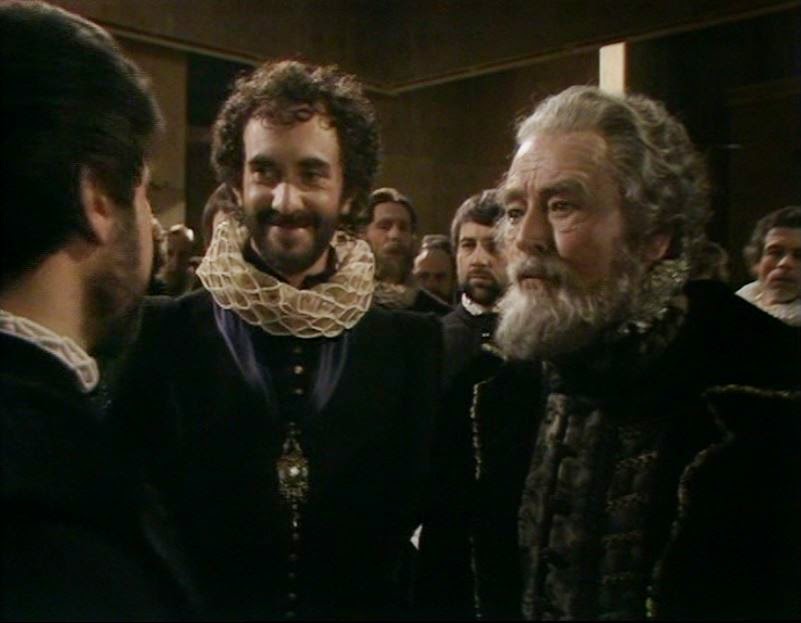
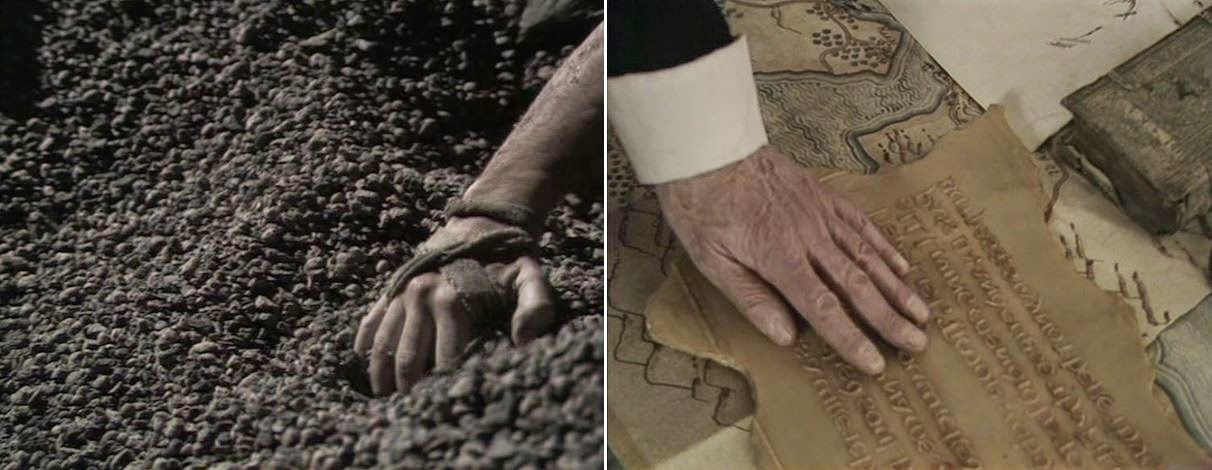
First transmitted 19th September 1982
 |
Michael Hordern rages against the dying of the light |
Director: Jonathan Miller

 So it’s interesting watching it again now, especially as I
have now seen so many of the other films in this series – as well as all the
rest of the productions directed and produced by Miller. This was Miller’s last
production for the series and, apparently, it was not his first choice to work
on it. He had directed a BBC version seven years prior to this – also starring
Michael Hordern as Lear and Frank Middlemass as the Fool – and proposed merely
showing that production again as part of this series. When that idea was
rejected, Miller was commissioned to direct a new production. Being,
presumably, pleased with many elements of his last production, Miller recast
many of the same actors and then reset elements of the first production within
some of the new staging ideas he had been experimenting with throughout the
series.
So it’s interesting watching it again now, especially as I
have now seen so many of the other films in this series – as well as all the
rest of the productions directed and produced by Miller. This was Miller’s last
production for the series and, apparently, it was not his first choice to work
on it. He had directed a BBC version seven years prior to this – also starring
Michael Hordern as Lear and Frank Middlemass as the Fool – and proposed merely
showing that production again as part of this series. When that idea was
rejected, Miller was commissioned to direct a new production. Being,
presumably, pleased with many elements of his last production, Miller recast
many of the same actors and then reset elements of the first production within
some of the new staging ideas he had been experimenting with throughout the
series. From Troilus and Timon through to Antony and Cleopatra, Miller had increasingly experimented with
stripped down, impressionistic sets that bring the focus into the acting. He
set the plays themselves in increasingly non-realistic settings that stress the
heightened emotions and events that occur. This style also worked to eliminate
the clunking realism of earlier productions (Romeo and Juliet and As You
Like It spring instantly to mind). The location used here is a deliberately
wooden stage, almost reminiscent of the original Globe theatre. A black backcloth
is used to establish the background (and no effort is made to suggest it is
anything other than a cloth). The only other location used is a bare wasteland
for the storm scenes, which is adapted into a sandy wilderness for the final
battle. It’s deliberately bleak and spare for a production that stresses the
harsh and violent world of the play. It’s matched by the Velazquez-inspired
costumes, all of which are black and white with only touches of colour to
thematically link characters (such as the white in the Fool’s facepaint
mirroring the white in Cordelia’s).
From Troilus and Timon through to Antony and Cleopatra, Miller had increasingly experimented with
stripped down, impressionistic sets that bring the focus into the acting. He
set the plays themselves in increasingly non-realistic settings that stress the
heightened emotions and events that occur. This style also worked to eliminate
the clunking realism of earlier productions (Romeo and Juliet and As You
Like It spring instantly to mind). The location used here is a deliberately
wooden stage, almost reminiscent of the original Globe theatre. A black backcloth
is used to establish the background (and no effort is made to suggest it is
anything other than a cloth). The only other location used is a bare wasteland
for the storm scenes, which is adapted into a sandy wilderness for the final
battle. It’s deliberately bleak and spare for a production that stresses the
harsh and violent world of the play. It’s matched by the Velazquez-inspired
costumes, all of which are black and white with only touches of colour to
thematically link characters (such as the white in the Fool’s facepaint
mirroring the white in Cordelia’s).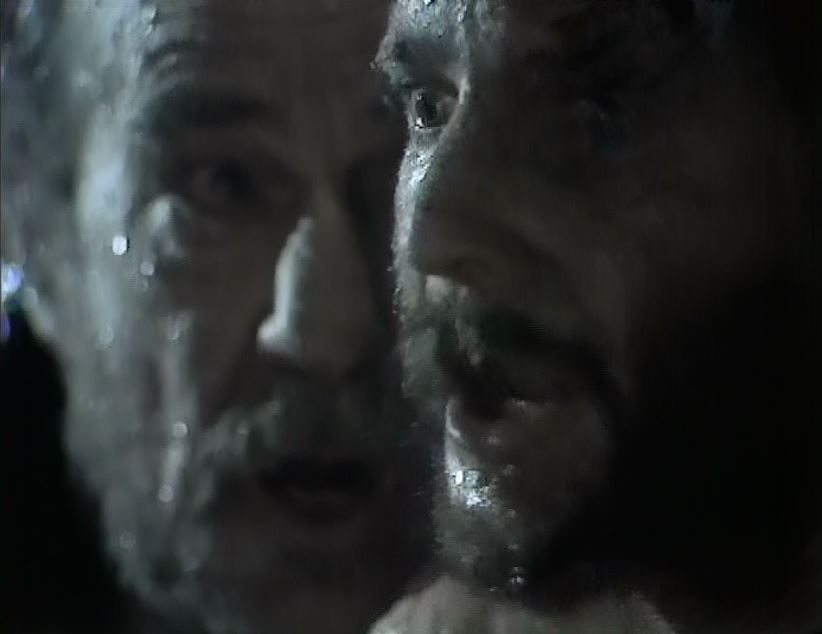 The camera work also aims to make the action “up close and
personal” with a proliferation of close-ups that zoom in on the actors’ (often
impassioned) faces as if to pull the emotions out like teeth. The storm scene
in particular relies on a series of prolonged close-ups of Hordern’s soaked
face, while the Fool and Kent can be seen in the background. Gloucester’s
blinding is largely framed from a reverse close-up on the Earl tied to a chair. A
common shot is a side-on close up in which an actor speaks while a second actor
stands (out of focus slightly) alongside them facing the camera – this is
repeatedly used, perhaps to suggest a continuing sense of events being
“witnessed” by others.
The camera work also aims to make the action “up close and
personal” with a proliferation of close-ups that zoom in on the actors’ (often
impassioned) faces as if to pull the emotions out like teeth. The storm scene
in particular relies on a series of prolonged close-ups of Hordern’s soaked
face, while the Fool and Kent can be seen in the background. Gloucester’s
blinding is largely framed from a reverse close-up on the Earl tied to a chair. A
common shot is a side-on close up in which an actor speaks while a second actor
stands (out of focus slightly) alongside them facing the camera – this is
repeatedly used, perhaps to suggest a continuing sense of events being
“witnessed” by others. Even wider-angle shots, such as the final death of Lear, use framing and actor
positioning to create a triangular “zooming in” effect, where the visual
attention of the viewer is pulled down towards Lear at a focal point of the
other characters in the scene. Of course this decision to use close-ups isn’t
always effective: noticeably during the fight sequence between Edmund and
Edgar, the entire fight is delivered in tight close-up on Edmund’s face. Sure
this might give the feeling that we are judging Edmund – but it also means it’s
rather difficult to tell what is going on (particularly as the fast paced
movement makes it hard for the cameraman to keep up!).
Even wider-angle shots, such as the final death of Lear, use framing and actor
positioning to create a triangular “zooming in” effect, where the visual
attention of the viewer is pulled down towards Lear at a focal point of the
other characters in the scene. Of course this decision to use close-ups isn’t
always effective: noticeably during the fight sequence between Edmund and
Edgar, the entire fight is delivered in tight close-up on Edmund’s face. Sure
this might give the feeling that we are judging Edmund – but it also means it’s
rather difficult to tell what is going on (particularly as the fast paced
movement makes it hard for the cameraman to keep up!). Perhaps this is part of the issue with the production itself: it feels like almost a greatest hits of Miller’s directing for the series, rather than him bringing a fresh new perspective to the series. While Shrew and Antony and Cleopatra seemed like fresh interpretations, this seems more like Miller reworking the play in response to ideas rather than other way around - something I was less aware of when watching it all those years ago.
 Miller’s general design aesthetic is to integrate the
motivations and feelings of the characters very closely, and this forensic
style is equally clear in Hordern’s studied and well observed performance as
Lear, which is packed with little details here and there. Indeed, Miller and
Hordern’s intention to tightly analyse Lear throughout actually rather stacks
the deck, particularly in the opening scene, towards exploring Lear’s mental
strength (or rather weakness). From the first scene Lear is clearly struggling
– he even seems momentarily confused and a little lost when entering the court
scene, before seeming to remember what he is there for.
Miller’s general design aesthetic is to integrate the
motivations and feelings of the characters very closely, and this forensic
style is equally clear in Hordern’s studied and well observed performance as
Lear, which is packed with little details here and there. Indeed, Miller and
Hordern’s intention to tightly analyse Lear throughout actually rather stacks
the deck, particularly in the opening scene, towards exploring Lear’s mental
strength (or rather weakness). From the first scene Lear is clearly struggling
– he even seems momentarily confused and a little lost when entering the court
scene, before seeming to remember what he is there for. 
 His Lear is capable of warmth – he is clearly close to the
Fool (as seen in A1 S5 and during the storm sequence) – and is able to
demonstrate affection to Regan in A2 S4 (even if it is grounded in
manipulation) but he is also clearly equally capable of self-delusion. In A1 S5
he distractedly mutters “I did her wrong” (of Cordelia) before clearly
dismissing the thought from himself. In A2 S4 he seems to persuade himself that
Regan is pleased to see him (despite all evidence to the contrary in Penelope
Wilton’s stony reaction) before angrily lashing out. It all builds towards the
impression of a man teetering on the edge of from the start, tipping during his
impassioned raging during the storm.
His Lear is capable of warmth – he is clearly close to the
Fool (as seen in A1 S5 and during the storm sequence) – and is able to
demonstrate affection to Regan in A2 S4 (even if it is grounded in
manipulation) but he is also clearly equally capable of self-delusion. In A1 S5
he distractedly mutters “I did her wrong” (of Cordelia) before clearly
dismissing the thought from himself. In A2 S4 he seems to persuade himself that
Regan is pleased to see him (despite all evidence to the contrary in Penelope
Wilton’s stony reaction) before angrily lashing out. It all builds towards the
impression of a man teetering on the edge of from the start, tipping during his
impassioned raging during the storm. 
 Recovering from madness, Hordern is gentle and apologetic,
delighting in Cordelia’s presence. Hordern holds her tight and can barely let
her go, his eyes rarely straying towards anything or anybody else in the scene.
Hordern is also particularly strong portraying Lear’s grief at the death of
this beloved child, mixing again moments of pained clarity with an almost
dreamlike lack of understanding and acceptance of the events around him.
Hordern’s performance makes a very watchable performance of this role – but it
seems to lack something, maybe because Hordern himself is not naturally a
‘charasmatic superstar actor’, with his style better suited to character roles
(such as in All’s Well That Ends Well)
rather than a more ‘glamourous’ part like Lear. His style inverted rather
better as Prospero than it does here as Lear. He’s watchable and touching at
several points, but he is never quite as moving as the part perhaps requires.
Recovering from madness, Hordern is gentle and apologetic,
delighting in Cordelia’s presence. Hordern holds her tight and can barely let
her go, his eyes rarely straying towards anything or anybody else in the scene.
Hordern is also particularly strong portraying Lear’s grief at the death of
this beloved child, mixing again moments of pained clarity with an almost
dreamlike lack of understanding and acceptance of the events around him.
Hordern’s performance makes a very watchable performance of this role – but it
seems to lack something, maybe because Hordern himself is not naturally a
‘charasmatic superstar actor’, with his style better suited to character roles
(such as in All’s Well That Ends Well)
rather than a more ‘glamourous’ part like Lear. His style inverted rather
better as Prospero than it does here as Lear. He’s watchable and touching at
several points, but he is never quite as moving as the part perhaps requires. Away from the lead, there are of course several other
performances of note. Michael Kitchen has a great deal of charisma (if not
depth of character or motivation beyond “he is a villain”) as Edmund, though
today visually he bears more than a passing resemblance to Blackadder. His
bastard is a cool and relaxed man, determined and intelligent, who makes
himself believable with a low-key assurance. Kitchen frequently looks into the
camera – notably when kissing Goneril – involving the audience in his schemes. He
makes a firm contrast with Anton Lesser’s at first more highly-strung Edgar (he
even needs to clash both swords for Edgar in A2 S1).
Away from the lead, there are of course several other
performances of note. Michael Kitchen has a great deal of charisma (if not
depth of character or motivation beyond “he is a villain”) as Edmund, though
today visually he bears more than a passing resemblance to Blackadder. His
bastard is a cool and relaxed man, determined and intelligent, who makes
himself believable with a low-key assurance. Kitchen frequently looks into the
camera – notably when kissing Goneril – involving the audience in his schemes. He
makes a firm contrast with Anton Lesser’s at first more highly-strung Edgar (he
even needs to clash both swords for Edgar in A2 S1).  Lesser however adds a
great deal of development to Edgar from A3 onwards, his Poor Tom is intense and
vulnerable (though a design decision to give him a Christ like appearance –
including stigmata – definitely overplays it). Edgar himself becomes
increasingly still, distant and devout, going from mortified pain at
Gloucester’s fate to a monkish authority and even a touch of cruelty after the
killing of Oswald. In the final confrontation between the brothers, Edgar wears
a death mask resembling Gloucester (a nice touch), and Edmund’s authoritative
assurance is broken into a desire to salvage something from his life.
Lesser however adds a
great deal of development to Edgar from A3 onwards, his Poor Tom is intense and
vulnerable (though a design decision to give him a Christ like appearance –
including stigmata – definitely overplays it). Edgar himself becomes
increasingly still, distant and devout, going from mortified pain at
Gloucester’s fate to a monkish authority and even a touch of cruelty after the
killing of Oswald. In the final confrontation between the brothers, Edgar wears
a death mask resembling Gloucester (a nice touch), and Edmund’s authoritative
assurance is broken into a desire to salvage something from his life. Of Lear’s children, Gillan Barge and Penelope Wilton are
little too close to villainous from the start, both nakedly selfish and
deceiving from the opening scene. Barge’s Goneril is an aloof, imperial figure,
with a sternness that only slightly cracks under Lear’s vicious verbal assault
in A1 S4 (which even Kent and the Fool seem shocked by) though she tightly
holds her hands throughout, and she allows a triumph on “Do you mark that” as
Lear exits. She seems a colder, more controlled figure than Wilton’s Regan, who
comes across here as more instinctive. Wilton does use her softness as a
performer to good effect however, her concern for Gloucester in A2 S1 a nice
parallel for the blinding that will come. In that blinding she seems fascinated
by the violence her husband unleashes, while her love for Edmund later seems
almost fanatical in its devotion. Brenda Blethyn’s Cordelia has a surface
softness that hides an inner determination, though her prominent dressing in
white is in its way as heavy handed as Edgar’s stigmata.
Of Lear’s children, Gillan Barge and Penelope Wilton are
little too close to villainous from the start, both nakedly selfish and
deceiving from the opening scene. Barge’s Goneril is an aloof, imperial figure,
with a sternness that only slightly cracks under Lear’s vicious verbal assault
in A1 S4 (which even Kent and the Fool seem shocked by) though she tightly
holds her hands throughout, and she allows a triumph on “Do you mark that” as
Lear exits. She seems a colder, more controlled figure than Wilton’s Regan, who
comes across here as more instinctive. Wilton does use her softness as a
performer to good effect however, her concern for Gloucester in A2 S1 a nice
parallel for the blinding that will come. In that blinding she seems fascinated
by the violence her husband unleashes, while her love for Edmund later seems
almost fanatical in its devotion. Brenda Blethyn’s Cordelia has a surface
softness that hides an inner determination, though her prominent dressing in
white is in its way as heavy handed as Edgar’s stigmata. As mentioned earlier, John Shrapnel is probably a stand out
as a dutifully loyal Kent, a man who seems almost incapable of self definition
but can only see himself in relation to others (specifically Lear or Cordelia)
rather than finding his own way. The disguising of Kent works very effectively
and he also brings a great deal of gruff humour to several key moments, while
his desolation at the play’s end is strikingly effective. Norman Rodway makes
an arrogant Gloucester who only finds wisdom when it is too late. Frank
Middlemass’ Fool is a mountain of vibrant anger and comic aggression matched
with a childish vulnerability and self pity at key moments.
As mentioned earlier, John Shrapnel is probably a stand out
as a dutifully loyal Kent, a man who seems almost incapable of self definition
but can only see himself in relation to others (specifically Lear or Cordelia)
rather than finding his own way. The disguising of Kent works very effectively
and he also brings a great deal of gruff humour to several key moments, while
his desolation at the play’s end is strikingly effective. Norman Rodway makes
an arrogant Gloucester who only finds wisdom when it is too late. Frank
Middlemass’ Fool is a mountain of vibrant anger and comic aggression matched
with a childish vulnerability and self pity at key moments. So overall, there are many qualities to be admired in this
production. But stylistically it’s not a complete success, with its televisual
craft occasionally getting slightly in the way of the story. Its reliance on
the close-up at points obscures the story (most notably in the storm scene)
with several moments losing the impact of the wider emotional experience of the
characters. Miller’s decision to not use cut aways in the many scenes that
feature large numbers of people on stage (but only a few talking at any
particular point) does mean that some actors get lost in the shuffle in scenes.
Similarly heavy handed acting and design decisions (stigmata and Lear’s
dementia for starters) take things too far.
So overall, there are many qualities to be admired in this
production. But stylistically it’s not a complete success, with its televisual
craft occasionally getting slightly in the way of the story. Its reliance on
the close-up at points obscures the story (most notably in the storm scene)
with several moments losing the impact of the wider emotional experience of the
characters. Miller’s decision to not use cut aways in the many scenes that
feature large numbers of people on stage (but only a few talking at any
particular point) does mean that some actors get lost in the shuffle in scenes.
Similarly heavy handed acting and design decisions (stigmata and Lear’s
dementia for starters) take things too far. But that is to ignore the good stuff on the table here. Many
of the performers are excellent, particularly Kitchen, Shrapnel and Wilton
while Hordern certainly gives everything he has to his Lear, even if the effect
at times doesn’t quite match up to how I personally might see the character,
and even if he sometimes lacks the charisma the role
might require. But the cut down design works quite well (even if it isn’t
particularly visually interesting) and the bleakness of the play is mirrored
well in the black and white costumes on display. As a display of intelligent
interpretation of this most complex play in the cannon, it is certainly far
more interesting than many of the other great tragedies in the cannon – better
than Hamlet, perhaps a little much of
a shadow of Othello. And that perhaps
is the final issue: it feels like Miller is simply reworking or resubmitting
previous ideas from old productions (both of this play and others) rather than
bringing a true unique freshness to it as he did with The Taming of the Shrew.
But that is to ignore the good stuff on the table here. Many
of the performers are excellent, particularly Kitchen, Shrapnel and Wilton
while Hordern certainly gives everything he has to his Lear, even if the effect
at times doesn’t quite match up to how I personally might see the character,
and even if he sometimes lacks the charisma the role
might require. But the cut down design works quite well (even if it isn’t
particularly visually interesting) and the bleakness of the play is mirrored
well in the black and white costumes on display. As a display of intelligent
interpretation of this most complex play in the cannon, it is certainly far
more interesting than many of the other great tragedies in the cannon – better
than Hamlet, perhaps a little much of
a shadow of Othello. And that perhaps
is the final issue: it feels like Miller is simply reworking or resubmitting
previous ideas from old productions (both of this play and others) rather than
bringing a true unique freshness to it as he did with The Taming of the Shrew.
Conclusion
 A solid production with several exciting performances and
design flourishes: but it feels a little like Miller on autopilot, as if the
production was almost done to complete his contract rather than because Miller
felt he had something fresh, new or interesting to bring to the play. If it’s
true that he wished to simply retransmit his original television production
from a few years before, perhaps he felt that remounting the same production in
the style of Othello and other
productions was the next best thing. So, despite the good things here, it feels
like a wasted opportunity, and a shame that a different director in the series
– an Elijah Moshinky or Jane Howell – didn’t get a chance to put their own spin
on the play. It’s still up there with the better of the productions, but it
could have been better.
A solid production with several exciting performances and
design flourishes: but it feels a little like Miller on autopilot, as if the
production was almost done to complete his contract rather than because Miller
felt he had something fresh, new or interesting to bring to the play. If it’s
true that he wished to simply retransmit his original television production
from a few years before, perhaps he felt that remounting the same production in
the style of Othello and other
productions was the next best thing. So, despite the good things here, it feels
like a wasted opportunity, and a shame that a different director in the series
– an Elijah Moshinky or Jane Howell – didn’t get a chance to put their own spin
on the play. It’s still up there with the better of the productions, but it
could have been better.