First transmitted 24th November 1984
 |
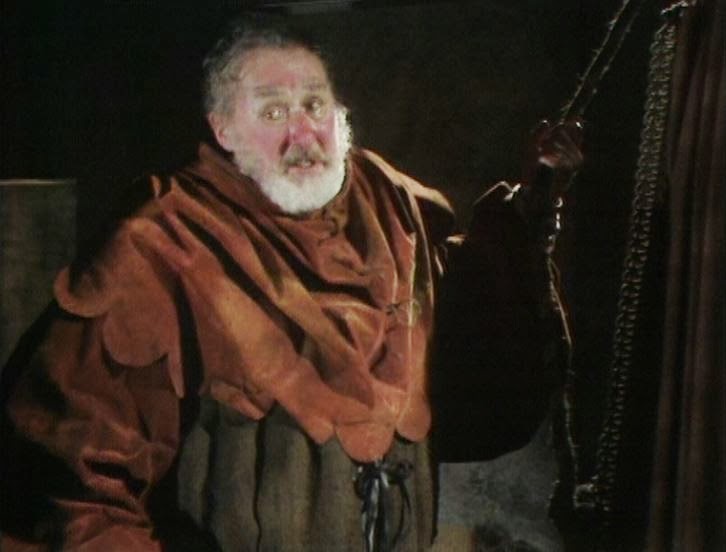
Leonard Rossiter schemes in vain in King John |
Cast: Leonard Rossiter (King John), George Costigan (Philip
the Bastard), John Thaw (Hubert), Claire Bloom (Constance), Charles Kay (King
Philip), Mary Morris (Queen Elinor), Richard Wordsworth (Cardinal Pandolph),
Robert Brown (Pembroke), John Castle (Salisbury), Jonathan Coy (The Dauphin), Gordon
Kaye (Duke of Austria), Janet Maw (Blanche), Phyllida Law (Lady Faulconbridge),
Edward Hibbert (Robert Faulconbridge)
Director: David Giles
 The final series of the BBC’s Shakespeare project kicked off
with the producers surely well aware that, due to lack of foresight at the
start, they were left with one whopper in Much
Ado About Nothing and then four relative minnows in the Shakespeare pool – Pericles, Love’s Labour’s Lost, Titus
Andronicus and King John. This is
a shame since from this point on many of the issues with these productions are
going to be about how well the director’s deal with flaws and problems in the
plays themselves, rather than how they bring the plays to the screen – issues
that I am not always confident that the directors who previously handled The Tempest and The Merry Wives of Windsor earlier in this series are going to be
able to cope with.
The final series of the BBC’s Shakespeare project kicked off
with the producers surely well aware that, due to lack of foresight at the
start, they were left with one whopper in Much
Ado About Nothing and then four relative minnows in the Shakespeare pool – Pericles, Love’s Labour’s Lost, Titus
Andronicus and King John. This is
a shame since from this point on many of the issues with these productions are
going to be about how well the director’s deal with flaws and problems in the
plays themselves, rather than how they bring the plays to the screen – issues
that I am not always confident that the directors who previously handled The Tempest and The Merry Wives of Windsor earlier in this series are going to be
able to cope with. King John is an
odd play, with Shakespeare unsure what type of story he wants to tell here, or
how he wants to tell it. The tone of the play zig zags oddly from almost light
comedy into dark tragedy. John is a curiously peripheral character for large
chunks of the play, struggling to impose himself on the action, as much as the
actor must struggle to impose himself on the play. Time is telescoped as
always, but in a scattergun and confused way, so that some events seem to
happen in a few hours, others months apart. Characters take on great importance
and then suddenly drop out of the action altogether. John is bad when the
actions he undertakes are without defence – but Shakespeare seems obliged to
present him as almost a hero when he defies the Catholic church and, that old
Shakespeare bug bear, the French. It’s a difficult period of history to dramatise,
so this is perhaps why Shakespeare feels more comfortable writing characters he
effectively invented, principally of course Philip the Bastard, who gets all
the best speeches and most of the best lines (if anything, John is a figurehead
in his own play).
King John is an
odd play, with Shakespeare unsure what type of story he wants to tell here, or
how he wants to tell it. The tone of the play zig zags oddly from almost light
comedy into dark tragedy. John is a curiously peripheral character for large
chunks of the play, struggling to impose himself on the action, as much as the
actor must struggle to impose himself on the play. Time is telescoped as
always, but in a scattergun and confused way, so that some events seem to
happen in a few hours, others months apart. Characters take on great importance
and then suddenly drop out of the action altogether. John is bad when the
actions he undertakes are without defence – but Shakespeare seems obliged to
present him as almost a hero when he defies the Catholic church and, that old
Shakespeare bug bear, the French. It’s a difficult period of history to dramatise,
so this is perhaps why Shakespeare feels more comfortable writing characters he
effectively invented, principally of course Philip the Bastard, who gets all
the best speeches and most of the best lines (if anything, John is a figurehead
in his own play). So that brings us to this production, which is a rather
lifeless version of this rambling play that gets excessively bogged down in the
earlier acts, in particular the long, long scenes that make up the bulks of
Acts 1, 2 and 3. The production fails to really kick into gear into well into
Act 4, instead developing into a series of scenes of speechifying, often under
powered in delivery. Camera angles are kept simple, as well as editing styles,
with direction favouring a straight combination of two-shot technique, with
plenty of cuts back to the person who happens to be speaking at that time.
There is a lack of inventiveness in any television technique or filmic
language, with the decision instead to treat this as a very theatrical
adaptation, possibly one of the most theatrical of the series. Occasional good
ideas and interesting camera movements are few and far between.
So that brings us to this production, which is a rather
lifeless version of this rambling play that gets excessively bogged down in the
earlier acts, in particular the long, long scenes that make up the bulks of
Acts 1, 2 and 3. The production fails to really kick into gear into well into
Act 4, instead developing into a series of scenes of speechifying, often under
powered in delivery. Camera angles are kept simple, as well as editing styles,
with direction favouring a straight combination of two-shot technique, with
plenty of cuts back to the person who happens to be speaking at that time.
There is a lack of inventiveness in any television technique or filmic
language, with the decision instead to treat this as a very theatrical
adaptation, possibly one of the most theatrical of the series. Occasional good
ideas and interesting camera movements are few and far between.  The staging and design follows this up, with the style
chosen for the different locations in the play (particularly outside locations)
deliberately going for as non-realist a design as possible. The French
locations are stylised exteriors, with the action taking place in front of huge
backcloths covered in fleur-de-lis,
absolutely no attempt made to suggest that we are ever outside in a ‘real’
place. The castles follow this design, with the stonework looking like exactly
what it is – papier mache – and the exteriors of castle locations almost
laughably wobbly in their woodenness. By contrast, interiors are detailed and
carefully constructed to resemble real castles. Nothing wrong with this of
course, but in a production that plays the action and the characters in as
determinedly realist a way as possible, this looks odd – better productions
have got away with non-realist locations, because either the action married
with this, or the locations had been made so non-realist that there was never a
feeling that we were meant to be looking at a real place. The inconsistency
between interiors and exteriors doesn’t help with this.
The staging and design follows this up, with the style
chosen for the different locations in the play (particularly outside locations)
deliberately going for as non-realist a design as possible. The French
locations are stylised exteriors, with the action taking place in front of huge
backcloths covered in fleur-de-lis,
absolutely no attempt made to suggest that we are ever outside in a ‘real’
place. The castles follow this design, with the stonework looking like exactly
what it is – papier mache – and the exteriors of castle locations almost
laughably wobbly in their woodenness. By contrast, interiors are detailed and
carefully constructed to resemble real castles. Nothing wrong with this of
course, but in a production that plays the action and the characters in as
determinedly realist a way as possible, this looks odd – better productions
have got away with non-realist locations, because either the action married
with this, or the locations had been made so non-realist that there was never a
feeling that we were meant to be looking at a real place. The inconsistency
between interiors and exteriors doesn’t help with this. Other creative and casting decisions in the play also don’t
really work. Was it really necessary to have every single one of Cardinal
Pandolph’s entrances (an underwhelming performance in any case by Richard
Wandsworth, which doesn’t convey the Cardinal’s ruthlessness) accompanied by
monastic chanting? This chanting keeps making clumsy appearances throughout the
production, whenever the theme of religion rears its head. This production is
also cursed with some of the weakest child actors we’ve seen yet in the series.
The child playing Arthur is woefully unconvincing and fatally undermines what
is usually the play’s best scene (Hubert’s planned blinding of Arthur) by
failing to convey any sense of fear or anxiety (he’s not particularly helped by
an underpowered John Thaw as Hubert). As a result, this scene, usually the emotional
centrepiece of the play, is actually rather dull here. A second child performer
pops up towards the end as Henry III and is equally ineffective.
Other creative and casting decisions in the play also don’t
really work. Was it really necessary to have every single one of Cardinal
Pandolph’s entrances (an underwhelming performance in any case by Richard
Wandsworth, which doesn’t convey the Cardinal’s ruthlessness) accompanied by
monastic chanting? This chanting keeps making clumsy appearances throughout the
production, whenever the theme of religion rears its head. This production is
also cursed with some of the weakest child actors we’ve seen yet in the series.
The child playing Arthur is woefully unconvincing and fatally undermines what
is usually the play’s best scene (Hubert’s planned blinding of Arthur) by
failing to convey any sense of fear or anxiety (he’s not particularly helped by
an underpowered John Thaw as Hubert). As a result, this scene, usually the emotional
centrepiece of the play, is actually rather dull here. A second child performer
pops up towards the end as Henry III and is equally ineffective. In terms of the themes of the play, one thing Giles really
focuses on, and brings out successfully, is the importance and strength of
mothers and the influence and control they have over their children. There are
three mothers in this play – Lady Faulconbridge, Eleanor and Constance – and all
three of them are clearly the driving forces behind their children, guiding
their decisions and fulfilling their own ambitions and desires through those
children. Giles shoots the mothers always in domineering positions, presenting them
as constantly controlling and manipulating their sons, living and achieving
their ambitions through them. Constance
speaks constantly for her son, and seems barely able to release her grip on
him, constantly holding him in a domineering grasp. Lady Faulconbridge clearly
controls her rather dullard son Robert and can see (and intends to enjoy) the clear
advantages of the success of her bastard son Philip. Even Janet Maw’s Blanche
clearly understands realpolitik.
In terms of the themes of the play, one thing Giles really
focuses on, and brings out successfully, is the importance and strength of
mothers and the influence and control they have over their children. There are
three mothers in this play – Lady Faulconbridge, Eleanor and Constance – and all
three of them are clearly the driving forces behind their children, guiding
their decisions and fulfilling their own ambitions and desires through those
children. Giles shoots the mothers always in domineering positions, presenting them
as constantly controlling and manipulating their sons, living and achieving
their ambitions through them. Constance
speaks constantly for her son, and seems barely able to release her grip on
him, constantly holding him in a domineering grasp. Lady Faulconbridge clearly
controls her rather dullard son Robert and can see (and intends to enjoy) the clear
advantages of the success of her bastard son Philip. Even Janet Maw’s Blanche
clearly understands realpolitik. This focus on mothers and sons is helped by impressive performances
from these actresses. Mary Morris is a fearsome, ruthless, ambitious and
intelligent Queen Eleanor, clearly positioned as the power behind her son’s
throne. Throughout A1, Eleanor is a constant presence beside John, almost a
co-ruler. Giles uses some intelligent cutting and reaction shots to keep
Eleanor to the forefront of the action throughout A2, allowing the audience to
constantly see how she is evaluating the consequences of the actions around
her. Phyllida Law equally makes a lot of Lady Faulconbridge’s wisdom and clearly
expresses the affection she holds Philip in. Claire Bloom gives another
impressive performance in this series, her Constance developing from a forceful
determination to achieve her son’s rights, through to a pained, desperation
progressing into despair as his hopes and dreams fall apart. Many of the finest
moments in A2 are dominated by her presence, and Constance’s overbearing
determination.
This focus on mothers and sons is helped by impressive performances
from these actresses. Mary Morris is a fearsome, ruthless, ambitious and
intelligent Queen Eleanor, clearly positioned as the power behind her son’s
throne. Throughout A1, Eleanor is a constant presence beside John, almost a
co-ruler. Giles uses some intelligent cutting and reaction shots to keep
Eleanor to the forefront of the action throughout A2, allowing the audience to
constantly see how she is evaluating the consequences of the actions around
her. Phyllida Law equally makes a lot of Lady Faulconbridge’s wisdom and clearly
expresses the affection she holds Philip in. Claire Bloom gives another
impressive performance in this series, her Constance developing from a forceful
determination to achieve her son’s rights, through to a pained, desperation
progressing into despair as his hopes and dreams fall apart. Many of the finest
moments in A2 are dominated by her presence, and Constance’s overbearing
determination.  It’s in the second half that the loss of these characters is
felt, as the play moves towards a confusing see-saw of events as men fall back
into doing what they do best – fighting and feuding. Robert Brown and John
Castle do their best with rather nondescript roles as the primary English
lords, but are not helped by some repetitive decisions both in writing and
playing – we don’t need to see Castle’s Salisbury in tears in almost every
scene to know that he is as conflicted at betraying his country as he was devastated
at the death of Arthur. A4 and A5 may pump up the number of events, but the production
presents them (admittedly not the finest dramatic sequences written by
Shakespeare) as formless and shapeless. Watching this I had no idea what this
production might be building towards – there is no real sense of drive, of a
narrative or thematic point being made here. Instead events continue forward
until they stop. This is even clearer in the end of the play, as the actors
shuffle off (accompanied of course by monastic chanting) without any real sense
that the production has concluded something or been about anything.
It’s in the second half that the loss of these characters is
felt, as the play moves towards a confusing see-saw of events as men fall back
into doing what they do best – fighting and feuding. Robert Brown and John
Castle do their best with rather nondescript roles as the primary English
lords, but are not helped by some repetitive decisions both in writing and
playing – we don’t need to see Castle’s Salisbury in tears in almost every
scene to know that he is as conflicted at betraying his country as he was devastated
at the death of Arthur. A4 and A5 may pump up the number of events, but the production
presents them (admittedly not the finest dramatic sequences written by
Shakespeare) as formless and shapeless. Watching this I had no idea what this
production might be building towards – there is no real sense of drive, of a
narrative or thematic point being made here. Instead events continue forward
until they stop. This is even clearer in the end of the play, as the actors
shuffle off (accompanied of course by monastic chanting) without any real sense
that the production has concluded something or been about anything. A part of this problem is George Costigan’s performance as
Philip the Bastard. An almost entirely invented character, Philip is probably
(if anyone is) the real lead of the play, the only character who addresses the
audience, and the character from whose perspective we are invited to see much
of the action. Costigan gives an intelligent and extremely well spoken
performance, but for me it’s too underpowered and calm. I don’t really get from
him a sense of the charisma the part needs – there has to be a reason why kings
and peers of the realm start to listen to this upstart Bastard, and I’m not
sure that is explained. Similarly, the progress that Philip makes towards decency
and patriotism (is there a nicer Bastard in Shakespeare?) doesn’t really become
clear either. Philip is the main lens through which the audience sees the play,
and when his journey seems hazy, so does the play.
A part of this problem is George Costigan’s performance as
Philip the Bastard. An almost entirely invented character, Philip is probably
(if anyone is) the real lead of the play, the only character who addresses the
audience, and the character from whose perspective we are invited to see much
of the action. Costigan gives an intelligent and extremely well spoken
performance, but for me it’s too underpowered and calm. I don’t really get from
him a sense of the charisma the part needs – there has to be a reason why kings
and peers of the realm start to listen to this upstart Bastard, and I’m not
sure that is explained. Similarly, the progress that Philip makes towards decency
and patriotism (is there a nicer Bastard in Shakespeare?) doesn’t really become
clear either. Philip is the main lens through which the audience sees the play,
and when his journey seems hazy, so does the play. Which brings us to the title character. Just like with John
Cleese in Shrew, the BBC went against
the expected choice by hiring an actor best known for sitcoms to play the
tragic lead. The impact is slightly lost today, largely because Rossiter is
less well known today than Cleese – no episodes of Rising Damp on Netflix! – but he gives a very good performance here
as a John, a weasly mummy’s boy unable to make a decision, prone to the snide
remark and glance but crucially lacking any ability to inspire confidence in
others. So he takes a slightly pathetic delight in little victories – like clasping
the King of France’s hand in a crucial diplomatic moment – but then looks total
at a loss at a major moment, as his lords rebel. His lords show little respect
for him – at one point Salisbury grasps him by the shoulder and John hardly
reacts – and he constantly shuffles on his feet when talking and whines like a
child, refusing at one point to acknowledge Philip until he has kissed his hand
first. It’s a decent performance that seems very true to the historical man
(and also quite good casting for Rossiter). It’s a real shame that this was
Rossiter’s last ever performance, as he passed away between filming and
transmission.
Which brings us to the title character. Just like with John
Cleese in Shrew, the BBC went against
the expected choice by hiring an actor best known for sitcoms to play the
tragic lead. The impact is slightly lost today, largely because Rossiter is
less well known today than Cleese – no episodes of Rising Damp on Netflix! – but he gives a very good performance here
as a John, a weasly mummy’s boy unable to make a decision, prone to the snide
remark and glance but crucially lacking any ability to inspire confidence in
others. So he takes a slightly pathetic delight in little victories – like clasping
the King of France’s hand in a crucial diplomatic moment – but then looks total
at a loss at a major moment, as his lords rebel. His lords show little respect
for him – at one point Salisbury grasps him by the shoulder and John hardly
reacts – and he constantly shuffles on his feet when talking and whines like a
child, refusing at one point to acknowledge Philip until he has kissed his hand
first. It’s a decent performance that seems very true to the historical man
(and also quite good casting for Rossiter). It’s a real shame that this was
Rossiter’s last ever performance, as he passed away between filming and
transmission. Rossiter gives us a firm centre for this production, but
even he gets a bit lost in the dully handled speechifying that makes up most of
the flat first half. A2 in particular seems to go on and on as more and more
hot air covers the destiny of the crown, and the dark comedy of this offer and counter
offer scene gets lost in the crush. It’s just not plain interesting enough for
anyone to care – and there doesn’t seem to be enough tension or indeed anything
really at stake during this long sequence. This then means that once things
start to happen in A4, the audience doesn’t have a sense of tension exploding,
or pay off from a build earlier. Instead, it remains a faithful but rather flat
rendition of a weak play that takes the audience nowhere in particular.
Rossiter gives us a firm centre for this production, but
even he gets a bit lost in the dully handled speechifying that makes up most of
the flat first half. A2 in particular seems to go on and on as more and more
hot air covers the destiny of the crown, and the dark comedy of this offer and counter
offer scene gets lost in the crush. It’s just not plain interesting enough for
anyone to care – and there doesn’t seem to be enough tension or indeed anything
really at stake during this long sequence. This then means that once things
start to happen in A4, the audience doesn’t have a sense of tension exploding,
or pay off from a build earlier. Instead, it remains a faithful but rather flat
rendition of a weak play that takes the audience nowhere in particular.
Conclusion
 A decent lead performance, and some impressive supporting
performances, can’t make up for what remains a rather disappointing and empty
production of one of Shakespeare’s weaker plays, that largely lacks real
narrative thrust and never really feels like it is going anywhere. Instead,
events continue until there are no more events, and material that could have
real emotional impact instead meanders past, lost in dull debate and a few too
many underpowered performances in crucial roles. Stylistically and filmically,
it also doesn’t really work – too bright, too colourful, not visually inventive
enough or done with enough dynamism. Disappointing.
A decent lead performance, and some impressive supporting
performances, can’t make up for what remains a rather disappointing and empty
production of one of Shakespeare’s weaker plays, that largely lacks real
narrative thrust and never really feels like it is going anywhere. Instead,
events continue until there are no more events, and material that could have
real emotional impact instead meanders past, lost in dull debate and a few too
many underpowered performances in crucial roles. Stylistically and filmically,
it also doesn’t really work – too bright, too colourful, not visually inventive
enough or done with enough dynamism. Disappointing.
NEXT TIME: Mike
Gwilym sails the seven seas as Pericles.