First Transmitted 23rd December 1979
 |
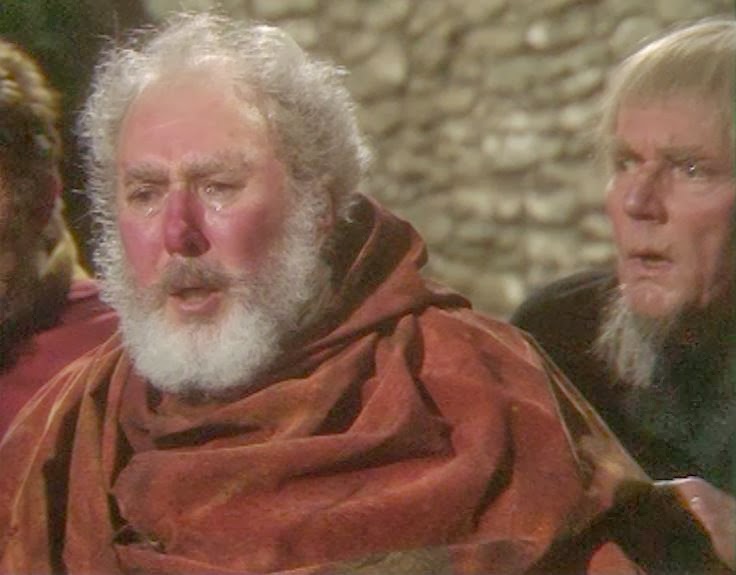
David Gwillim prepares to summon up the blood |
Cast: David Gwillim (Henry V), Alec McCowen (Chorus),
Clifford Parish (Exeter), Bryan Pringle (Pistol), Tim Wylton (Fluellen), David
Buck (Westmoreland), Thorley Walters (King of France), Keith Drinkel (Dauphin),
Julian Glover (Constable of France), Trevor Baxter (Canterbury), Jocelyne
Boisseau (Katherine), Brian Poyser (Gower), George Hower (Sir Thomas
Erpingham), David Pinner (Williams), Brenda Bruce (Mistress Quickly), Jeffrey
Holland (Nym), Gordon Gostelow (Bardolph), John Abineri (Ely), Garrick Hagon
(Mountjoy), Robert Harris (Burgundy), John Saunders (Orleans). John Bryans
(Bourbon), Pamela Ruddock (Queen Isabel), Anna Quayle (Alice), Rob Edwards
(Bedford), Martin Smith (Gloucester), Roger Davenport (Clarence), Rob Beacham
(Warwick)
Director: David Giles
 Very few Shakespeare plays have such a filmic legacy
as Henry V. The two most famous
cinematic interpreters of the Bard – Laurence Olivier and Kenneth Branagh –
have both acted and directed in productions of the play and it is the
Shakespeare role arguably most readily associated with them. Each of the films is
strikingly different, but both are imaginative productions of the play and
stand up to repeated viewings as well as being excellent films in their own
right. The question for any other filmed production of the play is quite
simple: is there any point watching this again when you could be watching one
of those productions? In the case of this film, the answer is a definite no.
Very few Shakespeare plays have such a filmic legacy
as Henry V. The two most famous
cinematic interpreters of the Bard – Laurence Olivier and Kenneth Branagh –
have both acted and directed in productions of the play and it is the
Shakespeare role arguably most readily associated with them. Each of the films is
strikingly different, but both are imaginative productions of the play and
stand up to repeated viewings as well as being excellent films in their own
right. The question for any other filmed production of the play is quite
simple: is there any point watching this again when you could be watching one
of those productions? In the case of this film, the answer is a definite no. To be fair, at the time of the making of this
production, Branagh’s film was still 10 years away. Never the less, this is so
old fashioned in its filming, acting and use of music (and in some scenes it is
so ham-fistedly made) it may as well be 20 years when comparing the two to each
other. What is a fair comparison is contrasting it with Olivier’s marvellous
spectacle of high budget and imagination. And it doesn’t stand up to that
either. In fact I think this production verges on the tragic, it’s such a
missed opportunity.
To be fair, at the time of the making of this
production, Branagh’s film was still 10 years away. Never the less, this is so
old fashioned in its filming, acting and use of music (and in some scenes it is
so ham-fistedly made) it may as well be 20 years when comparing the two to each
other. What is a fair comparison is contrasting it with Olivier’s marvellous
spectacle of high budget and imagination. And it doesn’t stand up to that
either. In fact I think this production verges on the tragic, it’s such a
missed opportunity. For the very first time ever in this series the
director goes for a non-realistic approach but, for whatever reason, it doesn’t
quite work. The most effective sequence is the opening. Alec McCowen’s well-spoken
chorus emerges from a blackened studio facing the camera, before lights come up
in the studio to reveal an artificial court scene (a suggestion of walls) and a
series of actors in freeze. Ely and Canterbury complete their plotting in a small
church, and turn smoothly to walk straight into the royal throne room, created
by a change of lighting in the set and the sudden reveal of other actors. It’s
a high point in the production’s non-realist approach. The video below shows
this sequence.
For the very first time ever in this series the
director goes for a non-realistic approach but, for whatever reason, it doesn’t
quite work. The most effective sequence is the opening. Alec McCowen’s well-spoken
chorus emerges from a blackened studio facing the camera, before lights come up
in the studio to reveal an artificial court scene (a suggestion of walls) and a
series of actors in freeze. Ely and Canterbury complete their plotting in a small
church, and turn smoothly to walk straight into the royal throne room, created
by a change of lighting in the set and the sudden reveal of other actors. It’s
a high point in the production’s non-realist approach. The video below shows
this sequence. The problem is that this is a half-hearted attempt. I
wanted this to stay on an obvious soundstage, with locations merging into each
other and to make no attempt to persuade us we were outside. But events become
a little too real. As soon as we are in France, the grass on the floor, the
solid blue backdrop and the stone walls look too much like attempts to create
the same realist feel as the Henry IV
films. Harfleur feels like a set we are not meant to think is a set rather than
a creative use of soundstage limitations.
Not only that, but the excellent movement of the Chorus between scenes
is gradually dropped. McCowen may appear suddenly as a French lord at the end
of A3 before walking into darkness, but by A5 it’s just become a simple cut
away to his face. It’s hugely
disappointing after the quiet inventiveness of the start. Instead, by going
with a more realist approach for most of A3 and A4, memories of the invention
of Olivier’s film (moving from the Globe to a location and back again) come
straight back to the viewer. And it’s not a flattering comparison. It makes this
production look like a pale copy – as one reviewer said “the borrowed robes of
Olivier”. Rather than use the budget and location limitations as a strength,
they become a crippling weakness.
The problem is that this is a half-hearted attempt. I
wanted this to stay on an obvious soundstage, with locations merging into each
other and to make no attempt to persuade us we were outside. But events become
a little too real. As soon as we are in France, the grass on the floor, the
solid blue backdrop and the stone walls look too much like attempts to create
the same realist feel as the Henry IV
films. Harfleur feels like a set we are not meant to think is a set rather than
a creative use of soundstage limitations.
Not only that, but the excellent movement of the Chorus between scenes
is gradually dropped. McCowen may appear suddenly as a French lord at the end
of A3 before walking into darkness, but by A5 it’s just become a simple cut
away to his face. It’s hugely
disappointing after the quiet inventiveness of the start. Instead, by going
with a more realist approach for most of A3 and A4, memories of the invention
of Olivier’s film (moving from the Globe to a location and back again) come
straight back to the viewer. And it’s not a flattering comparison. It makes this
production look like a pale copy – as one reviewer said “the borrowed robes of
Olivier”. Rather than use the budget and location limitations as a strength,
they become a crippling weakness. The invention returns slightly in A5 with the French
court created by suggested walls and free-standing tapestries on a soundstage.
The French courtroom looks great as a fleur de lis decorated room (floor and
all) but it’s also got a clear outline and structure, more so than the earlier
English court. The final sequence reverses the opening (the chorus walks from
the still action into darkness) but it feels like something went wrong here
with the plans of the director and designer (reportedly it ended up looking far
more realist than either had intended). It’s a massive disappointment.
The invention returns slightly in A5 with the French
court created by suggested walls and free-standing tapestries on a soundstage.
The French courtroom looks great as a fleur de lis decorated room (floor and
all) but it’s also got a clear outline and structure, more so than the earlier
English court. The final sequence reverses the opening (the chorus walks from
the still action into darkness) but it feels like something went wrong here
with the plans of the director and designer (reportedly it ended up looking far
more realist than either had intended). It’s a massive disappointment. And Henry V
is a play that needs invention: because it is so Henry-dominated, it takes a
lot of work (and a very strong cast) to make any of the rest of the parts make
an impact. That’s reflected in what happens here. No other actor other than
David Gwillim really registers with the viewer – certainly none of the other
English lords (for instance Rob Edwards, very good in Part 2, completely passed
me by as a presence) who are barely characters. Clifford Parish makes a solid
impression as Exeter, but David Buck continues to default to shouting as
Westmoreland. For the rest, they are just interchangeable county names.
And Henry V
is a play that needs invention: because it is so Henry-dominated, it takes a
lot of work (and a very strong cast) to make any of the rest of the parts make
an impact. That’s reflected in what happens here. No other actor other than
David Gwillim really registers with the viewer – certainly none of the other
English lords (for instance Rob Edwards, very good in Part 2, completely passed
me by as a presence) who are barely characters. Clifford Parish makes a solid
impression as Exeter, but David Buck continues to default to shouting as
Westmoreland. For the rest, they are just interchangeable county names. None of the French lords stand out either, despite
actors as strong as Julian Glover, Thorley Walters, Garrick Hagon and Keith
Drinkel filling the parts. Tim Wylton’s Fluellen raises the odd smile, but is
far too broad for my liking. Despite Bryan Pringle’s best over acting, Pistol
feels like a faded photocopy of Falstaff. Only very small moments from the
support cast make impressions: Brenda Bruce gives a wonderful, emotional
delivery of her eulogy to Falstaff and her sad “adieu” straight to camera is
one of the few moving moments. Keith Drinkel’s terrified Dauphin during
Agincourt is also a nice touch I haven’t seen before. Gordon Gostelow gives his
finest performance in the series as a sweet Bardolph. But that’s really about
it.
None of the French lords stand out either, despite
actors as strong as Julian Glover, Thorley Walters, Garrick Hagon and Keith
Drinkel filling the parts. Tim Wylton’s Fluellen raises the odd smile, but is
far too broad for my liking. Despite Bryan Pringle’s best over acting, Pistol
feels like a faded photocopy of Falstaff. Only very small moments from the
support cast make impressions: Brenda Bruce gives a wonderful, emotional
delivery of her eulogy to Falstaff and her sad “adieu” straight to camera is
one of the few moving moments. Keith Drinkel’s terrified Dauphin during
Agincourt is also a nice touch I haven’t seen before. Gordon Gostelow gives his
finest performance in the series as a sweet Bardolph. But that’s really about
it. The lead performance though does merit some praise.
Way back when watching Part 1 I
thought Gwillim was doing something very different with Henry – making him a
lighter, less charismatic figure, perhaps even more of a natural follower than
a leader. It’s an interpretation that has carried through to here. This is
easily the most softly spoken Henry V you are ever going to see. Gwillim’s
Henry listens carefully to all advice when considering the invasion of France.
He moves lightly and calmly with a smile through his troops, projecting calm
and ease – as if there was nothing of any concern about to happen. He carefully
uses emotion to win people to him – tears are in his eyes on “shall be my
brother” in A4 S3 – and he is relaxed enough to encourage men to laugh at the
gates of Harfleur. He only rarely shows anger (such as at Montjoy and at
Williams) and is self controlled enough to play a Falstaffian game of pretence
with the traitors in A2 S2.
The lead performance though does merit some praise.
Way back when watching Part 1 I
thought Gwillim was doing something very different with Henry – making him a
lighter, less charismatic figure, perhaps even more of a natural follower than
a leader. It’s an interpretation that has carried through to here. This is
easily the most softly spoken Henry V you are ever going to see. Gwillim’s
Henry listens carefully to all advice when considering the invasion of France.
He moves lightly and calmly with a smile through his troops, projecting calm
and ease – as if there was nothing of any concern about to happen. He carefully
uses emotion to win people to him – tears are in his eyes on “shall be my
brother” in A4 S3 – and he is relaxed enough to encourage men to laugh at the
gates of Harfleur. He only rarely shows anger (such as at Montjoy and at
Williams) and is self controlled enough to play a Falstaffian game of pretence
with the traitors in A2 S2. The impression you get is a man who did not
necessarily want to be king, who had to learn what it means to take on
responsibility and duty. He had to try to wear it lightly to stop it crushing
him. During his speech before Agincourt he is in genuine pain and sheds tears
of regret at the simpler life he has lost. Gwillim plays Henry with more
self-doubt and reluctance than I’ve seen from another actor before. It’s a
logical progression from the carefree young man of the start of Henry IV Part 1. The price paid of this
style of performance is that the big speeches lack the impact that they
normally carry. But it’s a very interesting reinterpretation of a famous role –
and allows Gwillim to put himself at the opposite end of the spectrum from
Olivier’s godlike interpretation.
The impression you get is a man who did not
necessarily want to be king, who had to learn what it means to take on
responsibility and duty. He had to try to wear it lightly to stop it crushing
him. During his speech before Agincourt he is in genuine pain and sheds tears
of regret at the simpler life he has lost. Gwillim plays Henry with more
self-doubt and reluctance than I’ve seen from another actor before. It’s a
logical progression from the carefree young man of the start of Henry IV Part 1. The price paid of this
style of performance is that the big speeches lack the impact that they
normally carry. But it’s a very interesting reinterpretation of a famous role –
and allows Gwillim to put himself at the opposite end of the spectrum from
Olivier’s godlike interpretation.
But unfortunately it is at the centre of a very flat
production, hideously overlong. Of all the ‘great’ plays, Henry V is possibly one of the weakest, and the decision to remove
virtually none of it here (the only really noticeable cut is the deletion of
Henry’s threats to the citizens of Harfleur) makes this production a bum-numbing
three hours, with too many dreadfully unfunny scenes featuring Pistol antics
and leeks left in.
 For Agincourt, Giles’ delivers his worst battle scenes
so far (and the idea of a film of this play including virtually no actual
fighting in it is hard to believe) and the empty green ground and blue skies
end up neither suggesting a non-realist setting or providing any visual
interest. Dramatically the worst of the history productions so far, with lines
delivered in profile during long exchanges in scenes lacking drive or purpose.
It’s a play with some of the most famous rhetoric in the English language, but
it has almost no oomph, no va-va-voom. Part of this is a deliberate decision –
but if a production of Henry V
doesn’t push some of those buttons at least some of the time, then what is it
actually for?
For Agincourt, Giles’ delivers his worst battle scenes
so far (and the idea of a film of this play including virtually no actual
fighting in it is hard to believe) and the empty green ground and blue skies
end up neither suggesting a non-realist setting or providing any visual
interest. Dramatically the worst of the history productions so far, with lines
delivered in profile during long exchanges in scenes lacking drive or purpose.
It’s a play with some of the most famous rhetoric in the English language, but
it has almost no oomph, no va-va-voom. Part of this is a deliberate decision –
but if a production of Henry V
doesn’t push some of those buttons at least some of the time, then what is it
actually for? This could have been balanced out if more attempt had
been made to tackle the subtle, underlying criticism of the war games that kings
play which Shakespeare threads through the play. Henry’s war causes no end of
death and wipes out his old friends. He threatens hideous vengeance on Harfleur
(threats which are cut here) and shows no hesitation in ordering a massacre of
prisoners. But these events lack impact – nothing is made of them. They don’t
shed light on kingship they just merely seem to happen. Gwillim’s performance
of a quieter King would have been a great opportunity to explore the cost of
the king from all this death and destruction – but it just doesn’t happen.
This could have been balanced out if more attempt had
been made to tackle the subtle, underlying criticism of the war games that kings
play which Shakespeare threads through the play. Henry’s war causes no end of
death and wipes out his old friends. He threatens hideous vengeance on Harfleur
(threats which are cut here) and shows no hesitation in ordering a massacre of
prisoners. But these events lack impact – nothing is made of them. They don’t
shed light on kingship they just merely seem to happen. Gwillim’s performance
of a quieter King would have been a great opportunity to explore the cost of
the king from all this death and destruction – but it just doesn’t happen.
Even the great scene with Williams and Henry falls
flat – there isn’t the sense of a common man (unknowingly) pointing out the
logic flaws and ambition of the king, or of Henry having to deal with this.
Giles never really confronts Henry with the implications of his actions, or
allows the drama to question the cost of Henry’s decisions or his potential
selfishness or aggression. Any material of that nature comes solely from
Gwillim’s more low-key interpretation.
 This production clearly wanted to do something
different within the restrictions of the series. It’s actually quite admirable
that they tried something so artificial on television. But it doesn’t have the
courage of its own convictions and doesn’t bring enough interpretation or
interest to the play. I thought from the
opening moments I might be in for something special, but instead this is a
disappointment.
This production clearly wanted to do something
different within the restrictions of the series. It’s actually quite admirable
that they tried something so artificial on television. But it doesn’t have the
courage of its own convictions and doesn’t bring enough interpretation or
interest to the play. I thought from the
opening moments I might be in for something special, but instead this is a
disappointment.
Conclusion
The first time this series has gone for non-realism
and artificiality but the production is largely a failure with mediocre
direction and acting (outside David Gwillim). In a world awash with Henry V films it doesn’t offer anything
new. I can’t imagine this ever being anyone’s favourite film of the play and it
falls short of the high spot of Part 2 and the good work in Part
1.
Next
time: It’s with a small sigh of relief that I move away
from these history plays (five out of the first ten! I love the plays but I
need a break…) and look forward to Felicity Kendal cross dressing in Twelfth Night.