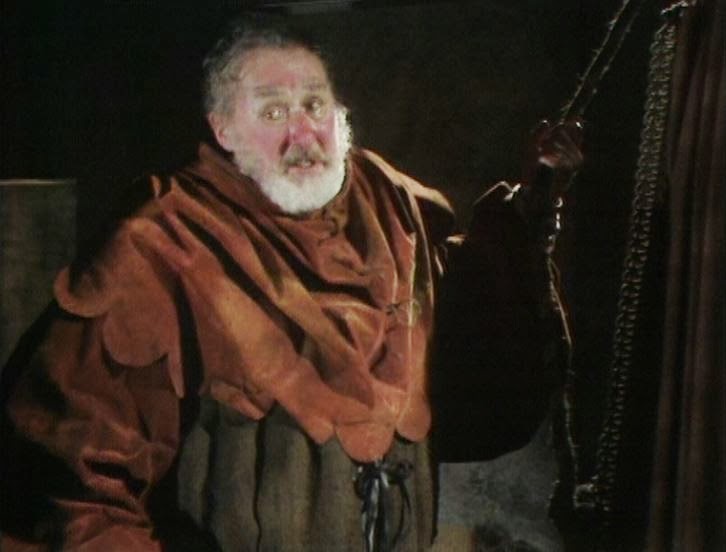
First transmitted 16th December 1979
 |
David Gwillim and Jon Finch pass the burden of kingship between them |
Cast: Anthony Quayle (Sir John Falstaff), David
Gwillim (Prince Henry), Jon Finch (Henry IV), Robert Eddison (Justice Robert
Shallow), Brenda Bruce (Mistress Quickly), Bryan Pringle (Pistol), Jack
Galloway (Poins), Gordon Gostelow (Bardolph), Ralph Michael (Lord Chief
Justice), Frances Cuka (Doll Tearsheet), Rod Beacham (Earl of Warwick), David
Buck (Earl of Westmoreland), Bruce Purchase (Northumberland), Leslie French
(Justice Silence), Rob Edwards (Prince John of Lancaster), David Neal (Archbishop
of York), Michele Dotrice (Lady Percy), Michael Miller (Lord Mowbray), Richard
Bebb (Lord Hastings), John Humphry (Lord Bardolph)
Director: David Giles
It’s been the case in the series, so far, that the
lesser-known plays have excelled over the more well known ones, as if the
production team felt slightly freer with the pressure off as less of the
audience would be coming to the plays with expectations. It’s the case again here.
Henry IV Part 2 is often one of the
flatter plays in the history cycle, but this time emerges as a deeply
heartfelt, melancholic and profound work.
 Production-wise we are on very similar territory as Part 1 – the same crew, the same cast
and the same design aesthetic. The merits and demerits of this design approach
I think I went into in depth in my review of Part 1. The key new touch here is a garish, oversize crown that at one
point dominates half the frame, its size cleverly suggesting the pressure it
brings. Giles as a director seems to have engaged with this work far more. He
identifies a key theme in the play and designs the entire production around it,
playing each scene with a subdued, quiet tone that slowly but surely engages
the audience’s emotions. As such, this is his most impressive work in the
series so far.
Production-wise we are on very similar territory as Part 1 – the same crew, the same cast
and the same design aesthetic. The merits and demerits of this design approach
I think I went into in depth in my review of Part 1. The key new touch here is a garish, oversize crown that at one
point dominates half the frame, its size cleverly suggesting the pressure it
brings. Giles as a director seems to have engaged with this work far more. He
identifies a key theme in the play and designs the entire production around it,
playing each scene with a subdued, quiet tone that slowly but surely engages
the audience’s emotions. As such, this is his most impressive work in the
series so far. Heavily cut – the most heavily so far, as pages and
pages of ‘recap’ dialogue are removed – this moves with pace and purpose while
still allowing itself to breathe. It’s a production about ageing and the death
of innocence. All the characters go through some sort of awakening or
disillusionment, and this air of impending disaster seems to hang over every
frame. This makes Giles’ restrained directing style here highly effective –
flash and bangs would only detract from this atmosphere. The camera lingers on
faces, zeroing in on what are often intense emotions, never wavering or looking
away.
Heavily cut – the most heavily so far, as pages and
pages of ‘recap’ dialogue are removed – this moves with pace and purpose while
still allowing itself to breathe. It’s a production about ageing and the death
of innocence. All the characters go through some sort of awakening or
disillusionment, and this air of impending disaster seems to hang over every
frame. This makes Giles’ restrained directing style here highly effective –
flash and bangs would only detract from this atmosphere. The camera lingers on
faces, zeroing in on what are often intense emotions, never wavering or looking
away. 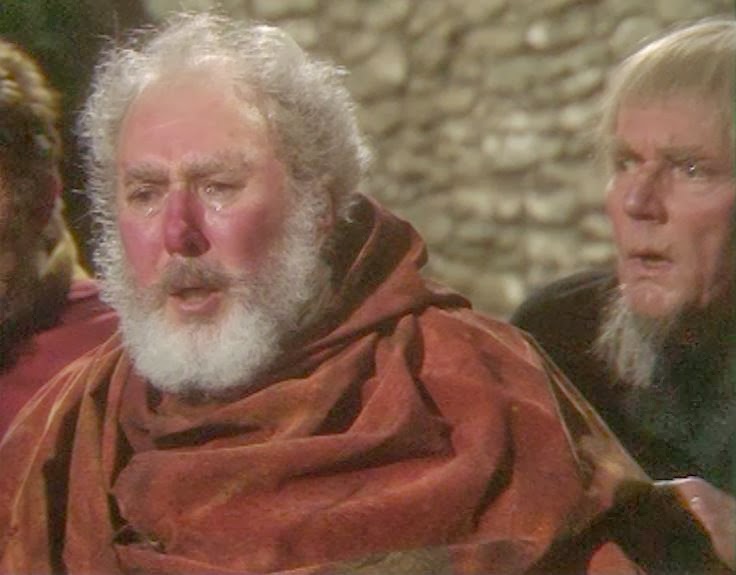 Giles allows careful pauses in dialogue, most
strikingly during the rejection of Falstaff, where the camera fixes on a
stunned, emotional Falstaff as a crowd moves past him. This allows Quayle to
play an array of emotions from shock to disbelief, acceptance and then faint
hope while also allowing the audience to share these emotions with him. This is
just one of several moments – from Northumberland’s heart-rendering reaction to
Hotspur’s death through to Hal and Henry’s reconciliation – where the economy
of the direction make the events more moving and affecting than they could
otherwise be.
Giles allows careful pauses in dialogue, most
strikingly during the rejection of Falstaff, where the camera fixes on a
stunned, emotional Falstaff as a crowd moves past him. This allows Quayle to
play an array of emotions from shock to disbelief, acceptance and then faint
hope while also allowing the audience to share these emotions with him. This is
just one of several moments – from Northumberland’s heart-rendering reaction to
Hotspur’s death through to Hal and Henry’s reconciliation – where the economy
of the direction make the events more moving and affecting than they could
otherwise be.
What’s particularly impressive is this is a strange
play, a slightly clumsy sequel to Part 1.
As the first play has a clear arc of Hal growing up and coming to an
understanding with his father, it becomes necessary to ‘hit the reset button’:
Hal is back in the pub, Henry IV is back to fearing the worst, Falstaff still
seems sure of his position, the rebellion is still a threat. Essentially,
perhaps in order to see some more Falstaff, Shakespeare went ‘back to basics’
and decided to largely forget the satisfying thematic ending he had already
crafted for Part 1.
 Shakespeare acknowledged that the characters of the
two Henries had been comprehensively covered by pushing them to the margins of
the play (Henry IV doesn’t appear until A3 and Hal appears only in A2 before
disappearing until A4). The focus is very much on Falstaff, the character who
learned the least from Part 1. His antics
are motivated more and more by avarice and pride. But all his actions seem
somehow small, sad and pointless – as a character he seems older, more tired,
trying not to dwell on his own mortality. And it serves really well to point up
the doomed nature of Falstaff’s position – we know his dream of a life as the
Prince’s companion can never last.
Shakespeare acknowledged that the characters of the
two Henries had been comprehensively covered by pushing them to the margins of
the play (Henry IV doesn’t appear until A3 and Hal appears only in A2 before
disappearing until A4). The focus is very much on Falstaff, the character who
learned the least from Part 1. His antics
are motivated more and more by avarice and pride. But all his actions seem
somehow small, sad and pointless – as a character he seems older, more tired,
trying not to dwell on his own mortality. And it serves really well to point up
the doomed nature of Falstaff’s position – we know his dream of a life as the
Prince’s companion can never last. It helps that the acting is sublime, some of the best
so far in the series. Anthony Quayle seems the logical place to start. I’ve
already mentioned his final moments which are extremely moving in their
simplicity, low key pain and how he seems to age twenty years before our eyes.
It works even better because Quayle’s performance carefully signposts this
reaction throughout. Falstaff at several points seems to sit on the edges of
scenes looking aged and less energetic. The famous “chimes at midnight” line is
just one of many where Falstaff seems to quietly acknowledge that his time is
coming to an end. Falstaff seems like a geriatric
Flashman – aware he is smarter than those around him, but arrogant, cowardly
and entirely self-occupied – in a quiet way he’s raging against the dying of the
light. With Doll Tearsheet he may growl with sexual excitement, but seems too
depressed to act upon it.
It helps that the acting is sublime, some of the best
so far in the series. Anthony Quayle seems the logical place to start. I’ve
already mentioned his final moments which are extremely moving in their
simplicity, low key pain and how he seems to age twenty years before our eyes.
It works even better because Quayle’s performance carefully signposts this
reaction throughout. Falstaff at several points seems to sit on the edges of
scenes looking aged and less energetic. The famous “chimes at midnight” line is
just one of many where Falstaff seems to quietly acknowledge that his time is
coming to an end. Falstaff seems like a geriatric
Flashman – aware he is smarter than those around him, but arrogant, cowardly
and entirely self-occupied – in a quiet way he’s raging against the dying of the
light. With Doll Tearsheet he may growl with sexual excitement, but seems too
depressed to act upon it.
His desperation seems to make him more grasping than
before. Falstaff constantly adjusts his personality depending on who he is
with. With the Chief Justice he’s proud but ingratiating. With Shallow and the
characters from the Boar’s Head he’s
like a visiting dignitary. With Prince John he’s an earnest rogue, cheeky but
honest. With Henry he’s a jester and a willing fool. But always he’s got his
eye on the main chance. Every version of himself is designed to get the most he
can out of the person he is speaking to. His tragedy is that we know he can get
nothing he wants, no matter what he tries – and Quayle’s quiet moments of pain
suggest that, deep down, even he knows it.
 The desperation in Falstaff is echoed in Henry IV.
Finch is much better here. Henry is a broken shell, a million miles from the
man of action in Richard II: wracked
by illness (which unfortunately plasters his face in some cornflake-style
make-up), dwelling constantly on his sins and terrified his son will destroy
himself. Just as with Quayle, the camera lingers on his face, capturing every
moment of his disappointment, rage and finally hope. Finch is more successful here
because he is able to ally his verse speaking with emotion. Just as with
Falstaff, his every moment on screen carries a constant air of sadness and
regret, more overt, but informing every action the character undertakes.
The desperation in Falstaff is echoed in Henry IV.
Finch is much better here. Henry is a broken shell, a million miles from the
man of action in Richard II: wracked
by illness (which unfortunately plasters his face in some cornflake-style
make-up), dwelling constantly on his sins and terrified his son will destroy
himself. Just as with Quayle, the camera lingers on his face, capturing every
moment of his disappointment, rage and finally hope. Finch is more successful here
because he is able to ally his verse speaking with emotion. Just as with
Falstaff, his every moment on screen carries a constant air of sadness and
regret, more overt, but informing every action the character undertakes. The reconciliation scene of A4 is key. Both actors are
terrific. Gwillim’s Hal seems more at peace with his father when he believes him
dead than at any other point. When he takes the crown, he seems unable to
remove his hands from it, as if weighted down with its power – there is real
fear in his eyes at its burden. When confronted with Finch’s rage, genuine
tears run down his face before a vicious verbal assault provokes a passionate
defence, impressing his father despite himself. It’s a scene with the actors
playing their long speeches off each other very effectively – and the camera chooses
to stick with the actors’ faces with only small cut aways, which also works to
pull the audience into the emotional story in a very subtle way. The oversize
crown also comes into its own here – the responsibility and burden it carries
really hit home when seeing this ungainly, over-decorated object move from son
to father and back again.
The reconciliation scene of A4 is key. Both actors are
terrific. Gwillim’s Hal seems more at peace with his father when he believes him
dead than at any other point. When he takes the crown, he seems unable to
remove his hands from it, as if weighted down with its power – there is real
fear in his eyes at its burden. When confronted with Finch’s rage, genuine
tears run down his face before a vicious verbal assault provokes a passionate
defence, impressing his father despite himself. It’s a scene with the actors
playing their long speeches off each other very effectively – and the camera chooses
to stick with the actors’ faces with only small cut aways, which also works to
pull the audience into the emotional story in a very subtle way. The oversize
crown also comes into its own here – the responsibility and burden it carries
really hit home when seeing this ungainly, over-decorated object move from son
to father and back again. Gwillim’s Hal is from the start a colder character. With
Poins it’s clear the balance of power has shifted, with Hal almost cruel to
Poins in his scorn. The scene plays as a foreshadowing of the later Falstaff rejection.
Gwillim’s body language is now all command and confidence. Jack Galloway shows Poins
knows his influence is lost. In the Falstaff rejection, Gwillim allows Henry to
visibly sadden but shows no regret. He may be a colder man than before, but he
is finally ready to become a leader. It’s the end of youth and innocence and from
the moment he puts the crown on his head, he knows it.
Gwillim’s Hal is from the start a colder character. With
Poins it’s clear the balance of power has shifted, with Hal almost cruel to
Poins in his scorn. The scene plays as a foreshadowing of the later Falstaff rejection.
Gwillim’s body language is now all command and confidence. Jack Galloway shows Poins
knows his influence is lost. In the Falstaff rejection, Gwillim allows Henry to
visibly sadden but shows no regret. He may be a colder man than before, but he
is finally ready to become a leader. It’s the end of youth and innocence and from
the moment he puts the crown on his head, he knows it.
This end of innocence is not restricted to the leading
characters, but runs throughout the play. David Neal’s steely Archbishop of
York is a man who lives his whole life on principle and honour and can’t begin
to believe that others don’t do the same – even his enemies. Speaking to people
like public meetings, he all too easily falls for Prince John’s lies. Prince
John, established in Part 1 as a
chivalric youth, is here a scheming liar. In his brief appearance, Bruce
Purchase’s bearlike Northumberland is wracked with pain and self loathing at
the death of Hotspur. Robert Eddison’s Shallow is as much a grasping, tired old
man as Falstaff, obsessed with a happy past that never actually happened. Even
Doll Tearsheet (a fabulous, scene-stealing performance by Frances Cuka, like
something out of Coronation Street)
and Mistress Quickly are preoccupied, sad figures not sure what they want. It
takes real skill to run a theme so well through so many disparate plot themes
and characters.

It’s all about the emotion here, and an atmosphere is
created here more effectively than almost any other production so far. Giles may
have delivered solid productions of the previous history plays, but here he
elevates what is often an overwhelming play into a tragic litany of loss and
death. It’s the best production so far of the cycle and I would go so far as
saying the production I think I’ve enjoyed most out of the lot. Certainly I
feel there is a lot here that is going to stick with me for days to come – and
you can’t ask much more than that of any production of a Shakespeare play.
Conclusion
David Giles pulls it out of the bag on the third attempt with a heartfelt and melancholic interpretation of this play, one of the strongest productions of it I've seen and far more successful than Part 1. With some terrific performances and some nice very affecting scenes, it might be straight forward in its production but it nails the atmosphere. One of the best of the series so far.
NEXT TIME: David Gwillim takes on the whole of France in Henry V.
David Giles pulls it out of the bag on the third attempt with a heartfelt and melancholic interpretation of this play, one of the strongest productions of it I've seen and far more successful than Part 1. With some terrific performances and some nice very affecting scenes, it might be straight forward in its production but it nails the atmosphere. One of the best of the series so far.
NEXT TIME: David Gwillim takes on the whole of France in Henry V.