Monday, 4 August 2014

The Winter's Tale (Series 3 Episode 4)

First Transmitted 11 January 1981 

Jeremy Kemp goes wild with envy as Leontes

Cast: Jeremy Kemp (Leontes), Anna Calder-Marshall (Hermione), Margaret Tyzack (Paulina), Robert Stephens (Polixenes), Rikki Fulton (Autolycus), David Burke (Camillo), Robin Kermode (Florizel), Debbie Farrington (Perdita), Cyril Luckham (Antigonus), Arthur Hewlett (Shepherd), Paul Jesson (Clown), John Welsh (Archidamus), Colin McCormack (Dion), John Curless (Cleomenes), Janette Legge (Dorcas), Maggie Wells (Mopsa), John Benfield (Gaoler/Sailor), Peter Benson (Servant)
Director: Jane Howell

When I was starting out on this journey through the annals of BBC Shakespeare, this production of Winter’s Tale was one which seemed to meet particular ire. In fact, I remember being in a production of Winter’s Tale myself almost seven years ago (I played the Clown if anyone is interested) and discussion with a few other members of the cast turned to film versions of the play. Sure enough this production was named as being particularly bland, awful and dull. So this felt like it had a bit of a reputation coming into it. Was it, in fact, a real low point in the series or was it much misunderstood?

Well to quote Alan Hansen, it was “a game of two halves”. Firstly, with its incredibly minimalist set and restrained acting, I can see why people find this production dry and lacking in energy. And I would agree with them certainly when criticising Acts 4 and 5 which are very bland and forgettable with most of the intended comedy misfiring or simply dragging on too long (arguably as much a fault of the play). But the first half of the production, covering Acts 1-3 has a quiet intensity that actually works very well, creating an atmosphere of paranoia and tension very effectively. In fact the biggest fault of the production is the darkness of the first half is undermined by the lightness of the second half.

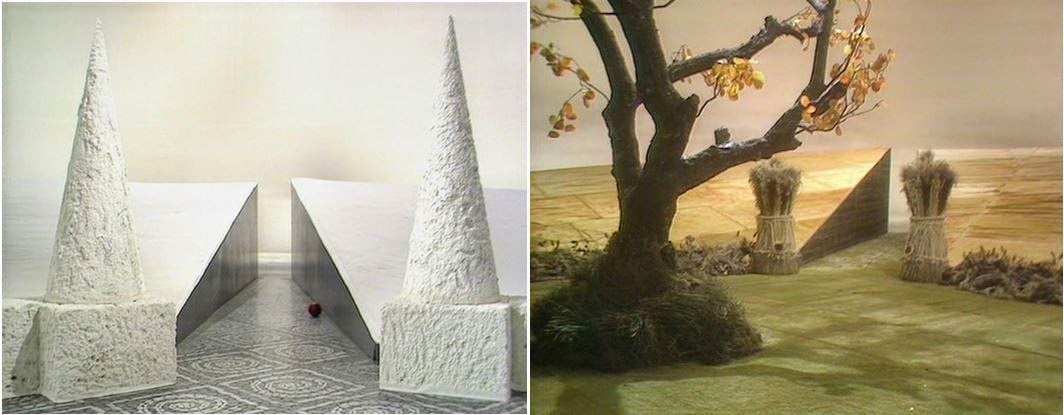
For the style of the production. Jane Howell chooses a deliberately minimalist set, essentially a single rounded stage, centred around a tree (that only flowers in the second half) and full of strange cone shaped objects. Reflecting the mood of the first half of the play, it is kept almost overbearingly white. The second half – the spring section of the play – transforms the same basic location into a lush green countryside. It’s an interesting, non-realist style that uses the limitations of the sound stage and budget to good effect. But it works much better for the first half to be honest – the action of the first half is so constricted and paranoid that the stripped down, stark set marries up very well with the existential crisis that makes up the drama. It’s far less effective when full of colour and dressed to look like a more “real” location.
The introspective quality of the play’s narrative also allows Howell to make extensive use of breaking the fourth wall. In a highly effective device, characters turn towards the frame – often with other characters continuing conversations or action behind them – and confide their inner thoughts to the audience. Intriguingly this is not just restricted to obvious asides or speeches but also for parts of speeches or small individual lines. The consistent application of this throughout does a great job of making the camera another character in the drama and allows the actors to develop a lovely balance between a “public” and “private” face. The device is well enough used that Howell even allows Fulton’s Autolycus to question it by peeping over Camillo’s shoulder mid-speech as if wondering who he is talking to.

But, as with the set, the effectiveness of this device is restricted to the first half of the production. In fact, it’s hard not to shake the feeling that Howell and the creative team were seized with interest in the idea of making a drama about misdirected envy and family tragedy and got lost once the play moved away from these themes.

These themes are present throughout the first half. Howell makes it clear that, other than some hand holding and affection, there is nothing between Polixenes and Hermione (even if there are suggestions that Polixenes would not be averse to such an arrangement). Leontes’ decision to publically condemn his wife is challenged – there are several effective scenes of courtiers crowding around Leontes in an attempt to moderate his actions – but he remains fanatically fixed on his course of action.

The intensity of the first half of the play is expertly handled, with events piling forward with an unstoppable force. The acting style chosen – remote and restrained – makes the flash points of anger and fury even more effective. At points Howell’s camera focuses in tightly on the faces of the leading characters, but she also allows the frame to be filled with courtiers and trial officials, all pushing their perspective of events with an impassioned urgency. The emotion and pain of the events pours out from the faces of Kemp, Calder-Marshall and Tyzack in particular and the other actors successfully convince with the puzzled bafflement and powerlessness. Combined with the bleak set – which has echoes of Beckett – the whole first half seems to be taking place in some nihilistic world of despair. It’s fantastically effective and expertly done.

The switch occurs from A4 S3. Antigonus’ rather dull speech is left unfortunately intact. The limitations of the setting are displayed in their total failure to create a stormy night (indeed the darker storm backdrop is removed from the frame before the text seems to indicate that the storm has finished). The less said about the famous bear the better – the picture kind of says it all. But it brings back memories of Doctor Who. It’s a failure of directorial imagination to not find a better way - lights, editing, anything, to get a better vision of this on screen.

As noted, nearly all the directorial flourishes are focused on making a cold, claustrophobic atmosphere and none of them carry across effectively to the lighter second half, as the devices are repeated but to dramatically less effect. Even the court reconciliation scenes fail to carry any impact. The introspective underplaying of the first half is continued, but it leads instead to a rather cold response, with Kemp’s Leontes in particular being hard to read. In fact, the entire culmination of the play is almost entirely lacking in a satisfying emotional conclusion – I was completely unmoved by Hermione’s return from the dead, and the dry stale atmosphere runs through all the later court scenes. The sheep shearing and country scenes are complete duds and seem to stretch on forever. It’s a production that actually seems undermined by being uncut – you feel Howell would have been happier producing something closer to two hours in length.

The second half is also cursed by containing the weaker performances. Robin Kermode and Debbie Farrington make particularly unengaging and dull young lovers. Paul Jesson does provide plenty of energy as the Clown but Rikki Fulton’s Autolycus is less successful, never convincingly showing the selfish, sinister quality behind the joviality. Robert Stephens looks the worse for wear as Polixenes, but he does give him a lecherous quality that works well in Act 1. As mentioned, Kemp’s performance in Act 5 falls slightly flat.

Which is a shame as Kemp brings a great deal of emotion and power to Leontes in the first half of the production. Bubbling with tension and paranoid fury but also somehow consciously aware that he is on a path of self destruction, Kemp is a whirlpool of depression and self loathing, but a man convinced he has been wronged and determined to let justice be done though the heavens fall. His Leontes is a man who convinces himself so thoroughly that his suspicions snowball from hand-holding to a lifetime of betrayal. He is a man for whom emotions are at the fore – he practically weeps with an et tu pain when Camillo questions him – and who will not be shaken by anyone. Howell repeatedly shows Kemp at the centre of a whirligig of protests and Kemp demonstrates that his heartbroken pain will not stop him from doing what has to be done. It’s a powerful performance but I think slightly one-note – largely because I think Kemp struggles to introduce any new elements to it in the second half of the play. He nails the pain and rage of the first part but fails to bring the same depth to the second half.

A lack of depth is missing from most of the performances, and I think this ties into a slightly black and white interpretation of the characters. Margaret Tyzack is a terrific actress and she really nails the force of character and the strength of will of Paulina but the character seems the same throughout – even in the second part, there does not seem much change in her corrective tone as ifi she has been telling Leontes off for 16 years. Anna Calder-Marshall also gives a moving performance as Hermione, a blameless woman in torment, but that is basically the only note she is called upon to deliver. She does so expertly, but there is no room in the concept given to her to demonstrate any light or shade. David Burke gives perhaps the most shaded and multi-facted performance as Camillo, who like Leontes regretfully will do what he sees as right, but slowly introduces a greater shade of selfishness into his actions as age combines with a longing to see Bohemia (this change of character perhaps explains why he is the only character who seems to age in the play).
 

This is all part of a trend. It’s half a great adaptation but just falls short throughout. There are some excellent ideas – the set, the directing style, several moments of the acting, the tension – but it fails to push these ideas to the next level. All the leading performances – Kemp, Calder-Marshall, Tyzack – fail to develop and change from the first half to the second. Once the play breaks from the intensity of the build up to the trial into the rest of the action, the energy of the acting and directing disappears as if the spell is broken. All the structure and ideas work for that one set-up, all the performances are geared towards it, even the aesthetic only works for it. Once we break into the lightness and the comedy the production falls apart.

This is not the terrible production you might be led to believe, but it is a missed opportunity. If the elements had come together better – or even if the play had been reduced in length and the second half cut down significantly – then the production as a whole would have been a great success. As it is, this offers one prolonged sequence of excellence but then a deflating disappointment, like watching a hot air balloon fly, crash to the ground and then all the air slowly leak out over an hour and fifteen minutes. Such a shame.

Conclusion
The ideas are there and many of the performances are also very good. The directing style and aesthetics are very interesting and work in tandem with the text very well to create a particular mood and effect. But A3 S4 onwards feels botched, disengaged and low in energy – particularly compared to what has gone before – and the end result is a disappointment. Kemp, Tyzack, Calder-Marshall and Burke in particular are very good, but even they seem to dwindle in the second half and fail to completely change the pace away from tragedy to relief. A near miss, but a miss – but it lays good groundwork for staging ideas that would be explored later in the series.

NEXT TIME: Jonathan Pryce rages against the ingratitude of his fellows as Timon of Athens.

Monday, 23 June 2014

All's Well That Ends Well (Series 3 Episode 3)

First Transmitted 4th January 1981


Angela Down, Celia Johnson, Ian Charleson and Donald Sinden play unhappy families

Cast: Angela Down (Helena), Ian Charleson (Bertram), Celia Johnson (Countess of Rousillon), Donald Sinden (King of France), Michael Hordern (Lafew), Peter Jeffrey (Parolles), Rosemary Leach (Widow), Pippa Guard (Diana), Robert Lindsay (First Lord), Dominic Jephcott (Second Lord), Paul Brooke (Lavache), Kevin Stoney (Stewart), Nickolas Grace (Solider), Valentine Dyall (Astringer), Terence McGinty (First Gentleman), Max Arthur (Second Gentleman)
Director: Elijah Moshinsky

First off it’s been a huge break – so please blame the fact that I bought a house in the interim and basically didn’t have time to sit and watch a whole Shakespeare play and then write it up. Don’t even mention the problems I’ve had getting the internet reconnected. Anyway, I finally found the time to watch the third production of the Jonathan Miller years – All’s Well That Ends Well, directed by what would become a series regular: Elijah Moshinsky.

Straight off the bat I have to say I really enjoyed this production, despite not knowing the play very well at all. The first thing that will strike anyone watching this is the extraordinary visual beauty of the film. It’s an incredibly rare thing to say about a television production of the time – particularly one shot on the harsher, grainy medium of video rather than film. This strong visual sense is expertly combined with an acute and intelligent analysis of text and characters that has quickly become the hallmark of the Jonathan Miller era.

But first the visuals. Hard to believe it, but this was Moshinsky’s first ever work on film or television. Now apparently this was the secret behind its success – Moshinsky simply didn’t think, in the way of a more experienced TV director like John Gorrie, “this can’t be done” about the more complex, naturalistic lighting he wanted – he asked and his team strove to deliver it. Moshinsky wanted to create a feeling of scenes being lit by natural light, sometimes a few candles, and to allow shadows and areas of darkness to be created. His inspiration for this was the paintings of the Dutch masters – in particular, to my eyes, Rembrandt – though he was also inspired by a (to me) lesser known artist called Georges de la Tour, from the same era who was heavily inspired by Carravaggio.

The lighting team on the film – and credit must go to John Summers, the director of photography – duly went to work to create the sort of effects more experienced directors would have been trained to believe too difficult and time-consuming to attempt. The effect is extraordinary throughout, with extensive use of silhouettes, and scenes artfully framed and composed to form striking visual tableaux. The willingness to feature darkness on the screen, while bathing the action in a warm candlelight effect introduces an intimacy to the drama, making the action very personal. The inspiration of paintings can be seen throughout – the lords at the King’s sickbed bear more than a resemblance to Rembrandt’s The Anatomy Lesson; later the soldiers appear strikingly similar to The Night Watch; baroque imagery is used throughout for Helena and the women of the play.


This strong visual sense rings out through all the scene set-ups, each established with a skillful painterly eye, without ever appearing sterile or over studied. There is even room for a little tip of the hat – in A4 S3, while the lords Dumaine speak, a clear collection of Holbein and Rembrandt inspired “artistic metaphor objects” can be seen on the table before them. This painterly feel also serves to make a virtue of the studio bound locations – such effects could never have been created outside, but the visual skill never makes the action feel cramped or claustrophobic. Excellent use of mirrors throughout allow both scope to be added to small sets, and also suggest a commentary on the differences between projected image and actuality - tellingly, Parolles and the King are the characters seen most often in mirrors.

Moshinsky also makes excellent use of the camera, here a prowling part of the action, moving around scenes – particularly strikingly used in A3 S7 as the camera pans around a scheming Helena to slowly reveal the other characters listening to her. Such camera work also serves to demonstrate character notes – in the example above stressing both Helena’s leadership qualities, but also her slight distance from those around her. Later, at the play’s conclusion, a Helena POV shot allows the viewer to soak in the reactions of each of the characters at her return from the dead.

Of course the visuals would never be so successful without Moshinsky and his team undertaking a concentrated interpretation of the text itself. Most strikingly, both Helena and Bertram are presented as (to varying degrees) somewhat selfish and unwise characters, neither as clever or as noble as they at first appear. Helena’s infatuation with Bertram is demonstrated as being as thoughtless and self-obsessed as Bertram’s own later seduction of Diana – both of them show very little interest in the thoughts and feelings of the object of their affection in their attempt to gain possession of them. Is it any wonder that Bertram looks so sullen at being tied – against his will – in marriage to Helena?

This underlying theme of selfishness and a grasping, elitist control over the world is demonstrated throughout. Parolles may be a swaggerer and a braggart, but really he only reflects the conduct and actions of those around him – and indeed is quick to condemn them when given the opportunity. This atmosphere all stems from the King, here a power-crazed sexual pervert, strongly suggested to be suffering from veneral disease of some sort, grooming the young French lords to follow in his (dirty) footsteps. He takes what he wants and orders and controls the lives of those around him like they are his playthings. Is it any wonder these same lords think it “sport” to kidnap and perform a mock execution on Parolles later? The roughing up of Parolles – and the outrage of the bullies as their own faults are unwittingly told to them by their victim – is systematic in a world where the rich look down on the poor. Even Lafew, more kindly than the rest, has a clear idea of the “natural order of things”.

The sex running through this production is very pronounced. It’s more than heavily implied that a healthy dose of “rumpy-pumpy” is a key part of Helena’s cure for the King. Diana may have contempt for Bertram, but is more than aware of how to use her coquettish charms to get what she needs from him in a highly sexualized seduction. Lavatch – on the surface a comic part, but here played like some sinister backstairs servant – has a particularly sinister speech about love. Bertram is virtually a working hormone in the second half of the play. Even Helena makes decisions based on her own lust for Bertram, and is happy to perform the “bed trick” in order to cement her position over him. It’s a selfish society and the characters reflect these values – they are all, to degrees, only interested in getting what they want and have little regard for the feelings and  desires of others.

Angela Down, a great choice for Helena, brings a wonderful put-upon, self-sacrificing air to the role, which here is subtly inverted to suggest a disguise behind which lurks a far more selfish and manipulative personality. Her coldness and aloofness distance her from contemporaries in subtle ways – obviously from the more immature Bertram – but also give her a natural authority and control over the Widow and Diana. She also clearly has no qualms over manipulating the lecherous King with her body. Throughout the play she shows little interest in understanding Bertram – only once, when he angrily refuses the forced marriage does she seem to express any regret at her decisions, as if it never occurred to her that he might be unhappy at having marriage forced on him. Far from painting her as an angel, she is clearly a deeply flawed person and Ian Charleson’s sullen Bertram – while clearly not worthy of the affection lavished on him by her – surely has a point about being furious about being forced into a loveless (and what has a good chance of being) unhappy marriage.

Her coldness contrasts very well with Peter Jeffrey’s dandified, swaggering braggart Parolles, a generally harmless chancer perfectly happy to bumble along as a carefree hanger-on. Interestingly there is no hint of maliciousness to him – he is a man using what skills he has to get a foot on the ladder. His clashes with Lafew – a very boisterous performance from Michael Hordern, perhaps his best work in the series so far – may have moments of outrage in them (and Parolles goes to draw his sword at least once) but seem almost more like a game than a war. Where Helena’s manipulation is subtle, Parolles’ is played openly and simply, almost innocently. After his humiliation, Jeffrey embraces Parolles’ determination to be one of the few characters to no longer wear a face, but to be what he is – in his case a Dickensian beggar, kowtowing to his masters for favour. It’s a very engaging performance. It also serves as an interesting contrast with Helena – they are both using Bertram and others, but Parolles is open and honest about it, where Helena seems unwilling to admit it fully even to herself.

 
This is a very strong cast of actors. Celia Johnson probably gives the stand-out performance as a worldly-wise, kindly and gentle Countess, who takes a humane interest in those around her and exudes a motherly warmth – she is perhaps the most forgiving and generous character in the production. Pippa Guard is far better here than in The Tempest, making Diana a clever flirt but also giving her a moral force. Donald Sinden does verge towards a theatrical ham, but his clever interpretation of the King as a sex-crazed old man, still gleefully recalling trysts past, does bring a very interesting new vision to the play – and also ties in well with making the King more of a tyrant than other productions have done. Michael Hordern is a stand-out as a vigourous Lafew, worldly-wise but not an innocent. Robert Lindsay again stands out in a small role as a bullying Lord. All the characters fit very naturally into the interpretation of the play Moshinsky has created.

Some subtle cuts are made to the text – in particular all the scenes featuring the Duke of Florence have been deleted – to bring the focus tightly into the family drama Moshinsky wants to show, while still allowing the clashes of this family to reflect a wider society. Moshinsky brings out these themes of selfishness and lack of self-awareness extremely well – it’s suggested that Helena and Bertram learn very little over the course of the play or even really develop as characters, with the ending narration by the King being very open to interpretation (and he clearly also has his eye on Diana). Bertram and Helena may kiss, but is Bertram still responding to the pressure from others? Has Helena learned anything about forcing love on another? Clearly not as the old “bed trick” is the only reason Bertram reaffirms their marriage.

This is an intelligent and fascinating production of the play – in fact the sort of production that elevates the play straight up your list of “favourite Shakespeare plays”. It’s still a little known work, but this production really finds a depth and interest to it. Which of course makes it a credit to the series – and also a tribute to television. A lot of the very subtle work in this production could not have been created on the stage and the use of intercutting, close-up and camera movement – as well the gentle underplaying of some scenes – really uses the benefits of the medium. Moshinsky was quite some find, and it’s exciting to see what he may come up with next.


Conclusion
This is probably the best calling card for the series so far – actually the best. Only Taming of the Shrew I think gets close enough to touch it. It’s an adult, creative, intelligent interpretation, beautifully filmed and fantastic to look at. Coupled up with strong performances across the board – this must be the best cast assembled yet – it’s no surprise this received several awards. It’s certainly the best one to show people if you are trying to persuade them to watch the rest of the series!

NEXT TIME: I'm looking forward to it as we hit Jane Howell's controversial Winter's Tale Production. Those on the know are not favourable. Let's see shall we see?

Wednesday, 16 April 2014

The Merchant of Venice (Series 3 Episode 2)

First Transmitted 17th December 1980

Warren Mitchell must have a pound of John Franklyn-Robbins' flesh

 Cast: Warren Mitchell (Shylock), Gemma Jones (Portia), John Franklyn-Robbins (Antonio), John Nettles (Bassanio), Susan Jameson (Nerissa), Leslee Udwin (Jessica), Richard Morant (Lorenzo), Kenneth Cranham (Gratiano), John Rhys-Davies (Salerio), Alun David (Solario), Douglas Wilmer (Duke of Venice), Enn Reitel (Laucelot Gobbo), Marc Zubar (Prince of Morocco), Peter Gale (Prince of Arragon), Arnold Diamond (Tubal)
Director: Jack Gold
 
The second production of the Jonathan Miller years is a cold and forensic production of The Merchant of Venice, full of muted colours and distant characters. It’s also a clear continuation of style from Taming of the Shrew – theatrical in design and style and with a clear interpretation of the play at its heart. What it also does well, however, is not to force that interpretation on the viewer.
 
This is despite the fact that it seems fairly clear to me that Jack Gold pretty much dislikes nearly all the characters in the play. All the Christian characters are presented throughout as cold, rather empty individuals, imperious and slightly distant – to the extent that some of them barely exhibit clear characteristics at all. In fact what is striking is what little sense of their personalities you get here. It seems very much a directorial decision to accentuate this part of Shakespeare’s writing.
 
Shylock is such a vibrant, colourful character, capable of both feeling and villainy, that it often seems (particularly today) the Christian characters are comparatively trivial. Certainly the final act of the play, revolving around the exchange of rings and various comic schemes, seems anticlimatic and a dramatic switch in tone from what has come before. Now I think there is complexity behind these characters, but to me this production decides to accentuate this comparative blankness.
 
Shylock is a character who dominates the play and is the one character in the play truly unique to the cannon. It is impossible to imagine Shylock being dropped into any other play without changing the nature of the play itself – it is hard to imagine any other character having that impact. He is so unique – and historical attitudes to Judaism are such a controversial issue – that every production runs the risk of being accused of anti-Semitism if any of Shylock’s many negative elements are portrayed. This production was nearly banned in America – despite the fact that Gold, Miller and Mitchell are all Jewish. Productions can bend over backwards to reposition Shylock as a hero (or anti-hero), a man “more sinned against than sinning”, who only wants to demonstrate the injustice of Venetian society.
 
Such contorted thinking takes us away from what the play is trying to do. Shylock is, really, the villain of the play. Now he’s no Jew of Malta – he’s a regular Joe, trying to keep his head above water, fed up with being treated like filth, who responds to taunts and humiliation with a desire to return it with interest. That’s understandable, but many of the actions are inherently negative – there is a reason why his daughter is so eager to flee him. His driving intention throughout the final acts of the play is essentially to murder Antonio. Pained by the loss of his daughter he takes the (surprise) opportunity of Antonio defaulting on the loan to take revenge on everyone who has wronged him. It’s understandable why he does it – but such murderous glee is hard to sympathise with.
 
Having directed Merchant of Venice in the past, I could go on (at length) about the fascinating nature of this character. But this is about Gold and Mitchell! Warren Mitchell’s performance is most striking in its lack of judgement on this character. His Shylock is more comic than any other performance I’ve seen. Grubby, short and a little unclean Mitchell performance is also intensely Jewish in voice, manner and gesture. Throughout the other characters surround and tower over him. It’s a performance that I think of as being “line-by-line” – Mitchell plays every line as it is and avoids stamping a clear interpretive intention on Shylock – unlike other productions, where every line and action is twisted in order to present a particular idea (usually positive) of the character. There is also a wonderful sense that Shylock plays up his Jewish characteristics when in conversation with the other Venetians in order to unsettle, unnerve or even annoy them – when addressing the camera directly he is notably calmer, stiller and more relaxed.
 
This is also a Shylock who laughs – and a fair bit. The laughter is often artificial – in A1 S3 it’s clearly used as a wheedling, even ingratiating tool – a defence to Antonio to demonstrate that his abuse does not hurt him. The jovial manner is also used as a cover to get pointed sharpness towards the people he is speaking to (he does this in A1 S3 when pointing out Antonio’s hypocrisy in asking for a loan). Laughter is a tool to allow Shylock to convince himself he is in control and, as is clear in A2 S5, to dominate those around him like Gobbo and Jessica (who, despite his concern for her, he is notably distant and self-preoccupied when talking to). Laughter is used again when confronting Salerio and Solanio in A3 S1, where their aggressive (and openly racist) bullying is met with Shylock laughing along in an almost manic way before flinging his famous “Hath not a Jew” speech with an increasingly pained, revengeful fury back at them.
 
Which brings us to the trial scene – always destined to be the centre of attention for any production of Merchant. Mitchell’s Shylock here actively enjoys the position of power he has over the Christians but still with a touch of the comic about him. There are moments of gentleness and a tinge of sadness when remembering his lost daughter, but Shylock’s potential nobility is continuously undercut throughout by his scuttling glee, his obvious delight at the prospect of the act of murder. The court may clearly be rigged – and Douglas Wilmer’ excellent performance of the Duke carries all the weight of a system that won’t allow itself to be seen as fixed even when it so clearly is – but Shylock himself is hardly either completely sympathetic or in any way  particularly noble. He’s a trodden down, trampish man who is given the chance of cocking a snook at his betters.
 
It’s a largely underplayed scene surprisingly – it’s kept low and quiet, perhaps matching Gemma Jones’ cold Portia – and it would be better if there was more sense of community or crowd reaction from the many onlookers of the trial. But its focus on the lead does mean that Shylock’s eventual breaking – his quiet “let me go” is the voice of the eternal victim returned to his victim status – carries a neat emotional force that is reflected later in the play in Antonio’s own isolation. It would be hard to take a sense away of a good man, even while being possible to feel sorry for Shylock. The violence of his forced conversion – and the sudden switch in character to a small man eager to escape as quickly and easily as he can – makes Shylock a tragic figure, even if the victim of self-inflicted wounds.
 
This review has placed a lot of the focus on Shylock, but then I feel this is the intention of the production as well. Shylock’s vibrancy is accentuated by the coolness of everything else. With the set largely made of blues and greys, reflected in the largely muted colours of the costumes and even the paleness of the actors. The artificial setting and backdrop makes Venice seem even more constructed and controlled, with the backsheets used (and so undisguised) keeping the world disconnected and unreal. It’s telling that the Shylock scenes occur in the most ‘realistic’ locations while Portia’s house (the centre of the Christian characters’ world) is the most stylised. Gold’s stylised use of imagery also yields some results through the framing of the Christian characters – particularly in a striking image of the three happy couples at the end, all embracing as if to hammer home their essential uniformity.
 
This distance is seen in the performances as well. Gemma Jones’ Portia is a cold, rather distant figure. She may relax slightly with Susan Jameson’s engaging Nerissa but she is still an unknowable figure, her sharp intelligence and manipulative ability suggesting that she is bound for disappointment in John Nettles’ handsome but empty Bassanio, a man here almost devoid of imagination and wit. Jones’ grand tone works well for the trial scene – and Portia has rarely seemed as cold and unfeeling as she does in parts of this trial scene (although Gold handles the comedic asides with Nerissa during this scene with an assured touch and allows the comedy).
 
John Franklyn-Robbins’ Antonio is a tortured, lonely figure unable to truly relax or relate to people – martyrism at the end is a tempting opportunity to lend his life meaning. Gold plays the homosexual subtext of the relationship between him and Bassanio very openly – though it is suggested that Bassanio is very much aware that affection for Antonio can yield prizes. Franklyn-Robbins brings the age of Antonio out very well, and Gold’s decision to leave him isolated and alone in Portia’s house at the end – lost between two worlds – brings out the bittersweet nature of the ending, also echoed in Jessica’s unease at Shylock’s loss of his land. The final image of Antonio is also striking for the replication it makes of his pose from the very start – the futility of Antonio’s journey and the lack of progression for the character (still in the same place emotionally as he was at the start) has rarely been so well expressed.
 
For the other performances, John Rhys-Davies is a stand out as an energetic Salerio, but others – especially Enn Reitel’s Gobbo – are less successful. Leslee Udwin has her moments as Jessica but the relationship between her and Richard Morant’s Lorenzo is played fairly straight and without complexity.  Kenneth Cranham misses a trick as a slightly under played Gratiano.
 
Gold’s production in a stylised and artificial Venice is an interesting mixture. While in Shylock it is happy to present a nuanced and fairly open view of a character so often twisted into positivity, it then weights the dice slightly by making the other prominent characters considerably colder and less interesting both in contrast to Shylock and to the writing of the original play. While it’s great that this production is confident enough to present its lead as a very shabby figure, it seems a shame that it couldn’t do the same with the others. Gold does use the budget constraints very effectively, and his embracing of a clearly artificial world reminiscent of cool late-Renaissance painting (Titian springs to mind) is a striking continuation of the style Miller had introduced.  But the contrast between the life of the Shylock scenes and the coldness of the Christian scenes is finally too great to keep the audience really engaged in the storylines of a significant number of the cast.
 

Conclusion
Some very good scenes and a fine performance by Warren Mitchell, but the rest of the cast selflessly sacrifice themselves to the conceit of the production. The development of the rest of the characters, except perhaps Antonio, is not revelatory but does draw a clear parallel between Shylock and the rest. It’s not the greatest production of the play that you will ever see but it’s a very intelligent production by a very experienced TV director that uses the constraints of the media to excellent effect. I enjoyed and liked its embracing of stylisation – but it’s too cold a production for it to be anyone’s favourite.


Thursday, 27 March 2014

The Taming of the Shrew (Series 3 Episode 1)

First Transmitted 23rd October 1980

John Cleese knows how to throw a wedding party in The Taming of the Shrew


Cast: John Cleese (Petruchio), Sarah Badel (Katherine), John Franklyn-Robbins (Baptista), Susan Penhaligan (Bianca), Anthony Pedley (Tranio), Simon Chandler (Lucentio), Jonathan Cecil (Hortensio), Frank Thornton (Gremio), Joan Hickson (Widow), John Bird (Pedant), John Barron (Vincentio), Harry Waters (Biondello), David Kincald (Grumio)
Director: Jonathan Miller

The third series of the BBC Shakespeare saw a new man take on the role of Producer: Jonathan Miller. A qualified doctor, experienced theatre director, member of Beyond the Fringe, documentarian and probably one of the UK’s best known polymaths, Miller is a genuine intellectual and no respecter of conventions. It’s no surprise then that Taming of the Shrew totally overhauls the playbook of the earlier films of the series, presenting a version that is thematically different and also bases many of its decisions around textual interpretation rather than faithful reproduction.
This attitude is clear throughout: from casting and filming choices to setting and interpretation. The three key elements of television Shakespeare are all addressed in a far more radical manner than previously under the Messina years. Although the production itself is not perfect, as an attempt to really bring a theatrical experience to television, this actually feels like watching something interesting at the National Theatre, rather than something stuffy in BBC studios.
The obvious place to start (and probably the main reason why curious viewers are pulled in to watch this drama) is the casting of John Cleese as Petruchio. Cleese was extremely cautious about taking on the role, having no experience of playing Shakespeare and with a low opinion of the first two series of the project. Perhaps unsurprisingly, he feared that a BBC production would be “about a lot of furniture being knocked over, a lot of wine being spilled, a lot of thighs being slapped and a lot of unmotivated laughter”. In other words, your straight forward romp. And under Messina, let’s be honest, that’s probably what it would have become. However, Miller saw Shrew as a more interesting work than that, and Petruchio as a more complex character than a berserk Basil Fawlty (which Cleese must have anticipated was being expected of him). What he gets Cleese to do is in fact play wildly against type.
Cleese’s Petruchio is a cold and aloof intellectual, a man of puritanical views who – rather than swaggeringly bullying Kate into submission – sees his duty with Kate to reflect back her own behaviour to her, to show her the sort of person she appears to others. Rather than the big shouting scenes, the key moments in the performance are the quiet reflective ones, particularly the speech in A3 S3, in which Cleese quietly and softly outlines his intentions, devoid of bombast. In his interactions with the other characters, he is calm and collected – the outbursts of energy are clearly him playing the role of the bombastic husband. The effect of this is to demonstrate his genuine feeling for Kate and, perversely, his respect for her as a person – he acts the way he does because her behaviour is unsustainable and (the drama suggests) comes from a bitter resentment towards a world and family that has never valued her. There are two Petruchios (much as you feel there are two Cleeses): the serious and thoughtful intellectual and the manic comedian – with the latter being the performance put on to obtain a specific effect. Cleese’s performance is very good indeed in a production that has, you feel, been shaped around him (I can’t really imagine him playing any other part in the cannon as successfully as he does this one).

Sarah Badel is similarly excellent as Kate. In a way, her casting is similarly inventive. Older than many Kates, Badel manages to make Kate very vulnerable from the start, meaning her aggressiveness feels forced and overdone. Again, it’s in the quiet moments where we get a feeling for the vulnerability she is hiding below the surface. She plays the intelligence of the role a great deal, bringing out the depths to her – the speech opening A4 S1 demonstrates a lot of this smartness. After being confronted with her own behaviour from Petruchio it’s clear she gets the point quickly – by A4 S3 (a triumphant interpretation) she is in fits of giggles at Petruchio’s changed moods and views which she is required to parrot – it’s clear that the whole thing has become a charming private joke for the two of them. Just as Cleese does, she re-interprets the part – a hurt, vulnerable woman with a great deal of warmth who has never had interest or regard paid to her by anyone else. There are enough hints from the start that she is interested in Petruchio from the start and she is more than happy by the end of the play as they kiss tenderly to settle into a loving – and puritan – household.

The suggestions of puritanism – Petruchio’s house is notably Spartan, his clothing is subdued – culminate in the decision to end the production with a communal singing of a Psalm, after a well-meaning piece of family banter. It’s hard to imagine a world further away from the ribaldry normally associated with this production, and is a mark of Miller’s interpretive work here. Petruchio’s intention is to get Kate to accept not just her place in society, but also to open her heart to other people – a decision she decides to take, and which clearly makes her a more contented person at the end. The clear and unambiguous affection shown between them at several points in the final scenes indicates the success that Petruchio has had, not so much in taming Kate, but in getting her to realise that her own behaviour was as damaging to herself as to others.

This is the sort of interpretative energy that is missing from so many other productions so far. Miller doesn’t just present the play as expected – he has analysed it, interrogated its themes and come up with a truly unique vision. It still has moments of comedy, but the core of the production is getting at the psychology: a damaged woman, clearly a black sheep of her family and friends, responds with mindless and continual aggression, far beyond the bounds of what is expected. A man uses reverse psychology to encourage her natural warmth and desire for love to emerge. Now, some people are not going to be convinced by this – and Miller makes it clear in the production that this is still a period piece (I doubt such tough love would be worn today) – but you can’t deny that this is a logical and consistent version of the play, something sorely missing from earlier versions.

Miller swiftly dispenses with the opening Christopher Sly vignette, to throw us straight into the action and keeps the play on a low-key, even sombre tone. This does sometimes mean that the comedy is sidelined in favour of the serious reflections on relationships (although there are some notably fine background jokes, including the infamous shoving over of a dwarf), but this is largely a price worth paying. Badel and Cleese have a clear and natural chemistry, and Miller focuses on the warmth in the relationship and the clear interest they have in each other from the beginning (despite protestations otherwise). Miller makes this a play about adult relationships and genuine feeling, with Kate a victim of depression and familial disregard rather than a naturally aggressive person.

In terms of filming, Miller also seems to have been determined to bring some of the elements of theatre into television. In particular, many of the scenes (the notable exceptions are those in Petruchio’s home) are shot in one take, or a series of takes. The average shot length (the amount of time between cuts or changes of shot) must be well over a minute (some shots, with roaming cameras, cover an entire scene) – for comparison the average shot length in The Dark Knight is 2.6 seconds. It makes great demands of the actors – the need to hit marks and avoid errors – and requires controlled conditions and rehearsal. It’s a merit of the BBC shooting scheme that both of these elements exist in abundance. The long takes not only make the experience theatrical but also add a fluid smoothness to the scene. It also means the scenes where cuts, reaction shots and different camera set-ups are used (all the scenes in Petruchio’s home) feel wilder and more disjointed than the other scenes – editing brings a greater energy to them.

Design wise, the production is also a big break. Miller intended to use artists as a visual inspiration. The locations are based around the architecture of Andrea Palladio and Sebastiano Serlio, the leading architects of the 16th century. Interiors of Baptista’s home are clearly reminiscent of Vermeer’s paintings. The clothing fits in with perfectly with similar paintings of the period. This is far from a gimmick – it adds depth and invention to the frame and also sets the plays in a world that has a recognisable context.

There are good performances from the rest of the cast as well. Anthony Pedley makes an excellent wide-boy Tranio. Susan Penhaligan is able to suggest subtly from the start Bianca’s contrary nature. John Franklyn-Robbins brings an excellent befuddled quality to Baptista combined with a sly suggestion of greed and naked ambition. John Bird is hilarious as the Pedant.

This production is a major advance from previous productions in the series. It uses the rules of the series to make a number of interesting visual decisions. It places the primary focus of the production on reinterpretation and textual analysis rather than straight story-telling. And it makes brave casting decisions that pay off. It’s an excellent calling card for Miller. As a production of Shrew it’s not as funny as others, but it has more than enough moments, treats the story and characters with a respectful seriousness rather than as cartoon cut-outs and stands out amongst the rest of the films made so far. And it certainly has no slapped thighs or spilled wine.

Conclusion
Cleese and Baker are excellent in Miller’s bright new start to the series, far more daring in terms of filming and interpretation than anything else that has been produced so far. For the first time, this is a version of one of the plays that actually has something new and unique to say rather than being a faithful, traditional retelling. And, despite the comedy being side tracked, this is the funniest production so far by far. A refreshing and ambitious start for a new era in the films - and also one of the best productions.

Next time: Warren Mitchell must have his pound of flesh and only Gemma Jones can stop him in The Merchant of Venice.