Showing posts with label John Rowe. Show all posts

Tuesday, 18 October 2016

Coriolanus (Series 6 Episode 5)

First Transmitted 21st April 1984

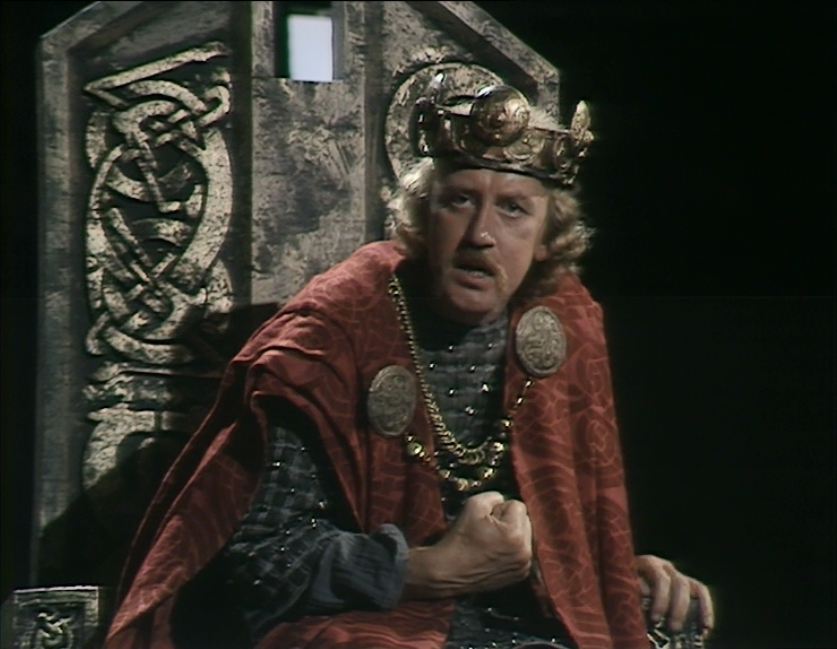
Alan Howard makes a point. The people of Rome ain't pleased with it.

Cast: Alan Howard (Coriolanus), Joss Ackland (Menenius), Irene Worth (Volumnia), Joanna McCallum (Virgilia), Mike Gwilym (Aufidius), John Burgess (Sicinius), Anthony Pedley (Junius Brutus), Patrick Godfrey (Cominius), Heather Canning (Valeria), John Rowe (Senator), Valentine Dyall (Adrian), Peter Sands (Titus Lartius), Nicholas Amer (Aedile), Paul Jesson (First Citizen), Ray Roberts (Second Citizen), Leon Lissek (Third Citizen), Jon Rumney (Fourth Citizen), Russell Kilmister (Fifth Citizen)
Director: Elijah Moshinsky

For a long time, I would have said the existence of this production helped justify the very existence of the BBC Shakespeare series. Not so much due to the quality of the production itself (although that is largely high) but because I felt it was so unlikely anyone would ever consider making a film of a play that deals with such heavyweight political themes and has a central character who, for large chunks of the action, is essentially a bit of a dick and an advocate of, at best, paternalistic, elitist government. But now – after first Ralph Fiennes’ excellent Bosnian-set film and Tom Hiddleston’s sell-out run in the West End and on National Theatre Live, I wonder if we are perhaps on the crest of a wave with this play. Its ideas of the mob being easily swayed by demagogues and encouraged to blame selected figures (Volsces! Senators! Caius Martius himself!) may be about to come into its own.

Well be that as it may, this production by itself not only makes a strong case for the series, it’s also in a way quite a milestone. Firstly, perhaps because there was more freedom with such a little known work (not many schools in the American mid-West trawling through Coriolanus), Moshinsky actually makes some pretty major cuts to the play here – I would say at least 40 minutes minimum of stage time has been hacked out. In addition, scenes have been re-arranged, split up, combined, lines reassigned to different characters – try following along with a script, it’s tricky. None of these feel like cuts “for the sake of it” – they tighten and streamline the action. For example, in one clever cut in A5 the dialogue is rearranged so we see the Menenius’ reaction to his failed mission to Coriolanus before we see Volmunia’s successful one, not after as in the script. This makes the build-up to Volumnia’s mission more daunting and emphasises Coriolanus’ coldness – making the character reversal in A5 S3 more effective. The script is full of clever little rearrangements like this.

This helps Moshinsky to create a production that actually feels like it has something to say about the play. The cuts, rearrangements and tightening bring the focus very closely into a claustrophobic character study in a hot, troubled Rome. The focus is also very firmly placed on Coriolanus himself, a character study of this confused and confusing man, a cocktail of split impulses, unable to find his place in society outside of his martial role. The heat of the city – bees are heard buzzing on the soundtrack, and sweat tickles brows in close-up – is matched by the homoerotic tension Moshinsky stresses (perhaps a bit too thickly) between Coriolanus and Aufidius – these two men of action, seemingly unable to understand or relate to much else in their world, finding a sensuous fascination in each other’s temperaments and bodies. But more of that later.

The set design and lighting Moshinsky has chosen for the production also serve this mood, Rome being a sparsley furnished, sandy coloured, overbearing metropolis of narrow streets and featureless walls, as if the whole place was some sort of elaborate prison or rat cage. He lights it throughout with strong strips of Caravaggio lighting, throwing a few areas into light and others into a semi-darkness. Through this, the small strips of colour on the otherwise predominately black and white costumes (carried over from the Miller house style for the series) stand out strikingly. Several scenes bring to mind Caravaggio – I was reminded in particular of The Calling of St. Matthew (where the design for Rome – right down to a window that views out into nothing – seems to be identical) but also The Taking of Christ for the way the light is used to catch the armour and with the vibrancy of the crowd scenes.

The Rome that Moshinsky sets his play in is a world of windowless rooms – the only ones are seen in the streets overlooking the square where Coriolanus fails to hide his contempt for the people, while making cursory efforts to appeal for their votes. A nice touch as well – that I didn’t notice at first – is that a virtue is made of the studio location by omitting any shots of a sky or skyscape – buildings just seem to stretch up, horizons are dim without being seen, rooms have higher ceilings. No where seems warm or friendly, everywhere is efficient, distant and cold – even Coriolanus’ home has an austerity to it. This then allows the crowd themselves in many places to create the city – and in several cases this works really effectively, as the crowds move as one disorganised mass, pressing in the directions they have been pushed towards, or starring impassively and unmovingly at the camera while the arguments of those they disagree with are presented.

Alongside this, Moshinsky throws in plenty of stylistic flourishes. The battle scenes in particular in A2 are deliberately reduced to a stylised series of clashes, largely with no soundtrack other than some suitably martial music, as soldiers move forward under Coriolanus’ direction. The soldiers armour is presented to give them an impersonal machine like quality, moving grimly forward to victory. Coriolanus’ thoughts intrude at times over the action, with some speeches and soliloquies moved to voiceover while the camera holds on his face. Music is also used effectively in the production, a percussive, low beat helping to bring everything into a tight, claustrophobic focus on Coriolanus himself, who is often placed in close-up.

At the centre of this character study of a production is Alan Howard’s domineering Coriolanus. Howard was one of the leading classical actors of the time, though his lack of interest in film and television has meant he remains less well known than many of his contemporaries. However, he was in many ways a perfect choice for Coriolanus – a part he had already played to great success on stage. It plays well to Howard’s coolness as a performer and makes great use of his arch, patrician, almost cruel voice with its studied, slightly sinister pronunciation. His face seems to constantly wear a scornful sneer – introduced from the off in A1 S1 as he confronts the citizens of Rome – although what is great is that Howard suggests Coriolanus simply can’t understand or relate to people – in A2 S1 he seems a little lost and awkward as he heads through a crowd of cheering citizens. This is accentuated in A2 S3 where the great soldier skulks awkwardly around fountain, nervously approaching the citizens to ask if he can count on their vote – barely able to restrain his self-loathing at asking for favours, unable to picture himself as one of the many representatives of the human race.

It’s this little tinge of weakness, nerves and immaturity that Howard trickles in that makes the final scenes work well – his Coriolanus is essentially a slightly spoiled kid, whose emotional maturity has been stunted at a very early age – he may have a wife and child but it’s almost impossible to imagine that he could have done something as normal as having sex. His natural defence seems to be to lash out – the comfort we see in his manner and form when raging at the tribunes in A3 S1, contrasted with his shame when forced to make an apology he does not feel in A3 S2. A man who it seems who has had his mother drum into him from an early age that he is special – is it any wonder that he sees the ‘normal’ interaction of Roman politics as beneath him, that indeed he sees the rest of the city’s population as less deserving or worthy than himself? Is it any wonder that he explodes in rage when banished, that he takes a glee in burning his bridges?

What’s interesting about the performance is the way Coriolanus constantly seems to be wrestling with these dual natures in her personality – the warrior (and Howard always seems to be fiddling with a sword until the final Act) and the family man. Moshinsky camera literally places Howard centre stage in close up for many of the major speeches – most impressively after this furious denunciation of the Roman citizens, when the camera pans back from close up to reveal Howard standing in isolation, stunned Romans looking on. After the banishment, Howard’s hollow eyes constantly suggest a man acting against his own principles – his refusal to look at Menenius during A5 indicating he is aware of this weakness – which his teary eyed, voice cracked “Mother, what have you done” when succumbing to Volumnia’s pleas later in A5 finally brings to the surface.

Howard’s performance is not perfect – he’s a little too stagy as an actor, the camera’s close-ups liable to make his facial acting turn a little too far towards gurning, his intensity as a performer sometimes too much on the small screen. The realities of television viewing also work against him – a scene when he leans against a wall admiring his blood covered blade is the sort of visual that would look terrific from the Grand Circle, but looks campy and ridiculous in semi close-up. His voice sounds just a fraction too sinister and scornful at times. He never really looks like the great warrior he must be (times have changed – the muscle we expect actors to put on for this sort of role now would amaze TV execs of this series).

It’s the elite quality about Coriolanus – his inability to really see anyone as an equal – that Moshinsky is most interested in exploring. Mike Gwilym’s surly Aufidius is presented as sort of mirror-image – a man with more ability for ‘playing the game’ but who also sees himself as ‘more than’ his fellow Volscians, who sees the fate of the city to a certain extent tied up with his own destiny. The method that Moshinsky uses to explore this contrast between the two is bring a concentrated sexual subtext between the two straight to the surface. These two macho warriors are engrossed in each other, hardly able to take their eyes off each other – even their fights are near-naked wrestling matches. When meeting after Coriolanus’ banishment, Aufidius wraps his arms around him tenderly while Coriolanus retells the story of his banishment, both of them in a slight state of undress. This is only a more tender version of their fight earlier in A2 - here a near nude, sweaty scrap, which quickly becomes a physical wrestling match, both actors panting and grappling each other in an intimate clash of bodies.

Even their final confrontation is recast as a near sexual climax. Reworking the scene from the play, here Aufidius personally murders Coriolanus, with Coriolanus himself egging him on, staring into his eyes while chanting a mantra of “kill, kill, kill” slowly taken up by Aufidius as he brings Coriolanus close to him, stabbing him silently with a sword, while Coriolanus holds his gaze, silently accepting this fatal penetration. To be entirely honest, the issue is brought a little too heavily to the fore (although there is tonnes of textual justification for such a theory) but it does make for some drama – and reinforces the very martial world (and cast of mind) of the lead character, who sees the world as one that should be governed solely by similarly strong men. No wonder that the only man who may be an equal to him is the only other character in the play to spark his interest.
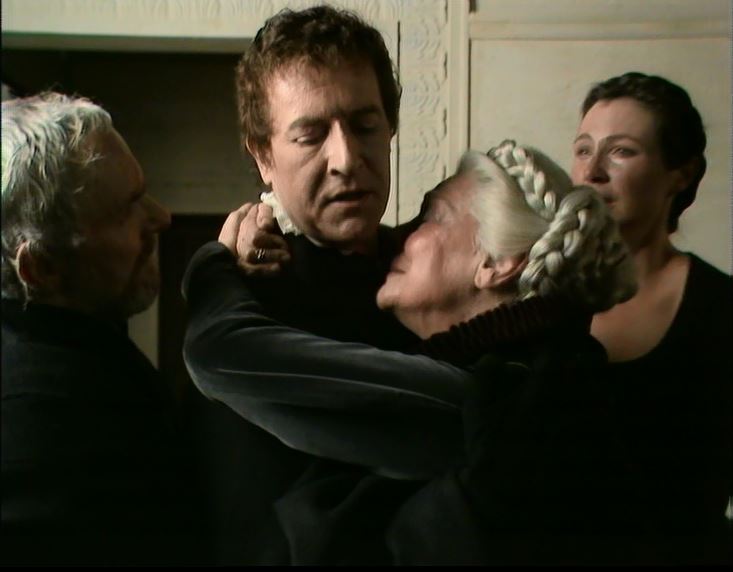
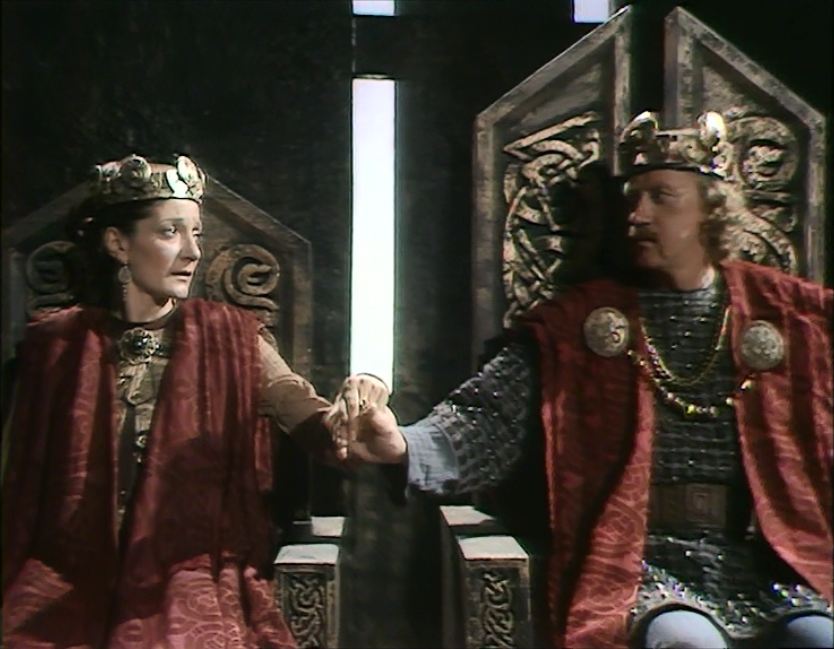
By comparison the women of the play get rather shorter shrift in this version. Virgilia is as demure and timid as you might expect – and Coriolanus treats her more like a sister than a wife. Irene Worth’s full throttle Volumnia is a little too much for my taste and I found her relationship with Coriolanus is not really given the time in the production to really invest the audience in it. Similarly to Aufidius, as a character she is used to demonstrate elements of Coriolanus’ character rather than as a character herself per se (namely to show us the juvenile, little boy lost quality of Coriolanus bubbling just under the surface – his eternal “mummy’s boy” nature, always kow-towing to the only woman who ever controlled him). Worth’s performance brings that force and passion but I found the decisions taken to play her were, bizarrely, so close to Howard’s performance that it was almost too much. As a result I found the scene where she turns Coriolanus away from Rome in A5 – usually the highpoint of the production – actually rather monotonous. Probably not helped by the fact that Moshinsky’s interest is clearly with the Coriolanus/Aufidius relationship rather than the (more central in the text) Coriolanus/Volumnia relationship (Aufidius is even present during this scene and cut-to on several occasions). This key relationship is presented as a result far more perfunctionally and traditionally.

For the other performances, Joss Ackland is a terrific Menenius, playing as a bluff old politician comfortable enough to talk the talk with commoners, while always remaining a member of the ruling class, like some sort of Roman Ken Clarke. His affection for Coriolanus (his wet eyed reaction to the banishment feels very sweet) never blinds him to the realities of politics – and also gives a cocky self assurance that he can guide and mentor his wayward pupil. Old stagers Anthony Pedley and Paul Jesson do their usual excellent work. Patrick Godfrey makes a lot of the expanded role of Cominius, a patrician mediocrity. The actors assigned to the roles of the citizens and senators really bring to life their community and social class.

So this is a very well done, with at times rather over-interpreted production that uses some real design strengths of the series to present a visually striking version of Rome. Despite its flaws, I have a real fondness for this production, which has a level of interpretation to it that is unusual for the series – and actually very refreshing. It’s great to see the series have the courage to allow its more talented directors to make these productions their own interpretations rather than by-the-numbers walk-throughs. More like this please from the rest of the series!

Conclusion
An impressive piece of film making, with plenty of flourishes, lots of interpretation from Moshinsky, whose visual sense is as strong as ever and a strong performance from Alan Howard anchoring the production. However, it’s sometimes a little too heavy handed, both in performance and in the interpretation placed on the production, with Moshinsky’s textual interpretation of the Coriolanus/Aufidius relationship shoved a little too much towards the fore. Despite that though, this is certainly one of the strongest (and most interesting) films in the series.


NEXT TIME: Into the final series of the BBC Shakespeare as Leonard Rossiter presents the weasley King John.

Tuesday, 16 February 2016

Macbeth (Season 6, Episode 2)

First transmitted 5th November 1983

Nicol Williamson and Jane Lapotaire go about the murdering of sleep

Cast: Nicol Williamson (Macbeth), Jane Lapotaire (Lady Macbeth), Tony Doyle (Macduff), James Hazeldine (Malcolm), Ian Hogg (Banquo), Mark Dignam (Duncan), John Rowe (Lennox), Gawn Grainger (Ross), David Lyon (Angus), James Bolam (Porter), Jill Baker (Lady Macduff), Brenda Bruce (First Witch), Eileen Way (Second Witch), Anne Dyson (Third Witch), John Woodnutt (Doctor)
Director: Jack Gold

It’s the nature of the slightly slap-dash planning of this series that, as we reach the final 10 or so films, the series has already covered most of the true classics of the cannon and is largely left with the Shakespearean equivalent of a few minnows. One of the few tent poles left is of course The Scottish Play, here finally working its way onto screen. This was hardly an unknown play to the viewing public, as the murderous Thane had already been brought to the screen several times, both on film and TV. Combine that with an unending parade of productions on the stage and so many schooldays memories, there can’t have been many people who didn’t already feel themselves familiar with this notoriously unlucky work.

Which is just as well really, as there is very little here that will add to anyone’s visual memory of the play. In fact it seems almost a crying shame that there wasn’t a more inventive production of this play, taking advantage of some of the more daring work that had come before. Of course, like Cymbeline, maybe this one just fades compared to the daring brilliance of Jane Howell’s Henriad but this is a rather flat and (whisper it) dull production of a play that is all about relentless momentum punctured by moments of introspection.

In fact it seems like a call back to the early days of the series, before the Miller influence. Where better to set a play set in a Dark Ages Scotland, but Dark Ages Scotland. The inventive playing with form and locations that Jonathan Miller used so well in, for example Antony and Cleopatra, is replaced with a straight placing of the play in its Braveheart style location. Layer on top of that the simple fact that few things look as dated to our 21st-century eyes than a load of actors with big wigs and rough clothing trying to give us the impression of olden times. Throw in the low budget cyclorama backcloth and some unconvincing grassy knolls and you end up with a production that visually looks every inch of its 32 years of age, in a way none of the productions perhaps since Henry V have done.

Actually that is quite a major problem I had with this production. If you are going down the ultra-traditional route, then that needs to be reflected in your casting. Here the cast are uniformly, despite their tough costuming and dark ages chic, a collection of RSC stalwarts who look and sound like they have stepped straight from an elocution class into the fray of battle. Not one of them convinces as a warrior or soldier, fatally crippling (for me) the concept below the waterline. In name only does this feel like a warrior culture, or a society brimming with barely concealed violence: aside perhaps from Nicol Williamson in places, the rest of them seem overwhelmingly well mannered and (how else can I put it?) English. For a play that has embraced the Scottish setting so vividly, there isn’t a single damn earthy Scotsman in it. It’s a patrician feeling show, like watching members of the Raj stage a little production of the piece.

Which is a shame as there are some good ideas here, and Jack Gold clearly wants to tackle some of them head-on. Gold stresses the psychology of the play. In this he is helped enomously by Nicol Williamson’s trademark intensity. Once described as an actor who all but physically attacked the text until it revealed its secrets, Williamson goes at it here, his intense and visceral performance really pushing the idea of a Thane who was (to be honest) already suffering from some real issues, even before the witches pop up (in a lovely touch there is a hint of sadness in his voice when the witches disappear in A1 S3). What is a particularly nice touch in this performance is that Williamson’s Macbeth actually gives the impression of being an almost gentle soul at first, out of his depth in world affairs and meekly dependent on his wife and his friends, often nervously fiddling with his hands. (Hands are a slight motif in this production, with the camera focusing at points on hands before the actions they commit. For example, the camera follows Lady Macbeth and Macbeth into the dining room to greet Duncan, the camera zooming in on their hands then past them into Duncan. Even this, though, is a rather obvious choice for a play famous for hand washing and wringing from its female lead).

The shock of committing murder almost makes Macbeth catatonic at first. However, when he discovers the capability for wickedness within himself, then it’s a slow spiral of Macbeth nudging himself a step at a time to see how far he will go – reluctance and even anxious timidity when planning Duncan’s death give way to a real adamantine quality when planning the murder of the Macduffs. By the end he’s left hollowed out, almost darkly amused by the attack on his castle and the efforts of so many to kill him. It’s a fine performance that brings the largest degree of interpretative originality to the production.

Gold internalises a lot of this as well by making the majority of the supernatural elements things that Macbeth sees but we do not – so no Banquo’s ghost, no shimmering dagger, no image of spirits telling Macbeth of the future to come. Instead for each of these the camera trains in largely on Macbeth’s face. This is most effective in his second scene with the witches. Crouched under a stone altar in the wilderness, with his head above a steaming cauldron with the camera tight on Williamson’s face it’s unclear whether he is reacting to something out of shot – or whether the witches are simply getting him high on whatever is in that cauldron. When Banquo’s ghost comes a calling, the camera tracks back to give us part of the same view as the other lords in attendance have of Macbeth’s unsettling reaction to what – to us as well – is little more than an empty chair.

The focus on the psychology extends just as swiftly to Lady Macbeth. Jane Lapotaire’s reading is from the start overtly sexual – it’s very clear what sort of power she can exert over Macbeth from the start – and her cry to be “unsexed” is effectively portrayed by an orgasmic writhing on a bed, the camera positioned above her, Lapotaire directly addressing it, as if inviting us (as well as the devil) to join her. This works quite nicely for positioning Lady Macbeth as initially the person more in touch with an understanding of the world and what needs to be done – and also allows Williamson’s Macbeth to be part pupil, part horny shy teenager around her. Her sharp, domineering presence drives the remainder of the first part of the play. It’s an absence that is then sorely missed later on.

The energy she beings effectively start to drop off in the remaining part of the action, as the consequences of events begin to take effect. Suddenly from the coronation onwards she is a startled, anxious woman – clearly already aware that Macbeth’s heart has grown cold and hard. She is a woman now without a pace, who has lost the position she had to attain an empty prize. The sleepwalking scene after that is a formality – she’s dead already by this point, a frightened and startled woman openly scared of the man her actions have helped to create.

Well she might be, as this is a world of violence. The murderers set upon Banquo with a gusto, frantically stabbing him in a carefully concealed ambush, all sense of hesitation and doubt excised. In a nice touch, they themselves are then swiftly dispatched by a psychopathic Seyton, here introduced as the third murderer. Seyton then takes the lead in the slaughter of the Macduff children in one of the production’s most effective scenes. In a parody of a child’s game, the kid is pushed from killer to killer, confused and disorientated, until finally lifted of the ground and thrown onto Seyton’s waiting sword (needless to say this is all watched by a distraught Lady Macduff). After this the final battle seems quite restrained: Macbeth at first can barely contain his amusement at the idea that death might wait at the end of Siward’s sword, before fear and eventual defiance in the face of the raging Macduff.

The production also successfully establishes the idea that everyone watches everyone else. When Malcolm is proclaimed Thane of Cumberland, the camera focuses on each Thane in turn – all of them staring unsmilingly at Malcom. Is it any wonder he sees evil in men’s smiles? No surprise that an armed guard searches Macduff on arrival in England. Or that, after being proclaimed as King, Malcolm stares with nervousness with the rest of the assembled lords as Fleance walks forward to collect the crown. Again the camera cuts to each Thane in turn as their blank, unclear faces stare at him. Are they wondering if he will seize the crown? Are they pondering following him? Will the cycle start again? All options are open in this production.

So there is a lot of promising material here. It’s just a shame that it never really makes much of an impression on the viewer, and never really feels like it is breaking new ground in the way some of these other productions have done so. Nicely done as it is, it’s hardly unique to suggest the Scotland of the play is a land destined to have the witches continually drive it towards destruction (in this production they pop up at brief moments, but never in a sustained enough way to suggest a deliberate design decision). A large part of the lack of impact is linked to the supporting cast. Many of the parts in Macbeth are rather ill defined on paper, so rely on strong performances to create individual characters. This production though largely fails to deliver that – I can’t think of a single supporting performance that really lingers in the mind. Others, like Tony Doyle’s Macduff, are simply overdone. I can’t even picture Ian Hogg’s Banquo, which is itself an indictment. The production just never really comes alive at any point. Simply put I don’t care.

So what have you really got with this production? Some decent ideas, some good uses of the tricks of television (particularly with music, which it probably uses more effectively than others of the series). There are two decent performances in the lead roles, in particular Jane Lapotaire’s sensitive Lady Macbeth. But what this really is a perfectly serviceable, rather safe and traditional production of Macbeth, no different than a hundred other stage performances before it. You’ll get more or less what you expected when you opened the tin – and I can’t remember a production delivering so little in terms of imagination of a major work in this series since Hamlet.

Conclusion
Not exactly a disappointment, but also not a success. Nicol Williamson plays the Thane of gusto, Jane Lapotaire is terrific as the wife, there are a few flashes of interest but this production plays it overwhelmingly safe and, as a result, only really succeeds in making something incredibly bland and unexciting. Bearing in mind it was screened four years after the Ian McKellen/Judi Dench Macbeth, and that productions by Orson Welles and Roman Polanski were already in existence at the time, it’s hard to imagine this even getting in a top ten of on-screen Macbeth adaptations today, let alone anywhere near a top ten of this series. Not the worst, not the best, just a bit meh.


NEXT TIME: The Who’s Roger Daltrey gets tackled up in The Comedy of Errors. Yes you read that right.

Saturday, 9 November 2013

Henry VIII (Series 1 Episode 6)

First Transmitted 25th February 1979

John Stride brings the Merry Monarch to life despite the best efforts of Shakespeare

 
Cast: John Stride (Henry VIII), Timothy West (Cardinal Wolsey), Claire Bloom (Katherine of Aragon), Ronald Pickup (Thomas Cranmer), Barbara Kellerman (Anne Bullen), Julian Glover (Duke of Buckingham), Peter Vaughan (Bishop Gardiner), Jeremy Kemp (Duke of Norfolk), Lewis Fiander (Duke of Suffolk), John Rowe (Thomas Cromwell), John Bailey (Griffith), John Nettleton (Lord Chamberlain), Nigel Lambert (Sir Thomas Lovell), David Rintoul (Lord Abergavenny), Oliver Cotton (Earl of Surrey), John Rhys-Davies (Capucius), John Cater (First Gentlemen), Roger Lloyd-Pack (Second Gentlemen)
Director: Kevin Billington
 
Everyone seems to believe that Shakespeare wrote a play about Henry VIII, but there are very few people who seem to have read, let alone seen, the play – including me. Its plot and themes were a total mystery to me so, for the first time this series, I sat down to see a play for the first time rather than watch an interpretation of something I was already familiar with. Which makes a change from Measure for Measure which, if anything, I knew too well going into it!
 
The play itself is an unusual one. For a start, it is matter of debate about who actually wrote it (no not that stupid Oxford debate!). The play is believed to be a collaboration between John Fletcher and Shakespeare (which means Fletcher’s agents should probably have words with the BBC), with Shakespeare usually given credit for the start of the play, the second half of Act 2 and parts of Act 3 and 5. Which probably means it is more a Fletcher play than Shakespeare, though some argue Fletcher was touching up Shakespeare’s work (notably scholars link most of the good bits with Shakespeare working with Fletcher and the duller parts as Fletcher alone. Make of that what you will). Anyway, I’ll call the author Fletchspeare here to make it easy.
 
Written either at the end of, or shortly after, the reign of Elizabeth I, the play offers what we would call today a “sanitised” version of one of the most turbulent few years of British history. In this play, Henry is not to blame for: his divorce (instigated by Wolsey), the execution of any of his lords (who turn on each other) or his relationship with Anne Boleyn (which happens mostly off-stage). The Reformation is barely mentioned, though there are dark murmurings of “Popish” corruption around Wolsey and Cranmer is accused of heresy.


Katherine of Aragon and Anne Boleyn are both presented sympathetically as loyal and faithful subjects (quite a coup!). Lords conspire against each other but only Wolsey and Gardiner are really guilty of anything. The later execution of many of the key figures in the play goes unmentioned and unhinted at. Fletchspeare is very much aware they were writing about very recent history to be presented to descendants and relatives of the featured players. This was not the time for comments as critical of historical figures as are found in the other history plays.
 
 
What an almost totally unknown play does though is to give a director and production team a clean slate – no worries about people having their perceptions shaped by other productions. Filmed entirely on location, including Hever Castle, Leeds Castle and Penhurst Castle, many of which were directly linked to (or the actual locations of) the action in the play. In comparison to the ghastly As You Like It, here the location shooting is expertly managed and of the highest possible quality, with the camera work and editing complementing the performances to create a world of courtly intrigue and clashing egos. Lords prowl down corridors and congregate in corners to whisper bitterness and conspiracy, the camera catching their breath forming in clouds from their mouths.
 
Extensive thought has clearly gone into framing and camera movements, with lower angles and wider lenses in the court room scenes allowing the full impact of these Tudor rooms to be felt on camera. By making such smart work of the location shooting, the pageantry of the play largely takes care of itself, allowing Billington to push front and centre the political machinations that fill the play. And he’s right to stress the acting, because this has one of the finest casts in the series.
 
In many ways, John Stride has the least interesting of the three lead roles. Compared to what we have seen in other versions of this story, the play presents Henry very much as he would have wished to be seen – a bluff, charming man quick to anger and to forgive with a keen sense of loyalty and justice. Stride brings this Holbein element of Henry very well to the screen but also laces his interpretation with subtle shades of a darker personality. At first Henry seems a dupe, willingly believing Wolsey’s plots. However, it becomes clear he is a ruthless man not wishing to appear ruthless – careful cuts to Henry during the trial scene stress his colder nature. At other points – in particular his treatment of the council and Cranmer in Act 5 – he seems as cool a manipulator as the Duke in Measure for Measure. Stride even works in anger and disappointment at the birth of Elizabeth (definitely not the intention of the play!). It’s a clever, sly interpretation of the part that gives it greater depth than Fletchspeare’s dialogue actually allows.
 
Alongside him, Timothy West’s Wolsey is like a venal company director crossed with an eminence grise, brought low like some shabby Robert Maxwell by a dodgy embezzlement scheme that he clumsily reveals himself. West is an exceptional Shakespearean actor and is on top of his game here. Wolsey, as written, is a small, mean man but West makes him a tragic figure, struggling to control great events but unable eventually to bend them to his will. When his power is broken, West moves through confusion, doubt, concern, fear and acceptance before sharp defiance towards his enemies. His final speeches have a real sense of nobility about them that West is careful not to introduce earlier – his Wolsey is a man that finds inner nobility after the loss of its outer trappings. West was nominated for a BAFTA for his work here and well deserved it.
 
 
Awards should also have found their way to Claire Bloom, who gives a sublime, poetic reading as Katherine of Aragon, a devout and holy woman, dutiful to her King and her people. It is clear why her obvious quality and regal bearing wins such devotees but also why it drives her apart from her husband. But Bloom also lets us see the grieving, sad woman under the surface of the pride, particularly in A4 S4 on her deathbed, weeping at the loss of her child and deeply feeling the pains of her life. The scenes between Wolsey and Katherine – the strongest written characters in the play – sizzle and are clear highlights. You end up wishing Fletchspeare had written a lot more of them.
 
Away from the three leads, there is really not a weak link in the cast. Jeremy Kemp’s Norfolk is a gruff natural number two. Julian Glover’s initially arrogant, impassioned Buckingham becomes a condemned man resigned to his fate. Ronald Pickup’s Cranmer is a wonderful mixture of naivety and cunning. Peter Vaughan’s Gardiner is a serpentine bully, a swaggering power player. Sylvia Coleridge is a delightfully gossipy Old Lady. There are other excellent performances and several actors who fill out smaller parts and would later come to greater prominence – David Troughton, Oliver Cotton, John Rhys-Davies, David Rintoul, Roger Lloyd-Pack – are all excellent.
 
What Billington’s direction does well is subtly present this play as almost a boardroom drama, full of aggressive alpha male shareholders pushing their own agenda. This is particularly clear in the interrogation of Cranmer by the council, but it’s a theme that’s introduced right from the first scene with three lords conspiring in a corner against Wolsey, a visual style that is repeated throughout the play. Wolsey even appears several times at a desk like a Chairman of the Board. Various court officials carry mounds of paper between meetings. Over all this, Henry presides like a majority shareholder, allowing himself to be swayed by others as fits his purposes.
 
Billington also makes extensive use of triangular shot arrangements to visually demonstrate these inward looking, conspiratorial conversations. Characters are frequently framed either between or either side of other characters in close-up (some examples of this are shown below). The use of the gentlemen as a type of chorus on the actions also works very well, with the camera following them via cross cutting and tracking shots, contrasting nicely with the more careful framing of the lords, to help suggest their more common backgrounds.
 
Technically this is certainly the best made of the films so far, with location shooting actually adding to the impact of the story. It’s got some of the best acting of the series and is directed with a great deal of competence (though the move out of the studio setting restricts certain camera moves seen in the best directed of these films Julius Caesar and Romeo and Juliet). In fact the main thing wrong with this is Fletchspeare. There are some fine moments and very good lines, but the play itself is carefully edited, politically-tinged history. It’s a bit like making a film about Margaret Thatcher and never really mentioning the miners’ strike (hang on – Hollywood actually did that!).
 
But then it comes down to what this is. We all know Henry VIII (and several other plays in the canon) have problems in their writing, structure and development. The question here is: does this production rise above the limitations of the source material? And the answer is, in this case, yes it did. It’s a very strong ending to the first series of Shakespeare plays. And it’s probably the best production of this play you are ever going to see (if you ever have a chance to see one).
 
Conclusion
Despite a weaker script, this is a hugely successful production – perhaps one of the best so far in the series – that uses wonderful acting, accomplished technical work and some great acting to create perhaps the only version of this play that will ever be filmed. If the series was for nothing else, it was to bring productions like this to life. And West and Bloom in particular are sensational.
 
NEXT TIME: We’re into series two as Anthony Quayle brings Falstaff to life in Henry IV Part 1, kicking off the first Henriad of the series.