
First transmitted 5th November 1983
 |
Nicol Williamson and Jane Lapotaire go about the murdering of sleep |
Director: Jack Gold

It’s the nature of the slightly slap-dash planning of this
series that, as we reach the final 10 or so films, the series has already
covered most of the true classics of the cannon and is largely left with the
Shakespearean equivalent of a few minnows. One of the few tent poles left is of
course The Scottish Play, here finally working its way onto screen. This was
hardly an unknown play to the viewing public, as the murderous Thane had
already been brought to the screen several times, both on film and TV. Combine
that with an unending parade of productions on the stage and so many schooldays
memories, there can’t have been many people who didn’t already feel themselves
familiar with this notoriously unlucky work.
 Which is just as well really, as there is very little here
that will add to anyone’s visual memory of the play. In fact it seems almost a
crying shame that there wasn’t a more inventive production of this play, taking
advantage of some of the more daring work that had come before. Of course, like
Cymbeline, maybe this one just fades
compared to the daring brilliance of Jane Howell’s Henriad but this is a rather flat and (whisper it) dull production
of a play that is all about relentless momentum punctured by moments of
introspection.

In fact it seems like a call back to the early days of the
series, before the Miller influence. Where better to set a play set in a Dark
Ages Scotland, but Dark Ages Scotland. The inventive playing with form and
locations that Jonathan Miller used so well in, for example Antony and Cleopatra, is replaced with a
straight placing of the play in its Braveheart
style location. Layer on top of that the simple fact that few things look as
dated to our 21st-century eyes than a load of actors with big wigs
and rough clothing trying to give us the impression of olden times. Throw in
the low budget cyclorama backcloth and some unconvincing grassy knolls and you
end up with a production that visually looks every inch of its 32 years of age,
in a way none of the productions perhaps since Henry V have done.
 Actually that is quite a major problem I had with this
production. If you are going down the ultra-traditional route, then that needs
to be reflected in your casting. Here the cast are uniformly, despite their
tough costuming and dark ages chic, a collection of RSC stalwarts who look and
sound like they have stepped straight from an elocution class into the fray of
battle. Not one of them convinces as a warrior or soldier, fatally crippling (for
me) the concept below the waterline. In name only does this feel like a warrior
culture, or a society brimming with barely concealed violence: aside perhaps
from Nicol Williamson in places, the rest of them seem overwhelmingly well
mannered and (how else can I put it?) English. For a play that has embraced the
Scottish setting so vividly, there isn’t a single damn earthy Scotsman in it.
It’s a patrician feeling show, like watching members of the Raj stage a little
production of the piece.
 Which is a shame as there are some good ideas here, and Jack
Gold clearly wants to tackle some of them head-on. Gold stresses the psychology
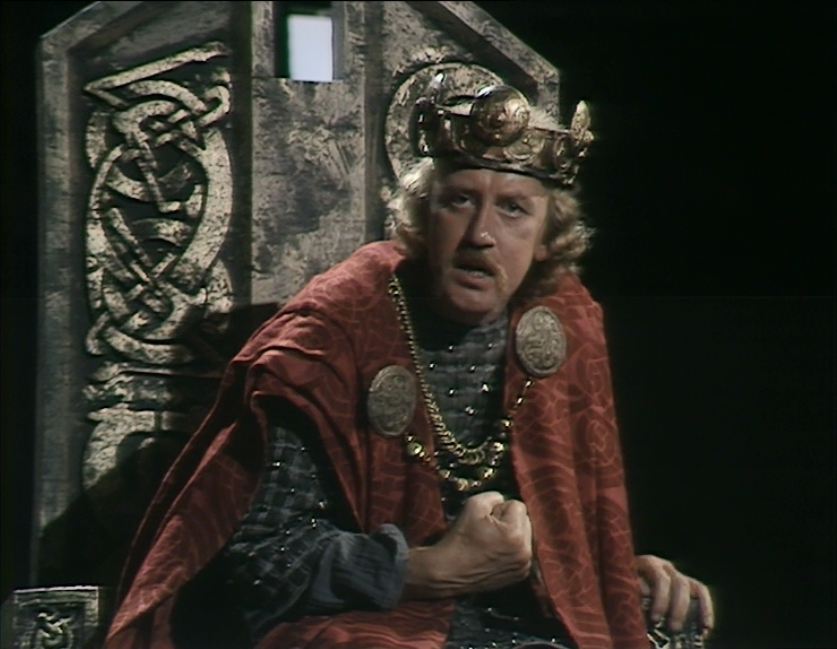
of the play. In this he is helped enomously by Nicol Williamson’s trademark
intensity. Once described as an actor who all but physically attacked the text
until it revealed its secrets, Williamson goes at it here, his intense and
visceral performance really pushing the idea of a Thane who was (to be honest)
already suffering from some real issues, even before the witches pop up (in a
lovely touch there is a hint of sadness in his voice when the witches disappear
in A1 S3). What is a particularly nice touch in this performance is that
Williamson’s Macbeth actually gives the impression of being an almost gentle
soul at first, out of his depth in world affairs and meekly dependent on his
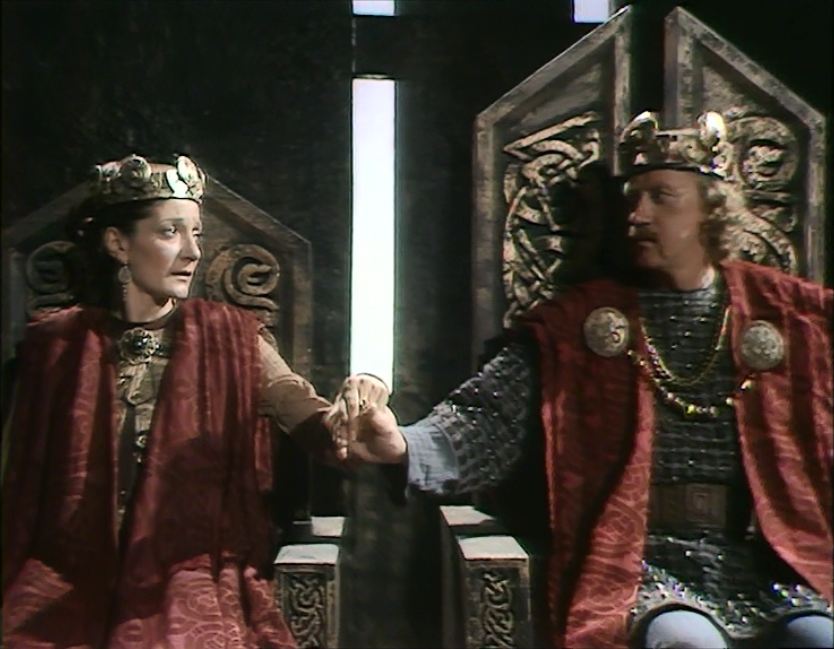
wife and his friends, often nervously fiddling with his hands. (Hands are a
slight motif in this production, with the camera focusing at points on hands
before the actions they commit. For example, the camera follows Lady Macbeth
and Macbeth into the dining room to greet Duncan, the camera zooming in on
their hands then past them into Duncan. Even this, though, is a rather obvious choice
for a play famous for hand washing and wringing from its female lead).
 The shock of committing murder almost makes Macbeth
catatonic at first. However, when he discovers the capability for wickedness
within himself, then it’s a slow spiral of Macbeth nudging himself a step at a
time to see how far he will go – reluctance and even anxious timidity when
planning Duncan’s death give way to a real adamantine quality when planning the
murder of the Macduffs. By the end he’s left hollowed out, almost darkly amused
by the attack on his castle and the efforts of so many to kill him. It’s a fine
performance that brings the largest degree of interpretative originality to the
production.
 Gold internalises a lot of this as well by making the
majority of the supernatural elements things that Macbeth sees but we do not –
so no Banquo’s ghost, no shimmering dagger, no image of spirits telling Macbeth
of the future to come. Instead for each of these the camera trains in largely
on Macbeth’s face. This is most effective in his second scene with the witches.
Crouched under a stone altar in the wilderness, with his head above a steaming
cauldron with the camera tight on Williamson’s face it’s unclear whether he is
reacting to something out of shot – or whether the witches are simply getting
him high on whatever is in that cauldron. When Banquo’s ghost comes a calling,
the camera tracks back to give us part of the same view as the other lords in
attendance have of Macbeth’s unsettling reaction to what – to us as well – is
little more than an empty chair.
 The focus on the psychology extends just as swiftly to Lady
Macbeth. Jane Lapotaire’s reading is from the start overtly sexual – it’s very
clear what sort of power she can exert over Macbeth from the start – and her
cry to be “unsexed” is effectively portrayed by an orgasmic writhing on a bed,
the camera positioned above her, Lapotaire directly addressing it, as if
inviting us (as well as the devil) to join her. This works quite nicely for
positioning Lady Macbeth as initially the person more in touch with an
understanding of the world and what needs to be done – and also allows
Williamson’s Macbeth to be part pupil, part horny shy teenager around her. Her
sharp, domineering presence drives the remainder of the first part of the play.
It’s an absence that is then sorely missed later on.

The energy she beings effectively start to drop off in the
remaining part of the action, as the consequences of events begin to take
effect. Suddenly from the coronation onwards she is a startled, anxious woman –
clearly already aware that Macbeth’s heart has grown cold and hard. She is a
woman now without a pace, who has lost the position she had to attain an empty
prize. The sleepwalking scene after that is a formality – she’s dead already by
this point, a frightened and startled woman openly scared of the man her
actions have helped to create.
 Well she might be, as this is a world of violence. The
murderers set upon Banquo with a gusto, frantically stabbing him in a carefully
concealed ambush, all sense of hesitation and doubt excised. In a nice touch,
they themselves are then swiftly dispatched by a psychopathic Seyton, here
introduced as the third murderer. Seyton then takes the lead in the slaughter
of the Macduff children in one of the production’s most effective scenes. In a
parody of a child’s game, the kid is pushed from killer to killer, confused and
disorientated, until finally lifted of the ground and thrown onto Seyton’s
waiting sword (needless to say this is all watched by a distraught Lady
Macduff). After this the final battle seems quite restrained: Macbeth at first
can barely contain his amusement at the idea that death might wait at the end
of Siward’s sword, before fear and eventual defiance in the face of the raging
Macduff.

The production also successfully establishes the idea that everyone
watches everyone else. When Malcolm is proclaimed Thane of Cumberland, the
camera focuses on each Thane in turn – all of them staring unsmilingly at
Malcom. Is it any wonder he sees evil in men’s smiles? No surprise that an
armed guard searches Macduff on arrival in England. Or that, after being
proclaimed as King, Malcolm stares with nervousness with the rest of the
assembled lords as Fleance walks forward to collect the crown. Again the camera
cuts to each Thane in turn as their blank, unclear faces stare at him. Are they
wondering if he will seize the crown? Are they pondering following him? Will
the cycle start again? All options are open in this production.
 So there is a lot of promising material here. It’s just a
shame that it never really makes much of an impression on the viewer, and never
really feels like it is breaking new ground in the way some of these other
productions have done so. Nicely done as it is, it’s hardly unique to suggest
the Scotland of the play is a land destined to have the witches continually
drive it towards destruction (in this production they pop up at brief moments,
but never in a sustained enough way to suggest a deliberate design decision). A
large part of the lack of impact is linked to the supporting cast. Many of the
parts in Macbeth are rather ill defined on paper, so rely on strong
performances to create individual characters. This production though largely
fails to deliver that – I can’t think of a single supporting performance that
really lingers in the mind. Others, like Tony Doyle’s Macduff, are simply
overdone. I can’t even picture Ian Hogg’s Banquo, which is itself an indictment.
The production just never really comes alive at any point. Simply put I don’t
care.
So what have you really got with this production? Some
decent ideas, some good uses of the tricks of television (particularly with
music, which it probably uses more effectively than others of the series).
There are two decent performances in the lead roles, in particular Jane
Lapotaire’s sensitive Lady Macbeth. But what this really is a perfectly
serviceable, rather safe and traditional production of Macbeth, no different than a hundred other stage performances
before it. You’ll get more or less what you expected when you opened the tin –
and I can’t remember a production delivering so little in terms of imagination
of a major work in this series since Hamlet.
Conclusion

Not exactly a disappointment, but also not a success. Nicol
Williamson plays the Thane of gusto, Jane Lapotaire is terrific as the wife,
there are a few flashes of interest but this production plays it overwhelmingly
safe and, as a result, only really succeeds in making something incredibly
bland and unexciting. Bearing in mind it was screened four years after the Ian
McKellen/Judi Dench Macbeth, and that
productions by Orson Welles and Roman Polanski were already in existence at the
time, it’s hard to imagine this even getting in a top ten of on-screen Macbeth adaptations today, let alone
anywhere near a top ten of this series. Not the worst, not the best, just a bit
meh.
NEXT TIME: The
Who’s Roger Daltrey gets tackled up
in The Comedy of Errors. Yes you read that right.


