Showing posts with label Jack Gold. Show all posts

Tuesday, 16 February 2016

Macbeth (Season 6, Episode 2)

First transmitted 5th November 1983

Nicol Williamson and Jane Lapotaire go about the murdering of sleep

Cast: Nicol Williamson (Macbeth), Jane Lapotaire (Lady Macbeth), Tony Doyle (Macduff), James Hazeldine (Malcolm), Ian Hogg (Banquo), Mark Dignam (Duncan), John Rowe (Lennox), Gawn Grainger (Ross), David Lyon (Angus), James Bolam (Porter), Jill Baker (Lady Macduff), Brenda Bruce (First Witch), Eileen Way (Second Witch), Anne Dyson (Third Witch), John Woodnutt (Doctor)
Director: Jack Gold

It’s the nature of the slightly slap-dash planning of this series that, as we reach the final 10 or so films, the series has already covered most of the true classics of the cannon and is largely left with the Shakespearean equivalent of a few minnows. One of the few tent poles left is of course The Scottish Play, here finally working its way onto screen. This was hardly an unknown play to the viewing public, as the murderous Thane had already been brought to the screen several times, both on film and TV. Combine that with an unending parade of productions on the stage and so many schooldays memories, there can’t have been many people who didn’t already feel themselves familiar with this notoriously unlucky work.

Which is just as well really, as there is very little here that will add to anyone’s visual memory of the play. In fact it seems almost a crying shame that there wasn’t a more inventive production of this play, taking advantage of some of the more daring work that had come before. Of course, like Cymbeline, maybe this one just fades compared to the daring brilliance of Jane Howell’s Henriad but this is a rather flat and (whisper it) dull production of a play that is all about relentless momentum punctured by moments of introspection.

In fact it seems like a call back to the early days of the series, before the Miller influence. Where better to set a play set in a Dark Ages Scotland, but Dark Ages Scotland. The inventive playing with form and locations that Jonathan Miller used so well in, for example Antony and Cleopatra, is replaced with a straight placing of the play in its Braveheart style location. Layer on top of that the simple fact that few things look as dated to our 21st-century eyes than a load of actors with big wigs and rough clothing trying to give us the impression of olden times. Throw in the low budget cyclorama backcloth and some unconvincing grassy knolls and you end up with a production that visually looks every inch of its 32 years of age, in a way none of the productions perhaps since Henry V have done.

Actually that is quite a major problem I had with this production. If you are going down the ultra-traditional route, then that needs to be reflected in your casting. Here the cast are uniformly, despite their tough costuming and dark ages chic, a collection of RSC stalwarts who look and sound like they have stepped straight from an elocution class into the fray of battle. Not one of them convinces as a warrior or soldier, fatally crippling (for me) the concept below the waterline. In name only does this feel like a warrior culture, or a society brimming with barely concealed violence: aside perhaps from Nicol Williamson in places, the rest of them seem overwhelmingly well mannered and (how else can I put it?) English. For a play that has embraced the Scottish setting so vividly, there isn’t a single damn earthy Scotsman in it. It’s a patrician feeling show, like watching members of the Raj stage a little production of the piece.

Which is a shame as there are some good ideas here, and Jack Gold clearly wants to tackle some of them head-on. Gold stresses the psychology of the play. In this he is helped enomously by Nicol Williamson’s trademark intensity. Once described as an actor who all but physically attacked the text until it revealed its secrets, Williamson goes at it here, his intense and visceral performance really pushing the idea of a Thane who was (to be honest) already suffering from some real issues, even before the witches pop up (in a lovely touch there is a hint of sadness in his voice when the witches disappear in A1 S3). What is a particularly nice touch in this performance is that Williamson’s Macbeth actually gives the impression of being an almost gentle soul at first, out of his depth in world affairs and meekly dependent on his wife and his friends, often nervously fiddling with his hands. (Hands are a slight motif in this production, with the camera focusing at points on hands before the actions they commit. For example, the camera follows Lady Macbeth and Macbeth into the dining room to greet Duncan, the camera zooming in on their hands then past them into Duncan. Even this, though, is a rather obvious choice for a play famous for hand washing and wringing from its female lead).
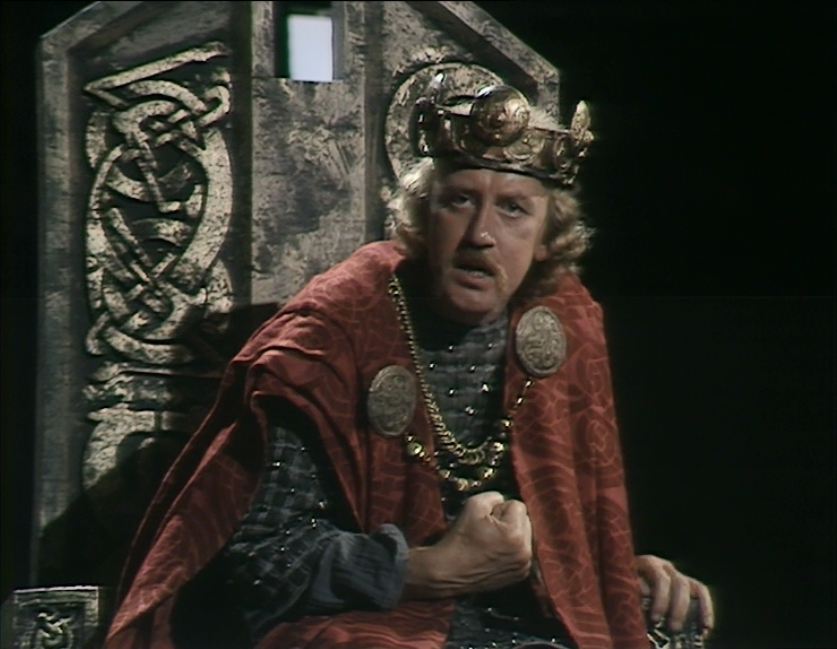
The shock of committing murder almost makes Macbeth catatonic at first. However, when he discovers the capability for wickedness within himself, then it’s a slow spiral of Macbeth nudging himself a step at a time to see how far he will go – reluctance and even anxious timidity when planning Duncan’s death give way to a real adamantine quality when planning the murder of the Macduffs. By the end he’s left hollowed out, almost darkly amused by the attack on his castle and the efforts of so many to kill him. It’s a fine performance that brings the largest degree of interpretative originality to the production.

Gold internalises a lot of this as well by making the majority of the supernatural elements things that Macbeth sees but we do not – so no Banquo’s ghost, no shimmering dagger, no image of spirits telling Macbeth of the future to come. Instead for each of these the camera trains in largely on Macbeth’s face. This is most effective in his second scene with the witches. Crouched under a stone altar in the wilderness, with his head above a steaming cauldron with the camera tight on Williamson’s face it’s unclear whether he is reacting to something out of shot – or whether the witches are simply getting him high on whatever is in that cauldron. When Banquo’s ghost comes a calling, the camera tracks back to give us part of the same view as the other lords in attendance have of Macbeth’s unsettling reaction to what – to us as well – is little more than an empty chair.

The focus on the psychology extends just as swiftly to Lady Macbeth. Jane Lapotaire’s reading is from the start overtly sexual – it’s very clear what sort of power she can exert over Macbeth from the start – and her cry to be “unsexed” is effectively portrayed by an orgasmic writhing on a bed, the camera positioned above her, Lapotaire directly addressing it, as if inviting us (as well as the devil) to join her. This works quite nicely for positioning Lady Macbeth as initially the person more in touch with an understanding of the world and what needs to be done – and also allows Williamson’s Macbeth to be part pupil, part horny shy teenager around her. Her sharp, domineering presence drives the remainder of the first part of the play. It’s an absence that is then sorely missed later on.

The energy she beings effectively start to drop off in the remaining part of the action, as the consequences of events begin to take effect. Suddenly from the coronation onwards she is a startled, anxious woman – clearly already aware that Macbeth’s heart has grown cold and hard. She is a woman now without a pace, who has lost the position she had to attain an empty prize. The sleepwalking scene after that is a formality – she’s dead already by this point, a frightened and startled woman openly scared of the man her actions have helped to create.

Well she might be, as this is a world of violence. The murderers set upon Banquo with a gusto, frantically stabbing him in a carefully concealed ambush, all sense of hesitation and doubt excised. In a nice touch, they themselves are then swiftly dispatched by a psychopathic Seyton, here introduced as the third murderer. Seyton then takes the lead in the slaughter of the Macduff children in one of the production’s most effective scenes. In a parody of a child’s game, the kid is pushed from killer to killer, confused and disorientated, until finally lifted of the ground and thrown onto Seyton’s waiting sword (needless to say this is all watched by a distraught Lady Macduff). After this the final battle seems quite restrained: Macbeth at first can barely contain his amusement at the idea that death might wait at the end of Siward’s sword, before fear and eventual defiance in the face of the raging Macduff.

The production also successfully establishes the idea that everyone watches everyone else. When Malcolm is proclaimed Thane of Cumberland, the camera focuses on each Thane in turn – all of them staring unsmilingly at Malcom. Is it any wonder he sees evil in men’s smiles? No surprise that an armed guard searches Macduff on arrival in England. Or that, after being proclaimed as King, Malcolm stares with nervousness with the rest of the assembled lords as Fleance walks forward to collect the crown. Again the camera cuts to each Thane in turn as their blank, unclear faces stare at him. Are they wondering if he will seize the crown? Are they pondering following him? Will the cycle start again? All options are open in this production.

So there is a lot of promising material here. It’s just a shame that it never really makes much of an impression on the viewer, and never really feels like it is breaking new ground in the way some of these other productions have done so. Nicely done as it is, it’s hardly unique to suggest the Scotland of the play is a land destined to have the witches continually drive it towards destruction (in this production they pop up at brief moments, but never in a sustained enough way to suggest a deliberate design decision). A large part of the lack of impact is linked to the supporting cast. Many of the parts in Macbeth are rather ill defined on paper, so rely on strong performances to create individual characters. This production though largely fails to deliver that – I can’t think of a single supporting performance that really lingers in the mind. Others, like Tony Doyle’s Macduff, are simply overdone. I can’t even picture Ian Hogg’s Banquo, which is itself an indictment. The production just never really comes alive at any point. Simply put I don’t care.
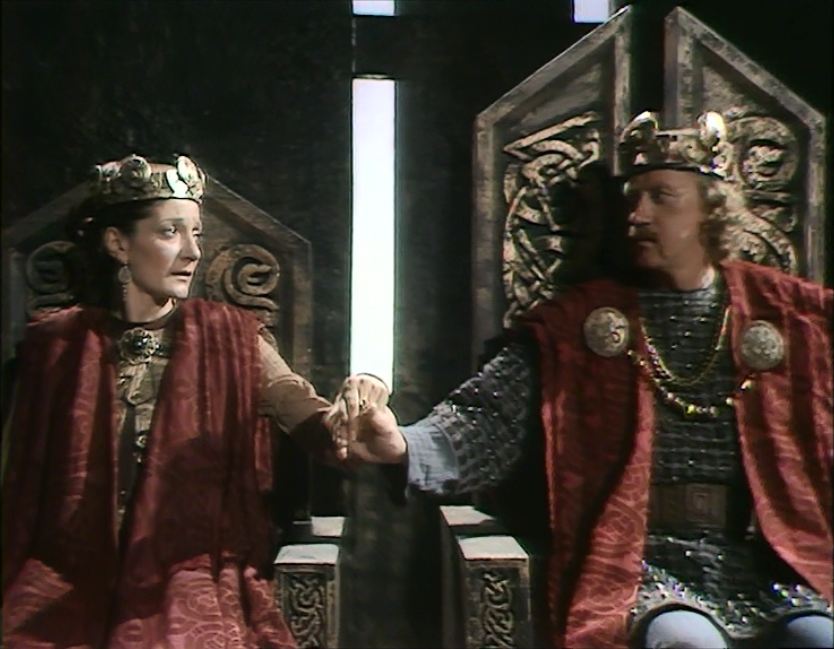
So what have you really got with this production? Some decent ideas, some good uses of the tricks of television (particularly with music, which it probably uses more effectively than others of the series). There are two decent performances in the lead roles, in particular Jane Lapotaire’s sensitive Lady Macbeth. But what this really is a perfectly serviceable, rather safe and traditional production of Macbeth, no different than a hundred other stage performances before it. You’ll get more or less what you expected when you opened the tin – and I can’t remember a production delivering so little in terms of imagination of a major work in this series since Hamlet.

Conclusion
Not exactly a disappointment, but also not a success. Nicol Williamson plays the Thane of gusto, Jane Lapotaire is terrific as the wife, there are a few flashes of interest but this production plays it overwhelmingly safe and, as a result, only really succeeds in making something incredibly bland and unexciting. Bearing in mind it was screened four years after the Ian McKellen/Judi Dench Macbeth, and that productions by Orson Welles and Roman Polanski were already in existence at the time, it’s hard to imagine this even getting in a top ten of on-screen Macbeth adaptations today, let alone anywhere near a top ten of this series. Not the worst, not the best, just a bit meh.


NEXT TIME: The Who’s Roger Daltrey gets tackled up in The Comedy of Errors. Yes you read that right.

Wednesday, 16 April 2014

The Merchant of Venice (Series 3 Episode 2)

First Transmitted 17th December 1980

Warren Mitchell must have a pound of John Franklyn-Robbins' flesh

 Cast: Warren Mitchell (Shylock), Gemma Jones (Portia), John Franklyn-Robbins (Antonio), John Nettles (Bassanio), Susan Jameson (Nerissa), Leslee Udwin (Jessica), Richard Morant (Lorenzo), Kenneth Cranham (Gratiano), John Rhys-Davies (Salerio), Alun David (Solario), Douglas Wilmer (Duke of Venice), Enn Reitel (Laucelot Gobbo), Marc Zubar (Prince of Morocco), Peter Gale (Prince of Arragon), Arnold Diamond (Tubal)
Director: Jack Gold
 
The second production of the Jonathan Miller years is a cold and forensic production of The Merchant of Venice, full of muted colours and distant characters. It’s also a clear continuation of style from Taming of the Shrew – theatrical in design and style and with a clear interpretation of the play at its heart. What it also does well, however, is not to force that interpretation on the viewer.
 
This is despite the fact that it seems fairly clear to me that Jack Gold pretty much dislikes nearly all the characters in the play. All the Christian characters are presented throughout as cold, rather empty individuals, imperious and slightly distant – to the extent that some of them barely exhibit clear characteristics at all. In fact what is striking is what little sense of their personalities you get here. It seems very much a directorial decision to accentuate this part of Shakespeare’s writing.
 
Shylock is such a vibrant, colourful character, capable of both feeling and villainy, that it often seems (particularly today) the Christian characters are comparatively trivial. Certainly the final act of the play, revolving around the exchange of rings and various comic schemes, seems anticlimatic and a dramatic switch in tone from what has come before. Now I think there is complexity behind these characters, but to me this production decides to accentuate this comparative blankness.
 
Shylock is a character who dominates the play and is the one character in the play truly unique to the cannon. It is impossible to imagine Shylock being dropped into any other play without changing the nature of the play itself – it is hard to imagine any other character having that impact. He is so unique – and historical attitudes to Judaism are such a controversial issue – that every production runs the risk of being accused of anti-Semitism if any of Shylock’s many negative elements are portrayed. This production was nearly banned in America – despite the fact that Gold, Miller and Mitchell are all Jewish. Productions can bend over backwards to reposition Shylock as a hero (or anti-hero), a man “more sinned against than sinning”, who only wants to demonstrate the injustice of Venetian society.
 
Such contorted thinking takes us away from what the play is trying to do. Shylock is, really, the villain of the play. Now he’s no Jew of Malta – he’s a regular Joe, trying to keep his head above water, fed up with being treated like filth, who responds to taunts and humiliation with a desire to return it with interest. That’s understandable, but many of the actions are inherently negative – there is a reason why his daughter is so eager to flee him. His driving intention throughout the final acts of the play is essentially to murder Antonio. Pained by the loss of his daughter he takes the (surprise) opportunity of Antonio defaulting on the loan to take revenge on everyone who has wronged him. It’s understandable why he does it – but such murderous glee is hard to sympathise with.
 
Having directed Merchant of Venice in the past, I could go on (at length) about the fascinating nature of this character. But this is about Gold and Mitchell! Warren Mitchell’s performance is most striking in its lack of judgement on this character. His Shylock is more comic than any other performance I’ve seen. Grubby, short and a little unclean Mitchell performance is also intensely Jewish in voice, manner and gesture. Throughout the other characters surround and tower over him. It’s a performance that I think of as being “line-by-line” – Mitchell plays every line as it is and avoids stamping a clear interpretive intention on Shylock – unlike other productions, where every line and action is twisted in order to present a particular idea (usually positive) of the character. There is also a wonderful sense that Shylock plays up his Jewish characteristics when in conversation with the other Venetians in order to unsettle, unnerve or even annoy them – when addressing the camera directly he is notably calmer, stiller and more relaxed.
 
This is also a Shylock who laughs – and a fair bit. The laughter is often artificial – in A1 S3 it’s clearly used as a wheedling, even ingratiating tool – a defence to Antonio to demonstrate that his abuse does not hurt him. The jovial manner is also used as a cover to get pointed sharpness towards the people he is speaking to (he does this in A1 S3 when pointing out Antonio’s hypocrisy in asking for a loan). Laughter is a tool to allow Shylock to convince himself he is in control and, as is clear in A2 S5, to dominate those around him like Gobbo and Jessica (who, despite his concern for her, he is notably distant and self-preoccupied when talking to). Laughter is used again when confronting Salerio and Solanio in A3 S1, where their aggressive (and openly racist) bullying is met with Shylock laughing along in an almost manic way before flinging his famous “Hath not a Jew” speech with an increasingly pained, revengeful fury back at them.
 
Which brings us to the trial scene – always destined to be the centre of attention for any production of Merchant. Mitchell’s Shylock here actively enjoys the position of power he has over the Christians but still with a touch of the comic about him. There are moments of gentleness and a tinge of sadness when remembering his lost daughter, but Shylock’s potential nobility is continuously undercut throughout by his scuttling glee, his obvious delight at the prospect of the act of murder. The court may clearly be rigged – and Douglas Wilmer’ excellent performance of the Duke carries all the weight of a system that won’t allow itself to be seen as fixed even when it so clearly is – but Shylock himself is hardly either completely sympathetic or in any way  particularly noble. He’s a trodden down, trampish man who is given the chance of cocking a snook at his betters.
 
It’s a largely underplayed scene surprisingly – it’s kept low and quiet, perhaps matching Gemma Jones’ cold Portia – and it would be better if there was more sense of community or crowd reaction from the many onlookers of the trial. But its focus on the lead does mean that Shylock’s eventual breaking – his quiet “let me go” is the voice of the eternal victim returned to his victim status – carries a neat emotional force that is reflected later in the play in Antonio’s own isolation. It would be hard to take a sense away of a good man, even while being possible to feel sorry for Shylock. The violence of his forced conversion – and the sudden switch in character to a small man eager to escape as quickly and easily as he can – makes Shylock a tragic figure, even if the victim of self-inflicted wounds.
 
This review has placed a lot of the focus on Shylock, but then I feel this is the intention of the production as well. Shylock’s vibrancy is accentuated by the coolness of everything else. With the set largely made of blues and greys, reflected in the largely muted colours of the costumes and even the paleness of the actors. The artificial setting and backdrop makes Venice seem even more constructed and controlled, with the backsheets used (and so undisguised) keeping the world disconnected and unreal. It’s telling that the Shylock scenes occur in the most ‘realistic’ locations while Portia’s house (the centre of the Christian characters’ world) is the most stylised. Gold’s stylised use of imagery also yields some results through the framing of the Christian characters – particularly in a striking image of the three happy couples at the end, all embracing as if to hammer home their essential uniformity.
 
This distance is seen in the performances as well. Gemma Jones’ Portia is a cold, rather distant figure. She may relax slightly with Susan Jameson’s engaging Nerissa but she is still an unknowable figure, her sharp intelligence and manipulative ability suggesting that she is bound for disappointment in John Nettles’ handsome but empty Bassanio, a man here almost devoid of imagination and wit. Jones’ grand tone works well for the trial scene – and Portia has rarely seemed as cold and unfeeling as she does in parts of this trial scene (although Gold handles the comedic asides with Nerissa during this scene with an assured touch and allows the comedy).
 
John Franklyn-Robbins’ Antonio is a tortured, lonely figure unable to truly relax or relate to people – martyrism at the end is a tempting opportunity to lend his life meaning. Gold plays the homosexual subtext of the relationship between him and Bassanio very openly – though it is suggested that Bassanio is very much aware that affection for Antonio can yield prizes. Franklyn-Robbins brings the age of Antonio out very well, and Gold’s decision to leave him isolated and alone in Portia’s house at the end – lost between two worlds – brings out the bittersweet nature of the ending, also echoed in Jessica’s unease at Shylock’s loss of his land. The final image of Antonio is also striking for the replication it makes of his pose from the very start – the futility of Antonio’s journey and the lack of progression for the character (still in the same place emotionally as he was at the start) has rarely been so well expressed.
 
For the other performances, John Rhys-Davies is a stand out as an energetic Salerio, but others – especially Enn Reitel’s Gobbo – are less successful. Leslee Udwin has her moments as Jessica but the relationship between her and Richard Morant’s Lorenzo is played fairly straight and without complexity.  Kenneth Cranham misses a trick as a slightly under played Gratiano.
 
Gold’s production in a stylised and artificial Venice is an interesting mixture. While in Shylock it is happy to present a nuanced and fairly open view of a character so often twisted into positivity, it then weights the dice slightly by making the other prominent characters considerably colder and less interesting both in contrast to Shylock and to the writing of the original play. While it’s great that this production is confident enough to present its lead as a very shabby figure, it seems a shame that it couldn’t do the same with the others. Gold does use the budget constraints very effectively, and his embracing of a clearly artificial world reminiscent of cool late-Renaissance painting (Titian springs to mind) is a striking continuation of the style Miller had introduced.  But the contrast between the life of the Shylock scenes and the coldness of the Christian scenes is finally too great to keep the audience really engaged in the storylines of a significant number of the cast.
 

Conclusion
Some very good scenes and a fine performance by Warren Mitchell, but the rest of the cast selflessly sacrifice themselves to the conceit of the production. The development of the rest of the characters, except perhaps Antonio, is not revelatory but does draw a clear parallel between Shylock and the rest. It’s not the greatest production of the play that you will ever see but it’s a very intelligent production by a very experienced TV director that uses the constraints of the media to excellent effect. I enjoyed and liked its embracing of stylisation – but it’s too cold a production for it to be anyone’s favourite.