
Julius Caesar
First transmitted 11th February 1979
 |
Richard Pasco, Keith Michell and Charles Gray take us to Ancient Rome for paranoia and murder |
Cast:
Richard Pasco (Brutus), Keith Michell (Mark Antony), Charles Gray (Julius
Caesar), David Collings (Cassius), Virginia McKenna (Portia), Elizabeth Spriggs
(Calphurnia), Garrick Hagon (Octavius Caesar), William Simons (Trebonius), Sam Dastor
(Casca), Alexander Davion (Decius Brutus), Brian Coburn (Messala), Darien
Angadi (Cinna), Andrew Hilton (Lucilius)
Director: Herbert Wise
I
have always had a soft spot for Julius
Caesar. I have also always loved the classic BBC Roman drama series I, Claudius. So I should say that from
the start I was pre-disposed to like an ancient Roman set Shakespeare drama,
directed by the man who made I, Claudius.
But, even despite this, I’ve got to say this is an intelligent, well acted
adaptation of the play, inventively directed and full of a host of good ideas.
Returning to
the studio set from the total failure of location shooting is a massive boon
here. Tony Abbot’s complex Roman forum set feels suitably lived in. Yes if you
want you can pick fault with an (obviously) fake blue sky that is artfully
concealed in the background of several shots (and a matte painting hill), but
remember the constraints of the time. And I would take imaginative direction
and good acting over an expensive location shoot ham-fistedly managed any day.
 Herbert Wise
effectively creates a sense of scale here with a series of effective crane
shots. Right from the start, the camera looms down and into an empty street,
while we hear the chants of “Caesar, Caesar” off screen from the Roman crowds.
It straight away creates an atmosphere, before the screen is populated with a
vibrant crowd scene. These shots are repeated at key moments throughout, always
acting to stress the grandeur of events, most notably in the meeting of the
generals before the final battle.
Herbert Wise
effectively creates a sense of scale here with a series of effective crane
shots. Right from the start, the camera looms down and into an empty street,
while we hear the chants of “Caesar, Caesar” off screen from the Roman crowds.
It straight away creates an atmosphere, before the screen is populated with a
vibrant crowd scene. These shots are repeated at key moments throughout, always
acting to stress the grandeur of events, most notably in the meeting of the
generals before the final battle.  In fact the
camera work throughout is actually rather sophisticated. Long takes never
appear static as a roving camera is used throughout, moving in and around the
characters, prowling behind the actors, making the viewing experience the most
immersive I’ve seen so far in this series. Wise’s camera makes the viewer as
much a conspirator as the senators, joining them in close conversations and
twitchily moving with them, as if under a paranoid scrutiny. Crowd scenes are
shot throughout with an intelligence and dynamism that suggest a far larger
company – Antony’s speech uses the crowd particularly well. A neat trick is
carried out by having the crowds rush to get their revenge for Caesar’s reveal
leaving behind (in a reveal to the audience) the soothsayer staring at Caesar’s
corpse (take a look at the image below to see what I mean). Put your prejudices aside – this is seriously well-made stuff (for the
time). Imagine what could have been done with the budget of The Hollow Crown here. And god almighty
it is such a relief to find something so well made after the disaster of As You Like It.
In fact the
camera work throughout is actually rather sophisticated. Long takes never
appear static as a roving camera is used throughout, moving in and around the
characters, prowling behind the actors, making the viewing experience the most
immersive I’ve seen so far in this series. Wise’s camera makes the viewer as
much a conspirator as the senators, joining them in close conversations and
twitchily moving with them, as if under a paranoid scrutiny. Crowd scenes are
shot throughout with an intelligence and dynamism that suggest a far larger
company – Antony’s speech uses the crowd particularly well. A neat trick is
carried out by having the crowds rush to get their revenge for Caesar’s reveal
leaving behind (in a reveal to the audience) the soothsayer staring at Caesar’s
corpse (take a look at the image below to see what I mean). Put your prejudices aside – this is seriously well-made stuff (for the
time). Imagine what could have been done with the budget of The Hollow Crown here. And god almighty
it is such a relief to find something so well made after the disaster of As You Like It.
 Where Wise
really scores in is that his directorial invention is not just restricted to
the technical. Genuine thought about interpretation and the text seems to have
gone into this, in ways which haven’t really been as apparent in any of the
other productions I’ve seen so far. To Wise this is a paranoid, claustrophobic,
political thriller with a real psychological edge and every directorial
flourish is built around creating this interpretation of the play. This is most
apparent in the decision to have the monologues delivered primarily as
voiceovers, with a roving camera studying the actors intently thinking their
way through the line and thought processes. However, at crucial points the
characters blurt out loud key lines and phrases, as if the thoughts were too
strong for them to keep inside. For instance in A1 S4, Brutus’ speech is all
voiceover, other than the key phase “then lest he may prevent”. In A3 S1
Antony’s self accusation over Caesar’s body is all voiceover bar “Butchers!”
and from “Cry havoc” onwards. It sounds corny when written down, but it not
only shows the intelligence of the characters, it also gives a key
psychological impact to them – it’s the best expression yet I’ve seen of thinking in this series, and the only
real attempt so far to show soliloquies in a cinematic manner.
Where Wise
really scores in is that his directorial invention is not just restricted to
the technical. Genuine thought about interpretation and the text seems to have
gone into this, in ways which haven’t really been as apparent in any of the
other productions I’ve seen so far. To Wise this is a paranoid, claustrophobic,
political thriller with a real psychological edge and every directorial
flourish is built around creating this interpretation of the play. This is most
apparent in the decision to have the monologues delivered primarily as
voiceovers, with a roving camera studying the actors intently thinking their
way through the line and thought processes. However, at crucial points the
characters blurt out loud key lines and phrases, as if the thoughts were too
strong for them to keep inside. For instance in A1 S4, Brutus’ speech is all
voiceover, other than the key phase “then lest he may prevent”. In A3 S1
Antony’s self accusation over Caesar’s body is all voiceover bar “Butchers!”
and from “Cry havoc” onwards. It sounds corny when written down, but it not
only shows the intelligence of the characters, it also gives a key
psychological impact to them – it’s the best expression yet I’ve seen of thinking in this series, and the only
real attempt so far to show soliloquies in a cinematic manner.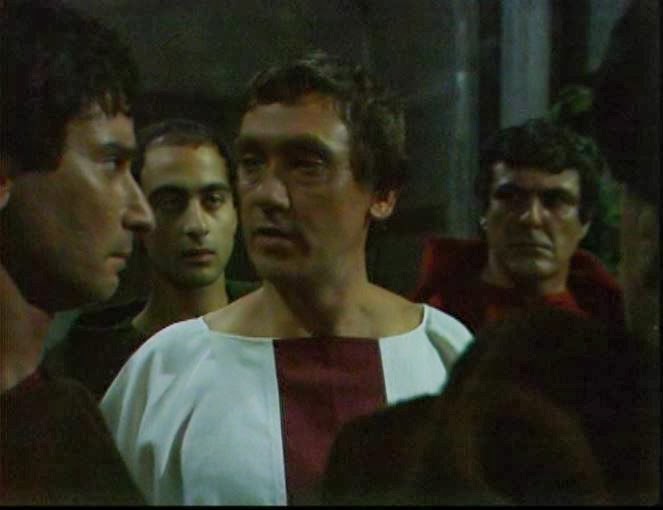 The
characterisation of the conspirators also stresses their ‘public schoolboy’
nature. I really noticed the number of times Brutus refers to his school here –
at least four characters are old school chums. Brutus himself is a patrician
Eton head-boy, totally at ease with his status and expecting respect and
deference from those around him, with Cassius almost like an over-eager
Eton-fag, yearning for approval. Everything about the manner of the
conspirators seems to suggest the simple assurance of men trained to positions,
treating the plebians as people who don’t know what’s best for them. It’s clear
from the start they never think through any of the things they must do to
conduct a successful conspiracy, expecting all to fall into place. These people
just don’t understand in any way ’politics’ in the way that Caesar and Antony
do.
The
characterisation of the conspirators also stresses their ‘public schoolboy’
nature. I really noticed the number of times Brutus refers to his school here –
at least four characters are old school chums. Brutus himself is a patrician
Eton head-boy, totally at ease with his status and expecting respect and
deference from those around him, with Cassius almost like an over-eager
Eton-fag, yearning for approval. Everything about the manner of the
conspirators seems to suggest the simple assurance of men trained to positions,
treating the plebians as people who don’t know what’s best for them. It’s clear
from the start they never think through any of the things they must do to
conduct a successful conspiracy, expecting all to fall into place. These people
just don’t understand in any way ’politics’ in the way that Caesar and Antony
do.  Richard
Pasco’s performance really seizes this interpretation of the conspirators with
a vengeance. His Brutus is a hard man to like, impassive, arrogant and imposing
but crucially not charismatic. He is a man devoid of any doubt once he has made
a decision, he seizes the position of authority in any group as a divine right
– the slightest questioning of him in A4 S2 by Cassius sees him first treat him
like a dismissive older brother and then flip a table over in fury. There is a
strange, unsettling calm about him and a sense of a man unable to truly
understand the situation he is in. He sees himself as a master of events but is
constantly buffeted by them. His appeal to the people is like a top scholar’s
detailed homework and betrays his lack of appeal to those beyond his immediate
contact. It’s a really interesting insight into a man who doesn’t seem to
appreciate and understand anything – an arrogant man reduced in the end to
literally crawling through the dirt asking someone to kill him. He is exactly
the sort of man these posh schoolboys would think should appeal to the people.
Richard Pasco is a little forgotten today, but you can see why he was such a
leading classical actor at the height of his career.
Richard
Pasco’s performance really seizes this interpretation of the conspirators with
a vengeance. His Brutus is a hard man to like, impassive, arrogant and imposing
but crucially not charismatic. He is a man devoid of any doubt once he has made
a decision, he seizes the position of authority in any group as a divine right
– the slightest questioning of him in A4 S2 by Cassius sees him first treat him
like a dismissive older brother and then flip a table over in fury. There is a
strange, unsettling calm about him and a sense of a man unable to truly
understand the situation he is in. He sees himself as a master of events but is
constantly buffeted by them. His appeal to the people is like a top scholar’s
detailed homework and betrays his lack of appeal to those beyond his immediate
contact. It’s a really interesting insight into a man who doesn’t seem to
appreciate and understand anything – an arrogant man reduced in the end to
literally crawling through the dirt asking someone to kill him. He is exactly
the sort of man these posh schoolboys would think should appeal to the people.
Richard Pasco is a little forgotten today, but you can see why he was such a
leading classical actor at the height of his career. It’s fair to
say that the other performances don’t quite come up to his level. Keith Michell
feels a little too old for Antony, and slightly overplays his wilder emotions,
particularly in A3 S2. But he handles the
big speech very well, subtly demonstrating Antony’s feel for politics. Small
moments show him measuring the reaction of the audience and steeling himself to
make the correct intervention at the crucial moment. David Collings’ Cassius veers
a little too close to camp at key moments, particularly in the play’s opening.
What he does do well is demonstrate how unequal the friendship with Brutus is,
that Brutus is far more important to Cassius than vice versa. But although he
delivers a good sense of Cassius’ willing submission to Brutus he doesn’t
manage to make the part as moving as the interpretation suggests it could be.
It’s fair to
say that the other performances don’t quite come up to his level. Keith Michell
feels a little too old for Antony, and slightly overplays his wilder emotions,
particularly in A3 S2. But he handles the
big speech very well, subtly demonstrating Antony’s feel for politics. Small
moments show him measuring the reaction of the audience and steeling himself to
make the correct intervention at the crucial moment. David Collings’ Cassius veers
a little too close to camp at key moments, particularly in the play’s opening.
What he does do well is demonstrate how unequal the friendship with Brutus is,
that Brutus is far more important to Cassius than vice versa. But although he
delivers a good sense of Cassius’ willing submission to Brutus he doesn’t
manage to make the part as moving as the interpretation suggests it could be. A great
success in Richard II, Charles Gray
here is too weak a figure as Caesar. His features and manner suggest a stressed
Baron von Greenback, and there are too many moments of weakness thrown in by
Gray and Wise – this Caesar has a suggestion of an epileptic fit on his first
appearance, trips down the stairs in the background at one point and has a
constant sheen of sweat on his face. With Calphurnia he appears more as a
petulant schoolboy – it all serves to undermine the character a little too much.
Strangely, his strongest moment is his ghostly appearance late in the play. For
the other performances, Elizabeth Spriggs goes well against type as a matronly,
feminine Calphurnia and outshines Virginia McKenna’s high profile but less
interesting Portia. Amongst a host of alumni from I, Claudius, Sam Dastor makes an urbane Casca.
A great
success in Richard II, Charles Gray
here is too weak a figure as Caesar. His features and manner suggest a stressed
Baron von Greenback, and there are too many moments of weakness thrown in by
Gray and Wise – this Caesar has a suggestion of an epileptic fit on his first
appearance, trips down the stairs in the background at one point and has a
constant sheen of sweat on his face. With Calphurnia he appears more as a
petulant schoolboy – it all serves to undermine the character a little too much.
Strangely, his strongest moment is his ghostly appearance late in the play. For
the other performances, Elizabeth Spriggs goes well against type as a matronly,
feminine Calphurnia and outshines Virginia McKenna’s high profile but less
interesting Portia. Amongst a host of alumni from I, Claudius, Sam Dastor makes an urbane Casca. Whatever
small flaws there are in performances here though, each actor really handles
the close-ups very well. The pressure-cooker events are nicely conveyed by the
sweat that seems to be permanently placed on each forehead, as the camera
drills in – at one point right into Cassius’ eyes. Acting without speaking is
also spot-on here – unlike some other moments in these productions, the actors
are clearly measuring and weighing everything being said to them. It’s striking
in A1 S2 how little Brutus speaks, but yet how Pasco is always the focus of the
scene and that the viewer learns more about him than Cassius. In A4 S1 the
tension of the triumvirate is elegantly shown through a series of tight close
ups on frowning, tense faces. Before the final battle, the camera roams around
Brutus’ camp, lingering on the faces of the soldiers and observing a desolate
Cassius who can hardly look at Brutus as he says farewell. The focus is on
character not action – even the death of Caesar happens in the back of the
shot, with Brutus’ guilty face as the audiences’ primary focus.
Whatever
small flaws there are in performances here though, each actor really handles
the close-ups very well. The pressure-cooker events are nicely conveyed by the
sweat that seems to be permanently placed on each forehead, as the camera
drills in – at one point right into Cassius’ eyes. Acting without speaking is
also spot-on here – unlike some other moments in these productions, the actors
are clearly measuring and weighing everything being said to them. It’s striking
in A1 S2 how little Brutus speaks, but yet how Pasco is always the focus of the
scene and that the viewer learns more about him than Cassius. In A4 S1 the
tension of the triumvirate is elegantly shown through a series of tight close
ups on frowning, tense faces. Before the final battle, the camera roams around
Brutus’ camp, lingering on the faces of the soldiers and observing a desolate
Cassius who can hardly look at Brutus as he says farewell. The focus is on
character not action – even the death of Caesar happens in the back of the
shot, with Brutus’ guilty face as the audiences’ primary focus.
It’s
probably clear by now that I enjoyed this production a fair bit. I feel there
is more that I could mention and as I scan through the five pages of notes I
made on this production (the most so far!) I feel sure I missed some things
out. Now I will agree that not everything here is perfect – if you are not
immersed in the budgeted production standards of the time you will see the
obvious sets and dated costumes you expect to see. And yes, the final frenzied
stabbing of Caesar partly happens off camera as the actors (clearly!) are not
actually driving their swords into his body. But, honestly, look past some of
the cheapness and there is some really compelling stuff here. It’s TV with
intelligence but not flashy self-consciousness, and there should always be a
place for that and I think reflects something we’ve lost in this Golden Age of
high production values, brilliantly smart television – that love of something
put together on the cheap but with real imagination, creativity and love. So
god love you Herbert Wise, Richard Pasco and company – you should be proud of
this.
Conclusion
Some truly
intelligent direction delivers, for the first time, an actual interpretation
rather than a straight telling of the play. A terrific performance by Richard
Pasco anchors a production where everyone has their moment to shine. Stuffed
with ideas and creativity, and also with a coherent visual sense and an ability
to offer more than the ‘expected’ shots, this is the best film in the series so
far.
NEXT TIME: Tim Piggot-Smith blackmails
Kate Nelligan to surrender her virginity in Measure
for Measure.


