Showing posts with label Joseph O'Conor. Show all posts

Saturday, 29 August 2015

Henry VI Part 1 (Series 5 Episode 3)

First transmitted 2nd January 1983

Brian Deacon, Bernard Hill, Mark Wing-Davey, David Daker and Paul Chapman choose their favourite flowers. It won't end well.

Cast: John Benfield (Basset/French Sergeant), Peter Benson (Henry VI/Priest), Brenda Blethyn (Joan La Pucelle), Antony Brown (Burgundy), David Burke (Gloucester), Michael Byrne (Alencon), Paul Chapman (Suffolk), Ron Cook (Third Messenger/Porter), Arthur Cox (Mayor/Sir John Fastolfe), David Daker (Reigner/Vernon), Brian Deacon (Somerset), Tenniel Evans (Bedford/Mortimer/French General), Derek Farr (Salisbury/Sir William Lucy), Julia Foster (Margaret), Derek Fuke (Captain/Servant), Alex Guard (Young John Talbot), Bernard Hill (York/Master Gunner), Paul Jesson (Second Messenger), Oengus MacNamara (Messenger/Second Servant), Joanna McCallum (Countess d’Auvergne), Frank Middlemass (Cardinal Beaufort), Joseph O’Conor (Exeter/Shepherd), Trevor Peacock (Sir John Talbot), Brian Protheroe (First Messenger/Bastard of Orleans), David Pugh (Mayor’s Officer/Watchman), Nick Reding (Keeper), Ian Saynor (Dauphin), Mark Wing-Davey (Warwick), Peter Wyatt (Woodville)
Director: Jane Howell

Well cards on the table – I have seen these Henry VI films before. In fact I’ve seen them a couple of times: I even owned them before I purchased this boxset. So I’ve got to say I was already of the opinion that these were some of the finest adaptations of Shakespeare I’ve seen done for television: and re-watching this first episode in the cycle, I’ve not changed my mind. If anything, having seen quite a few of the other films in the cycle, I’m even more impressed with the imagination with which this has been made.

Part of the interest in watching this series has been seeing the slow movement away from the failures of realism towards a more impressionistic style, often more reminiscent of theatre rather than reality. This movement reaches its peak in this second cycle of history plays. I think it’s often fair to say that this is triumphant, because this second cycle of history plays (covering the “minor Henriad” and Richard III) is the most enjoyable, accomplished and impressive production so far, the first to completely successfully marry the joy of live theatre performance with the technical advantages of television to create an experience that could not exist if did not use elements from both.

Most obviously no attempt is made at all to set this play in a real location. Instead the setting is a multi-coloured wooden set, looking rather like an adventure playground, with a raised cyclorama platform and a number of doors and exits around a large courtyard which, with some minor changes, shifts and alters into a variety of different locations but where no attempt is made to suggest that any of them are “real places”, as there were with interior sets in previous history plays. The brightly coloured setting, and the high octane running around and energetic nature of many of the performances is used to brilliantly suggest that this feud between Dukes and Earls is no more than children squabbling over who shall go next on the swings.

Within this setting, the director Jane Howell also chose to avoid the normal televisual convention of one actor for each part. Instead a company of around 30 actors take on all the speaking parts of the cycle, with several taking on multiple roles within this production. What is particularly effective is the intelligent doubling, with actors taking on roles that contrast and comment upon each other. So here we have Bernard Hill playing both York, the man destined to blow the kingdom apart, and the Master Gunner who literally blows up a group of English generals. Joseph O’Conor plays two very different father figures whose advice is rejected by Henry and Joan. Derek Farr’s heroic Salisbury is reincarnated as an honourable but weak Sir William Lucy. This also reflects over multiple productions: Ron Cook, later to play Richard III, appears as a messenger bearing news of doom in France and a hunchbacked porter to the Countess. On top of this the company all do double time as various lords, mourners, courtiers, servants and soldiers in the myriad crowd scenes that fill this production, mixing with an over 20-strong “second ensemble” of extras who play the various French and English soldiers throughout. It’s a brilliant added delight, particularly as each actor so skilfully presents their performances that each character stands alone: Tenniel Evans, in particular, seems markedly different in each of the three roles he plays.

Howell’s direction of Part One uses the high energy of these performers to suggest that this play is positioned at the opening of one long descent into chaos and violence. Notably the first half is surprisingly light and playful, despite the huge numbers of battles. After the opening funeral scene the stage is brightly lit and the costuming chosen is a series of bright primary colours. The battles are represented throughout as almost keystone cops affairs, with actors – their faces plastered with childlike grins – run through doors and up ramps, waving swords and whooping with joy: as if war was all one big game. Which it’s easy to feel like it is within Shakespeare’s play, with the constant fast exchange of French cities, swopping sides as quickly as weathervanes in a strong wind. Even the clashes at courts between gangs of rival factions seem more like playground wrestling matches rather than events where actual killing and murder are not far off.

All this changes in the second half of the production, which is notably much darker visually, with the consequences of these wars starting to become more noticeable. Whereas battles in the first half were largely single take affairs, with crowds of extras running back and forth like balls at a tennis match, these later battles start to witness the cost of war. We see our first lifeless bodies of ordinary soldiers at the start of the act. By the fall of Talbot’s army, the battle is a series of quick cuts each showing some act of violence – bodies stabbed, throats slit, knives plunged into necks – and the pauses in the battle see the stage littered by bloodied dead bodies, with eyes staring sightlessly upwards.  Howell’s point being that this age of chivalry, of war being a great adventure, cannot last in a world where ambition and greed encourages men to be ruthless and uncaring for others. As men like York and Somerset take charge of the kingdom, it means the days of honourable adventurers like Talbot are numbered.
A montage of some of the violent images towards the end of the play
However, Howell also allows a lot of comedy to sit alongside this more serious intent: tellingly this production is far more amusing than any of the comedies made so far in this series. Comic imagery is used throughout to puncture the pretentions of the lords: a feuding Gloucester and Beaufort meet on hobbyhorse back, miming out the actions of riding on horseback, waving their swords at each other (this is also a tour-de-force of physical acting by Burke and Middlemass). The French lords are a collection of comic grotesques, alternately cowardly and argumentative (Michael Byrne stands out as a hilariously camp and prissy Alencon). Antony Brown’s uptight and cultured Burgundy finds himself totally out of place among the forthright English, at one point weakly forced to explain a joke to a bewildered Talbot (in a nice touch in the same scene he sits on a stool while all the English lounge on the floor, drinking from a glass while other swig from flasks). The countess’ attempt to capture Talbot ends in a comic tableaux of swords pointed at the defeated gentlewoman.

This sits beside a great deal of theatrical invention. Those who believe that “filmic technique” is largely a question of alternate head shots and edits rather than camera movements have claimed this is too close to a play. Far from it: Howell’s camera is a roving part of the action, moving in and out of scuffles and tracking key moments. In the courtroom scene of A3 S1, it moves in and among the lords of England, first during the court gathering and then through the manic action as rival factions of Gloucester and Beaufort fight each other in the courtroom. Tableaux are used effectively as well: before his final confrontation, Talbot’s soldiers form themselves into a defensive pyramid of swords with Talbot at the centre. Fast editing is used sparingly but effectively. Scene transitions are also very cleverly done: after meeting with Mortimer, York turns and charges through double doors – to emerge at the English court and in the next scene (Bernard Hill even allows a look of surprise to cross his face, another nice moment of both comedy and fourth wall breaking).

The main effect used for the camera is to use it as an active character and confessional for the actors. As in Howell’s Winter’s Tale production, actors frequently turn and address the camera to deliver their inner thoughts. What’s particularly imaginative about this, as in the previous production, is that this isn’t just used at obvious moments – speeches and asides – but that characters also use it in dialogues with other characters, and at select moments in larger speeches. It seems to work against the “rules” of film, but actually succeeds brilliantly as a bridge between theatre and film, acknowledging the viewer, but keeping us still at a distance. It also allows plenty of additional moments of comedy – particularly in duologues, as one character address the camera while the other stares at them, either confused or annoyed at the indiscretions. This is brought to its height in A5 S2 where Suffolk and Margaret meet for the first time and alternate in their addresses to the camera, moving all the time around each other (at one point side-by-side directing their dialogue into the camera) in a sequence that is both theatrical and filmic.
A range of some of the different camera addresses used in the production
Within such a parade of ensemble acting, all of the very highest standard (there is not a weak link in the cast), there are in this play a few key roles. Brenda Blethyn makes her sole appearance in the trilogy here as Joan of Arc, here imagined as a flirtatious, playful tomboy, a determined chancer who seems to only just be hiding her annoyance and satirical disdain for the French lords around her. Bouncing around with energy, waving her sword and easily besting English soldiers, she’s overflowing with confidence and certainty. Blethyn then contrasts this extremely well with the broken and terrified figure she becomes when “her spirits” abandon her late in the play and she finds herself sentenced to death. From arrogantly rejecting her lowly father, she moves to desperately pleading for mercy from the fire, her frantic cobweb of lies eventually exploding into contempt and fury when the sentence is not revoked. It’s a performance that packs in a great deal of fun and delight, mixed with serious emotion.

For the English, the leading character is Trevor Peacock’s Talbot: a blunt, straightforward soldier, honourable and plain-speaking who appears as a relic of an earlier age, a hangover from the age of chivalry under Henry V. A natural leader of men, he is at ease with the lords of England and adored by the soldiers.  Peacock also gives Talbot a certain modesty, a man who sees himself as merely the figurehead of English soldiery. What he also makes clear is that Talbot is a less than successful political and military strategist, someone who seems incapable of appreciating all the implications of a situation or of foreseeing possible outcomes. Instead he’s a simple man, with easy loyalties and open hearted. His affection for his son is warm and real, and his concern for him – and his pain when he falls in battle – comes from a genuine concern. His death here is also the death of honour in this world – reflected in the bloody imagery that sees so many soldiers die with him.

There are several other strong individual performances I’ve yet to mention. David Burke’s Gloucester is a decent, upright but proud figure, convinced of his moral certainty. His reactions to other characters and events (the sniggers he shares with Exeter in A5 S4 as conversation turns to Margaret are a perfect example of this) always ring true and are a frequent background delight. Frank Middlemass’ Cardinal Beaufort is openly venal, selfish and corrupt. David Daker (with two sizeable roles) draws sharp differences between the cold and proud Reignier and the loyal but aggressive Vernon. But the truth is all the cast shine at different moments in the production, and there is truly not a weak player in the ensemble.

This is sharply intelligent drama, expertly filmed and packed with wonderful moments of drama, comedy and imagination. It’s the sort of production that makes sitting through the weaker productions in the cannon worthwhile: and a testament to the project that it allows the minor plays like this to be brought so vividly to life.

Conclusion
Probably the best film so far in the series, directed with verve, embracing both the televisual and the theatrical. Thematically it creates a world that is just starting to change, with chivalry and honour beginning to give way to greed and chaos. The non-realist setting works brilliantly, avoiding the insummountable challenges of realistic filming (it would probably require a budget in the hundreds of millions) and makes the economies of scale and restrictions of television work to its advantage rather than against it. Similarly the decision to use an ensemble cast, to share so many roles out in an intelligent and well thought out manner, also works brilliantly. With a director on top form and not a single weak performance in the cast, this is the sort of production which, if it had been a theatrical performance, would be remembered as one of the landmark productions of this play. Best so far.


NEXT TIME: More Henry VI to come, this time with Trevor Peacock returning to wreak chaos as Jack Cade in Henry VI Part Two.

Thursday, 6 November 2014

Othello (Series 4 Episode 1)

First transmitted 4th October 1981

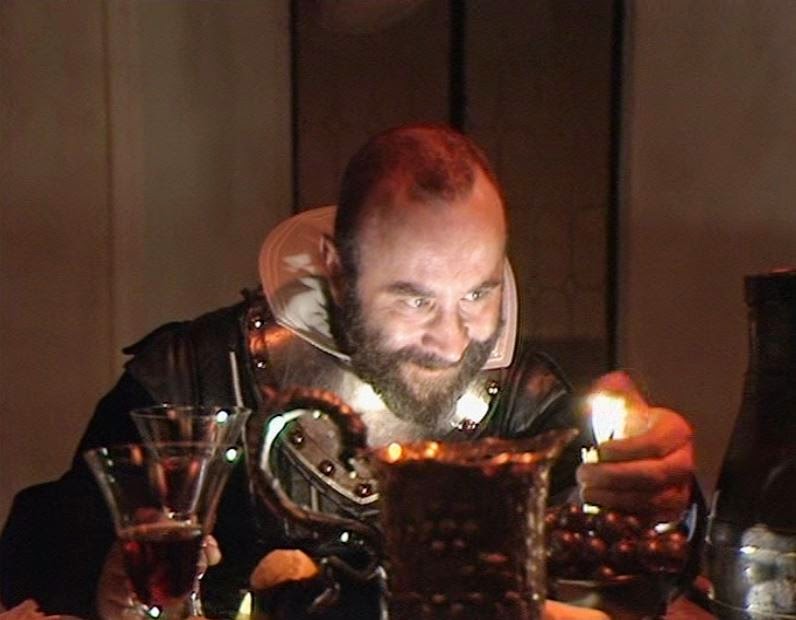
Bob Hoskins provokes the green-eyed monster in Antony Hopkins

Cast: Anthony Hopkins (Othello), Bob Hoskins (Iago), Penelope Wilton (Desdemona), Rosemary Leach (Emilia), David Yelland (Cassio), Geoffrey Chater (Brabantio), John Barron (Duke of Venice), Joseph O’Conor (Lodovico), Anthony Pedley (Roderigo), Tony Steedman (Montano), Wendy Morgan (Bianca)
Director: Jonathan Miller
 
Well there is no escaping it really. The picture above says it all. This production comes from a different time – a time when it was not seen as an unspeakable possibility that a white actor should don the facepaint and boot polish to play theatre’s most famous moor. So let’s tackle that issue first shall we?
For starters, it was not the original intention. Cedric Messina had originally intended to feature Othello in his plans for the second season of Shakespeare productions. He had the perfect actor lined up: James Earl Jones. A respected and well established Broadway star, Jones would have brought a real touch of Hollywood glamour to the series. Unfortunately, in the eyes of Equity he was guilty of an unpardonable fault: he was American. And, damn it, this was a British series that was there to give jobs for British actors – so why should this peach of a role go to some Yankee? So Jones was denied a visa to work on the series – and the production was placed on stand-by.
Enter Jonathan Miller. With no Jones, Miller announced, in his opinion, the play was less about race anyway, more about jealousy and envy. Miller had been one of the few openly critical of Olivier’s casting as Othello in the 60s and also believed Othello was an Arab rather than the African he was so often played as. As such, he focused on picking the best actor and avoiding playing up any racial characteristics in the performance. Of course you could criticise him (clearly) for not identifying a prominent black or Arabic classical actor – but the fact is a cursory glance at the RSC at the time shows he would not have been spoilt for choice in the 1970s. Hugh Quashie (later to appear in the series as a very different moor, Aaron) would have been the obvious choice – and would have given a very fine performance – but this time the election fell on Hopkins.
 
Hopkins does acquit himself well. Recent memories abound of scenery consuming roles in Hollywood films, but his Othello is a softly spoken, very controlled man, who has worked hard to integrate himself into his society – more Venetian than the Venetians. From his first scene, he is calm, rational, gentle and amused at the thought of threat or physical danger. It’s a very conscious absorbing of nobility, his calm assurance notable in a A1 S3 as he leans gently on the council table to tell the particulars of his wooing of Desdemona, smiling and with glances almost daring Brabantio to contradict him. When banishing Cassio, he stands quietly assured, hiding his fury.
 
The aim of Iago is to break down this controlled exterior to reveal the rage beneath. The one area where this man falls down is his almost childlike innocence in love. There is a boyishness in Othello – he playfully wrestles Iago to the floor when arriving in Cyprus – that extends to the chasteness of his relationship with his wife. Their kisses are brief and gentle, almost as if they are waiting to be told off. He seems almost in awe of her – the look on his face when she leaves him in A3 S3 (before Iago goes to work) is almost akin to worship. It hints at a deeper insecurity: as if he cannot believe that he, a stranger in Venetian society, could be loved by such a woman.
 
What a contrast then to the man destroyed by Iago! A3 S3 is a bravura scene of acting and direction (as is his custom, Miller uses many long takes to allow the performances to develop during the scene) and it deconstructs and rebuilds Othello into a man much wilder – almost bestial – than the calmer figure before. The scene is a slow descent: first he is sharper, pointedly stating “she chose me”, making a show of relaxing, of avoiding Iago. From there he becomes more emotional, tearful before ripping into a violent outburst, wild-haired and wild-eyed screaming, like a temper tantrum. It’s a note Hopkins carries forward, a man unbalanced by his passions, who strikes Desdemona one moment, then weepingly seems to be looking for the comfort he once had from her, but without being able to confess what concerns him.
His calmness only returns when he is once again given a purpose – her murder. Their dialogue before the murder could almost be a normal married argument, before his rage is unleashed – Penelope Wilton’s head-girl manner, from Othello’s perspective, her air of unimpeachable openness makes her betrayal far worse. Hopkins probably goes too far here with his maddened stare into the camera as he smothers her. After the death, he is a broken-hearted boy once more – and only returns to his regal manner after Iago’s villainy is revealed and he has a new duty – suicide. It’s a rich, complex performance, in no way a racial stereotype, but a great actor using the tools of his trade to utmost effect. Where it is perhaps weaker is in the moments of rage – Hopkins comes across at these points too theatrically. But the quieter moments are triumphs of filmic technique.
The real gem of the performance here however is Bob Hoskins. Has there been a finer performance of Iago captured on film? Hoskins certainly must stand up there with the greatest performances of this role of all time. His Iago is a playfully destructive figure, playing with lighted flames when he is alone, throwing water at Brabantio in the middle of gulling the man. Hoskins’ performance is a triumph of conveying inspiration – his soliloquies and asides showcase his ability to act ‘thinking’ before the camera, making it clear he is as uncertain about the next step he will take as anyone else.

There are several lovely moments of improvisation: in a particularly brilliant touch, in A4 S1 he leads Othello into the bedroom to point at the bed “she has contaminated”, clearly seizing inspiration for a suitable place for the murder. This improvisation is two-sided. He doesn’t think through implications (either because he can’t or he doesn’t care) and hands over damning letters about him from Roderigo’s corpse. He’s like a shark – only able to power forward and with very little thought about his eventual destination, seizing opportunities as they land in front of him. Momentum is his main weapon – Miller makes it clear that a simple pause and drawing of breath from the other characters would be enough to shatter his plans – making the events in many ways even more tragic.

Miller also uses Hoskins’ working-class roots as a strength – Iago here is a natural NCO, trusted by everyone as much because he is a ‘simple soldier’ among his betters. Hoskins never seems to stop smiling, his unaffected accent and bluntness signs to everyone else of his trustworthiness. Hoskins’ whole performance is a triumph of marrying up the many different images both the characters and the audience have of Iago – and in making it understandable why so many are fooled by him.
Iago’s instability is also to the fore. If Othello is a head-boy, Iago is a destructive tearaway, giggling delightedly at the slightest provocation (this giggling runs throughout the whole play, heightened during the murder of Roderigo, and he disintegrates into nothing but giggles by the play’s end). His psychotic nature is hidden by his constant ingratiation – Miller continually frames him on the left of the shot, often looking up at the face of the man he is manipulating, his face close, his voice calm and reasonable. He’s a different man for each character, but each personality is on the surface deferential – from his Sancho Panza to Roderigo, to his humble batman to Lodovico.
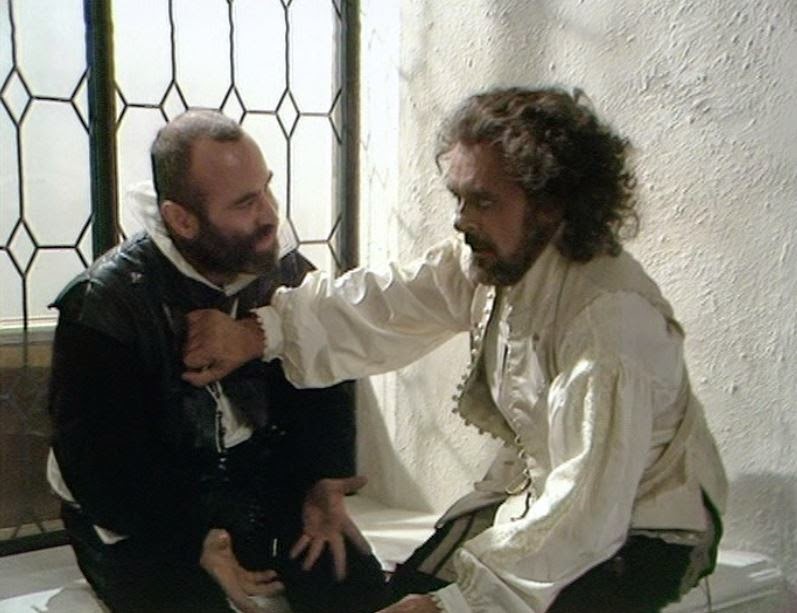
Miller’s work also demonstrates the close-bonds between Othello and Iago. Othello shows more comfort in physical contact with Iago than he ever does with Desdemona – Iago tenderly fixes his uniform, and the two of them wrestle playfully at several points. When spinning his lies, Iago takes Othello in a bear hug, and then an embrace/headlock (there are hints that Iago is even a little shocked at the emotion he has provoked from Othello) of a kneeling Othello. While Othello is controlled, calm and rational, Iago presents himself as jolly, open and likeable – but his psychotic anger under the surface is reflected in the murderous rage he unleashes in Othello. They make a fantastic partnership.
There is room for other performances as well, of course. Penelope Wilton’s Desdemona has a head-girlish prissiness, and is a woman who has lived an entirely open and honest life, devoid (until now) of any rebellion. She seems very innocent sexually (much like her husband), and earnestly wants to do the right thing. This characterisation is great at pointing up her helplessness and emotional upset at Othello’s behaviour – clearly having no idea what she has done. Her inward grief is very well played throughout – particularly in the (often cut) A4 S3 where her quiet sadness and helplessness is very affecting. Like Othello, she seems naïve and slightly adrift in the adult world – only at her death does she finally shy away from her gentleness towards anger and outrage at her treatment, though Wilton is careful never to suggest any compromise in her feelings.
Rosemary Leach gives a stirring performance in the scene-stealing role of Emilia, fiercely loyal and protective of those she loves and willing to stand for what she believes in. Anthony Pedley produces another strong performance in the series as an out-of-his-depth Roderigo, an aristocrat who never sees betrayal coming from a friend. David Yelland makes a wonderfully cool (and therefore suspicious) Cassio (his heartlessness towards Wendy Morgan’s needy Bianca is also a very nice touch). Geoffrey Chater and John Barron were both a little too broad or sing-song for my taste, although Tony Steedman and Joseph O’Conor make strong impressions in the smaller parts.
Miller’s direction is, as always, intelligent and illuminates small moments. Visual inspiration comes from Velazquez, while the set-design (essentially a long corridor of inter-connecting rooms) successfully uses the scale of television to focus the production as a claustrophobic chamber piece. His use of long takes is very successful, particularly in the main Iago/Othello scenes, as it gives the actors room to develop the scene naturally within shot. This is possibly the most performance-central production so far, focused by the fact that this play is almost a four-hander with only 2-3 other major characters, the smallest cast of any of the great tragedies.
Technically there are also some beautiful images here – lighting during the two contrasting dinner scenes is lovely – and Miller introduces many small touches, from Iago’s water antics at the opening to Othello performing magic tricks to amuse his guests. The murder of Roderigo takes place in a Third Man-style series of cloisters. He does sometimes overplay his hand visually: the prominent skull that sits on a table opposite Desdemona in an otherwise wonderfully played A4 S3 is perhaps a bit much.
I’ve already written a lot about Othello/Iago in this production, but Miller does manage to front-and-centre the theme of jealousy and envy, as well as the dangers of blind trust very successfully. With Hoskins he creates a demonic dwarf, who is vindictive rather than scheming. With Hopkins he creates an Othello, imposing and dignified in his comfort zone, naïve and lost outside it. What he does most successfully is present the characters and situation in such a way that you would believe these events would unfold like this. Cassio is cold enough to suggest he would betray Othello; Desdemona is calm and, for want of a better word, British enough to avoid confronting Othello until it is too late. Long takes hammer home the short timespan of the play (it feels almost ‘real time’), while the simple black and white design and costumes serve as a nice contrast to the far-from black-and-white story Iago is creating.
Miller also uses filming to enforce the manipulation. Framing repeatedly places Iago on the left of the frame, adding a visual consistency to his manipulation (strikingly he moves completely to the right for the final scene). In a daring sequence for a series based on placing text at the centre, he continues his experiments from Timon with deliberately making some of the dialogue inaudible to allow the viewer to feel some of the character isolation: in particular when Othello overhears Cassio 'confess' in A4 S1, he is placed behind the door with the camera with him - leaving us struggling to hear what is being said as much as Othello does (this infuriated some critics but is a lovely touch).
If there is a problem here, it’s got to come back to length – this is the longest production so far, and although that is partly Shakespeare’s fault, it’s tough on the bum. Miller sometimes I feel has so many good ideas and points he wants to explore that he finds it impossible to leave any of them out – combine this with the brief to avoid cutting, and you end up with something that you need a couple of sittings to get through. But then when there is such good stuff here as there is, it’s well worth the effort.
Conclusion
A good performance by Hopkins (despite the controversy) is overshadowed by a rip-roaring turn by Hoskins, who turns this into the Iago show – and gives one of the strongest turns of the series so far. Miller is full of ideas and invention as always, and brings the focus very much onto the leading characters, using moments of invention in performance to highlight their natures. It’s overlong and, yes, it does take a bit of getting used to seeing Hopkins black-up – but I’ve seen this production twice and it’s imaginative, enlightening and highly enjoyable – and also succeeds in making a familiar story sad and moving.
NEXT TIME: The only film version you will ever see of Troilus and Cressida (strewth, it’s hard enough to see on stage!) as Anton Lesser, Suzanne Burden and a host of Miller regulars bring the Trojan classic to life.

Sunday, 8 September 2013

Romeo and Juliet (Series 1 Episode 1)

Romeo and Juliet

First Transmitted 3rd December 1978

Rebecca Saire and Patrick Ryecart star in Shakespeare's romantic tragedy

Cast: Patrick Ryecart (Romeo), Rebecca Saire (Juliet), Celia Johnson (Nurse), Michael Hordern (Capulet), Joseph O’Conor (Friar Lawrence), Anthony Andrews (Mercutio), John Gielgud (Chorus), Laurence Naismith (Prince), Jacqueline Hill (Lady Capulet), Alan Rickman (Tybalt), Christopher Strauli (Benvolio), Christopher Northey (Paris), Paul Henry (Peter), John Paul (Montague), Esmond Knight (Old Capulet), Vernon Dobtcheff (Apothecary), John Savident (Friar John)
Director: Alvin Rakoff

The inaugural production selected by the BBC, it’s very easy to see Romeo and Juliet as a mission statement for the whole series, both in style, tone and interpretation. Which in this case is to present an incredibly faithful and traditional production of the play, on an intricate set with a studied focus on verse speaking and occasional moments of directorial and interpretative flair.

It’s surely not by accident that the first voice (and the first face) seen on screen in the entire project is Sir John Gielgud as the Chorus. The greatest verse speaker of the last century and hailed one of the best classical actors in the world, it was clearly a coup for the BBC to borrow his prestige. But this opening scene also sums up some of the issues with the project, as the director Alvin Rakoff seems completely unsure about how to handle the Chorus' appearance, with Gielgud appearing in period costume as the camera tracks down and into the great actor’s face while he performs a poetry recital without a trace of character. This staging manages to make both the nature of the Chorus (Is he part of the action? Is he a ‘voice of god’ or voice of Shakespeare?) vague and the dramatic thrust of the play rather deadened from the start, as Gielgud’s recital lacks emotion (beautifully spoken as it is) and the camera basically sits there and laps it up. These issues are symptomatic with wider problems with the direction of the play that I’ll come to later.


This is a version of Romeo and Juliet that appears to be about very little other than telling the story. There is no hint that any major interpretative work or even analysis of the text has taken place. Instead the play is presented exactly “as is” with boy meeting girl leading to tragedy. Any hints that Shakespeare might be looking at other themes – say the destructive nature of passionate love, or the shadow of death lingering over hot headed young people – are completely avoided in favour of a clear and concise reading of the text.

This lack of depth is not helped by the decision to cast Ryecart and Saire. Both were cast in this film as “stars of tomorrow” but the production shows up their limitations throughout. Firstly Ryecart is hideously miscast as Romeo, totally unable to bring out any sense of romantic passion or (later) despair. From the start his discussion of Rosalind and “love’s transgression” is poetic but empty, never persuading me that he felt anything. His performance remains low energy and contained, without any real fun to him – he already seems well on the way to middle age. This hollowness at the centre of his performance continues when he meets Juliet. He only seems to come to life during Mercutio’s death and his reaction to it (though he gives a curiously peevish reading of “I thought all for the best”). Fast delivery carries him through and gives him an impression of anger which he is able to maintain in A3 S2. But by the end of the play I have no idea, as a viewer, why this Romeo does what he does or why he feels there is nothing for him in life with the loss of Juliet. It’s a misfire at the centre of the play that the production can’t really recover from.

Rebecca Saire makes better job of Juliet. Famously selected for the part aged only 14, she makes a strong fist of dialogue and interpreting the lines but, quite frankly, spends large parts of the production looking uncomfortable and out of depth. The age difference (Ryecart is 12 years older and looks it) perhaps also explains the physical discomfort between the two leads – a repeated series of chaste kisses and lack of contact is the hallmark of their relationship while in A3 S5 in bed together they seem to be going out of the way to avoid kissing too intimately. What she does manage very well are the speeches and monologues where it is clear that she has put an immense amount of thought and feeling into the dialogue. Her major speech in A4 S2 is well done, choosing to stress the sharp changes in mood and feeling throughout the script. But with the all important relationship with Romeo not convincing at all, it isn’t enough. The central casting of the two inexperienced leads fatally holes the entire enterprise under the waterline.

More success is had with some of the supporting parts. Celia Johnson is best in show here, with her Nurse coming across as a wonderfully human portrayal of this old retainer, handling the dialogue with a confident naturalism and crafting a warm-hearted well meaning servant who seems to be as closely drawn from a Hardy novel as Shakespeare. Similarly Michael Hordern gives an interesting interpretation of Capulet as a tiresome old man almost touching the edge of senility, taking on menial tasks himself due to a lack of natural authority and whose own servants roll their eyes at his feeble gags once his back is turned. Joseph O’Conor brings a solid fatherly tone to the Friar (his relationship with Juliet is especially well drawn) and Jacqueline Hill gives a touch of steeliness to Lady Capulet.

This big surprise here however is the failure of Anthony Andrews’ Mercutio. For some unfathomable reason Andrews delivers his dialogue in a halting machine-gun way that not only gives no real insight into the character but becomes increasingly more and more tiresome – dialogue is fired out like follows: “who dreams. Of courses. Straight.” And “Some time. She gallops across men’s noses. As they lie. Asleep”. Again it’s never clear why Andrews chose to do it like this or what we are supposed to surmise about Mercutio’s character from it. He improves in time for his death scene but a sense of bond between him and Romeo is never developed and Andrews, for such a charismatic performer, fails to bring any charisma to the part.

The casting that attracts the most interest now is that of Alan Rickman as Tybalt, here making his television debut. It’s surprisingly hard to review Rickman’s performance objectively, with the fore knowledge that he would become such a successful actor, but nevertheless he shows great promise here with Tybalt, investing the young hot head with both a sense of caution and reserve often missing from many interpretations. Rakoff also gives him a small moment with Juliet in the ballroom scene that allows them to establish a warmth between these two characters. And yes the famous Rickman voice is already fully intact.

The small moment Rakoff gives Tybalt with Juliet, is an example of the moment of interpretative interest Rakoff brings to the play. In the opening scene he has the townspeople of Verona turn on the Capulets and Montagues – a flourish that is so rarely done that I was surprised to find there was any textual justification for it. A scene of Capulet buying oranges at a market has the air of a downmarket Brando in the Godfather. Abraham carries a noticeable black eye for the whole play, suggesting very neatly a world of constant violence from the start. A neat shift of location allows the Friar’s long speech at the end to be cut without any awkwardness. Above all it is in the crowd and fight scenes that Rakoff succeeds. The fight direction is by William Hobbs (he later went on to do sword choreography for, among others, Dangerous Liaisons, The Man in the Iron Mask, The Count of Monte Cristo and most recently Game of Thrones) and the sword fights are fantastic – intense, detailed but also ragged and exhausting. Rakoff allows the camera to roam through the fight scenes, using a combination of tracking shots and low angles to get a sense of the melee. The fights also have a raw sense of brutality to them which makes them feel genuinely dangerous.

The fight scenes use editing and camera angles to accentuate the frantic action
Rakoff also uses a lovely motif throughout of framing his characters through arches and other parts of the set, as if to suggest the world (and death) closing in on his characters. The images opposite give an idea of this. In the first, we see Tybalt cornered and trapped by an enraged Romeo. Shortly after we get Juliet similarly framed in the garden, which now seems claustrophobic (in contrast to its first appearance where Juliet is framed in a wide open space) – with the sets after this point increasingly closing in on her, narrowing her world as options slowly retreat from her (see the third image as she lies in bed deciding on whether to take the poison). Even at the end, with Romeo outside the tomb, the building seems to be pulling him in towards it, reducing his freedom to move – an effect heightened here (so to speak) by the low angle camera used to make Paris seem both imposing and almost spectre like. Similar effects are used elsewhere for Mercutio and to a degree Paris. It's flourishes like this where we get a sense of Rakoff’s visual eye and experience as a director.

The problem is that Rakoff fails as an interpreter of Shakespeare. It’s no surprise that the more experienced actors by and large come out of this best. In terms of questioning the text and putting a new spin on the play, Rakoff hasn’t got much to offer. In thrall to Gielgud’s speaking, he encourages similar from the rest of the cast, giving us poetry but not drama. For the dialogue scenes he directs them flatly – cutting from speaker to speaker, using establishment shots and not a lot else – and by and large leaves the actors to get on with it, to mixed success. This is when the pristine street sets of Verona – I was reminded somewhat of Doctor Who’s Logopolis – and the painfully unconvincing forest set really start to jar. When it’s left with just the text, neither the director nor the lead actors seem really sure exactly what they should be doing.

It’s a well meaning attempt at doing the play, but the problem is that this rather lifeless and passionless production aesthetically follows exactly the same playbook as Zefferelli’s 1968 film version and doesn’t really have anything to bring to the table on its own account. As a faithful, clear and straight reading of the play it’s serviceable if weakly acted by the leads. But if you want to watch a film version of the play, there really is no reason at all to watch this – check out Zefferilli for a more traditional production, Luhrmann for a re-interpretation of this play.

Conclusion

Poor leading performances and a lack on interpretative insight or originality are too dominant in this fumbled production. Despite some interesting directorial decision and some very well done fights, this is a lifeless production that totally fails to get across the passion the two leads have for each other. Having said that it’s better than expected, but that doesn’t mean it’s good.

NEXT UP: I’ll be seeing Sir John again alongside Derek Jacobi as Richard II.