Showing posts with label Michael Byrne. Show all posts

Thursday, 7 July 2016

The Two Gentlemen of Verona (Series 6 Episode 4)

First broadcast 27th December 1983

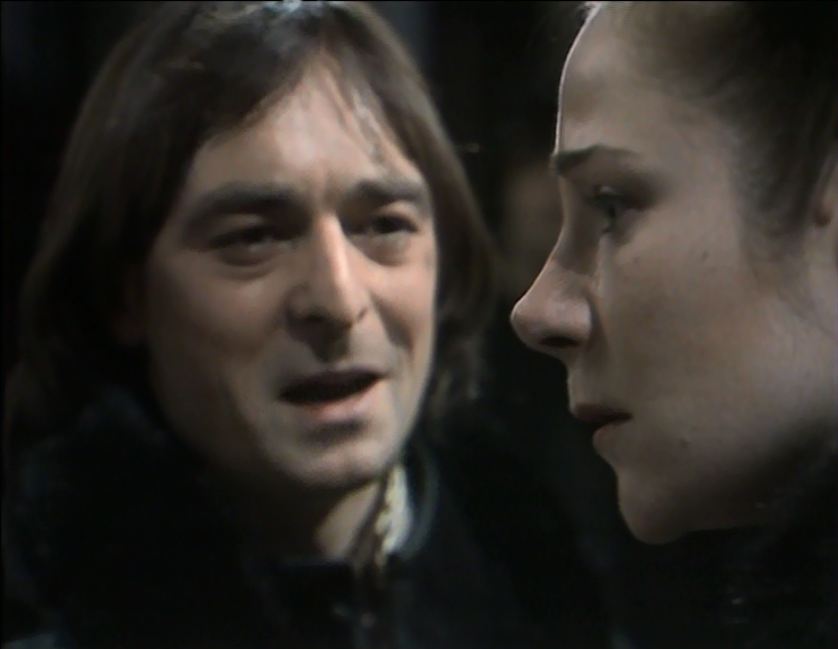
John Hudson and Tyler Butterworth: Two regular Veronese guys just shooting the breeze

Cast: Tyler Butterworth (Proteus), John Hudson (Valentine), Tessa Peake-Jones (Julia), Joanne Pearce (Silvia), Paul Daneman (Duke of Milan), Tony Haygarth (Launce), David Collings (Thurio), Nicholas Kaby (Speed), Hetta Charnley (Lucetta), Michael Byrne (Antonio), John Woodnutt (Panthino), Frank Barrie (Sir Eglamore)

Director: Don Taylor

The BBC series moves into the home straight (just six left after this one!) and, as we head into the final episodes, it becomes clear just how haphazard a lot of the planning around the series was. Not only are the remaining plays (with the exception of Much Ado About Nothing and possibly Coriolanus) a bizarre collection of minnows, the runts of the Shakespeare litter assembled into a bargain bucket, but this ramshackle transmission order in no way reflects the composition order of the plays itself. As we head into many of the earlier or weaker (or both) works, there is no sense of Shakespeare’s skills developing and building on top of each other – more a sense of completeness for completeness’ sake, like a kid tracking down the last few stickers for a Panini Football Album.

This feeling is particularly clear in Two Gentlemen of Verona, almost certainly (by critical consensus) one of the first plays written by Shakespeare. As such, it’s packed with signposts for future Shakespearean developments and ideas that would be explored in greater depth in future plays. This could have been built into the plans for the series, perhaps allowing viewers to see more of the contrasts. However, it’s not the case, so this is more of an easter egg for those in the know.

As for those early ideas – where to begin? Julia herself combines elements of Rosalind and Helena (AYLI and All’s Well), both her in her plotline and personality. Her dissing of potential suitors with Lucetta has much in common with Portia and Nerissa in Merchant. Her role, disguised as a boy, to pass messages from the man she loves to the woman he loves has more than an air of Viola. Proteus is an embryonic Iachimo from Cymbeline and Bertram from All’s Well. Our lovers all end up swopping each other in a forest a la Dream. Launce foreshadows a range of clowns to come from Touchstone to Feste. The Duke of Milan is another reasonable authority figure. A Friar called Laurence is name checked. Eglamour is like some distant cousin of Aguecheek and Falstaff. Large chunks of the plot (lovers separated, authority figures coming between true love etc.) would be recycled throughout both drama and comedy in Shakespeare’s work.

So what about this production itself? Well again, like Comedy of Errors, it’s a rather mixed bag: a combination of good ideas, misfires and some stodgy acting. Anyway, let’s focus on the positives first. Don Taylor does a rich and intelligent job of directing this play. Taylor decided to film long takes with multiple cameras, editing between the different shots to tell the story visually. This actually works rather well, getting a good balance between the Jonathan Miller style (single takes, tracking shots for single shots) and the Jack Gold (and others) style of a more traditional master shot/reaction shot style. Taylor wanted to allow the actors to perform “in the moment” and to have the opportunity to grow and develop within the scene, which he felt would be harder to achieve without allowing the actors to just go for it as they would in the theatre or rehearsal room. This works very well with many of the actors in the performance, particularly Tessa Peake-Jones (of whom more later).

The setting of the play is also an interesting combination of the realistic and the more stylistic. Verona (our original location) is a logical, consistent location – reminiscent of many of the courtly sets we’ve seen in previous comedies, with its own clear geography. Milan, however, is a far more stylistic place, an almost bizarre world where the entire court is a perfect stereotypical romantic image. This works quite well for the increasingly extreme and bizarre actions of the play, but is perhaps a little bit too much for a modern viewer. Silvia cannot enter without being covered in confetti. Two romantic young men strike poses in the background of scenes (wait in vain for them to become part of the plot). Some rather creepy painted cherubs run around throughout many of the scenes. In a slightly heavy-handed touch two statues are entitled “Amour” (struck by an arrow) and “Fidelity” (not). Prefiguring what is about to happen? Not half. What does work well is that, with the arrival of the treacherous Proteus, a windy storm sweeps through this Eden-like courtyard – serpent in paradise anyone? However this all works fairly well (despite looking a little odd) and means that we get a sense of why Valentine and Proteus get so swept up in romantic feelings the instant they arrive in Milan. How could they not with all these prompts around them?

Taylor also uses music very well in this production – perhaps better than many of the other productions. In Verona, a minstrel plays poems by Shakespeare and his contemporaries as a series of songs: this works well, both as something for the cast to interact with and also to smooth the transition between scenes. This also carries across quite nicely to Milan, where the music complements the stylistic world that Taylor has created. Taylor also starts the play with a nice little prologue of Julia being wooed by Sir Eglamore and another (random) character (who never appears again). It’s fairly inconsequential but adds context to why Julia pretends not to love Proteus and adds some visual interest as Eglamore rolls out a parchment of his lineage and the other courtier pours money across the floor from some sort of bird house (especially as this allows some witty screen images of this mess being cleaned up in the next scene).

The setting, however, does get a little odd in the forest in the final scenes. For some reason, the forest is turned into a series of metallic columns, wrapped in tinsel and leaves, their tops stretching past the camera lens, with a bridge like platform throughout. This looks like what it sounds like. The cast apparently even described it as “Christmas in Selfridges”. Now I’m all for impressionism over realism in these things – but within a consistent idea. Does this post-industrial forest match up in anyway with the romantic world of Milan? Not at all. Is there anything else in the production that even remotely ties in with that? Nope. Does it look, for want of a better word, a bit crap? Yes it does.

Having said all that, there is quite an affectionate warmth in the production for the characters and the story. By and large, the shades of gray are avoided, and even the bad characters like Proteus aren’t really that bad – he’s more misguided. The comic characters actually come across fairly well. In particular, Taylor draws a very good performance from young Nicholas Kaby as an energetic and engaging Speed, full of wit and banter with a skilful precision in piercing the pretensions of his masters. Similarly Launce is brought to life extremely well by Tony Haygarth, who portrays what could be a dullard with a real sensitivity and gentle wit – and with a truly adorable dog I’ve got to say. Haygarth does a fantastic job with the long monologues of Launce (Taylor wisely I think doesn’t play these as comic set pieces, or encourage any business from the dog), giving Launce a slightly world weary nature, someone who is far more plugged into the stupidity and vanity of the world than many others in the play. Taylor also directs these moments with a real simplicity – and recognises I think that high energy comedy didn’t work very well in the aesthetic of this series.

The best performance of the lot however is Tessa Peake-Jones as Julia. It helps of course that she has the most interesting character in the play, and certainly the most complex, but Peake-Jones mines this proto-Rosalind/Helena for all the depth she can, finding a great deal of emotional truth in the role. Her tearful, raw reaction to witnessing Proteus woo Silvia is genuinely quite moving. At the other end of the scale, her early conversation with Lucetta has a real lightness and affection behind it, and her reaction to receiving (then ripping, then trying to gather up the pieces of) Proteus’ love letter is quite sweet – she playfully plays a harpsichord to try and distract Lucetta from her interest in it before falling on the letter with a passionate longing when left alone. Similarly you really feel her pain and anger when she arrives in Milan dressed as a boy – and the mixed feelings she has towards Silvia, a woman she has much in common with. It’s a very well thought out, heartfelt performance that really grows on you as the play progresses.

It’s unfortunate that this isn’t matched by the other three main members of the cast. Surprisingly, in amongst all this invention and confident handling of the play, the acting styles of Tyler Butterworth, John Hudson and Joanne Pearce all come across as at best old fashioned, and at worst disengaged and dully traditional. All three go for a very poetic, breathy reading of the text, where youth and inexperience are conveyed by delivering many lines with a high pitch and eagerness. What this fails to do, however, is deliver any real sense of character or personality in these people, instead making them into rather distant figures strangely devoid of passion despite the actions they are involved in.

Butterworth’s Proteus never for one second convinces either as a conniving opportunist or as a man so wrapped up in a sudden passion that he sadly feels the need to take on a number of terrible actions. John Hudson’s Valentine is a dull figure, despite some efforts to add some moments of comic timing to him (such as his reaction when the Duke reveals the rope ladder beneath his cloak with which he intends to steal away Silvia) – but Hudson adds no sense of energy to it. Scenes involving him and Joanne Pearce are terribly dull, with both actors concentrating so heavily on getting the beauty of the language across that they forget to really add in any performing. Joanne Pearce continues where she left off from Comedy of Errors with a flat performance.

It’s these lead characters that, in the end, undermine the production. Despite all the efforts of some in the cast – and I want to mention as well Paul Daneman who gives a terrific performance as a Duke of Milan who is clearly savvy to Proteus from the start – the lead characters (sketchily drawn on paper) are simply not particularly engaging or interesting. I can see how they could be – there’s more than enough plot here – and I feel like there should be a sharp, active, vital quality to the performances – these guys are young, a bit dumb and horny as hell – but you don’t get any sense of that at all in the production. It’s a completely sex-free production, which is bizarre since virtually every single scene is about love or lust or some combination of the two.

Which is a shame as this is a solid enough production with a good selection of ideas and concepts behind it, and it generally has a lot of charm. What I liked about it is that Don Taylor clearly has an understanding of what the play is about, and where it sits in the cannon of Shakespeare’s work. Most of the design ideas effectively service the plot and allow us to understand the tone of each scene and the mood of the production. Yes, some of these design ideas don’t work, and the lead actors are weak – but the production effectively evokes a world, and creates a mood of warmth and lightness that makes it enjoyable.

Conclusion
Despite some key flaws, this is actually a rather engaging production. It’s very hard not to get wrapped up in the story, and to enjoy the events of the show – particularly with Peake-Jones’ performance, which is the true stand out of the show. There are also some well-done performances from the supporting cast, in particular Daneman, Kaby and Haygarth. The design ideas by and large work quite well (with some key flaws) and there are plenty of enjoyable moments. Where the production fails however is in the three other leads, who fail to bring any real emotion, passion or interest to their characters, which weakens the production as it detracts heavily from the audience’s interest in their plot. This doesn’t completely undermine the production, but it is a real shame that better performances (or actors) couldn’t have been found for the leads of this otherwise interesting and quite likeable production.

NEXT TIME: Alan Howard lays into those pesky commoners in Coriolanus

Saturday, 9 January 2016

Richard III (Series 5 Episode 6)

First transmitted 16th January 1983

Ron Cook's Richard III takes triumphant centre stage


Peter Benson (King Henry VI/Priest), Antony Brown (Sir Richard Ratcliffe), David Burke (Sir William Catesby), Michael Byrne (Buckingham), Anne Carroll (Jane Shore), Paul Chapman (Rivers/Archbishop of Canterbury), Ron Cook (Richard III), Rowena Cooper (Queen Elizabeth), Arthur Cox (Lord Grey/Lord Mayor/Sir Christopher Urswick), Annette Crosbie (Duchess of York), David Daker (Lord Hastings), Brian Deacon (Second Citizen/First Messenger/Richmond), Jeremy Dimmick (Young York), Tenniel Evans (Lord Stanley/Archbishop of York), Derek Farr (Sir Robert Brackenbury/Surrey/Scrivener/Third Citizen/Bishop of Ely), Dorian Ford (Edward V), Julia Foster (Queen Margaret), Derek Fuke (Second Murderer/Sir Thomas Vaughan/Fourth Messenger), Alex Guard (Dorset), Bernard Hill (First Murderer/Sir William Brandon/Sheriff), Paul Jesson (Clarence/Pursuivant/Third Messenger), Patsy Kensit (Lady Margaret), Oengus MacNamara (Halberdier/Lord Lovell/First Messenger), Brian Protheroe (Edward IV/Sir Walter Herbert/Second Messenger), Nick Reding (Ghost of Prince Edward), Stephen Rooney (Edward Plantagenet), Zoe Wanamaker (Lady Anne), Mark Wing-Davey (Sir James Tyrell/Sir James Blunt/First Citizen), Peter Wyatt (Norfolk/Keeper/Messenger)

Director: Jane Howell


Is there a more famous tour-de-force role in theatre than Richard III? Sure, Hamlet and Lear are challenging and engrossing roles and there are plenty of Mercutios and Malvolios lining the rest of the plays – but for sustained grandstanding impact, giving the actor the scope to really let rip it’s hard to think of many parts that beat out Tricky Dicky. Throw in the added frisson (even more so today) of Richard’s increasing number of advocates and the actor playing him  is usually lined up to tear the screen or stage up, gleefully embroiling the audience in his deadly plans.

But it’s precisely that force of personality – the great man theory of history if you will – that Jane Howell’s productions have been pushing against. Again and again Henry VI had reminded us that, bad or good, rich or poor, lord or peasant, we all meet death in the same way – with a frustrated monologue at the futileness of war and death. Henry VI time and again saw characters believe they were the masters of their destiny only to be chewed up and spat out by the meat grinder of the War of the Roses. So it’s those same themes that are carried through (highly successfully) in this production of Richard III, a striking re-imagining of the play – not least because it is presented uncut (a very rare first) and positively luxuriates in all the references back to the preceeding three plays in the cycle (references nearly always cut from stand-alone productions).

This is clear most of all in the characterisation of Richard himself. Even today the role is almost synonymous in people’s minds with Olivier’s 1955 performance. Olivier virtually wrote the book on the character – and defines what people expect when they watch the play. It’s quite something then for Ron Cook and Howell to fly in the face of this and present a softly spoken, quietly bitter, in many ways weak-willed and indecisive Richard, willing to play second-fiddle to Buckingham. From his opening speech this low-key bitter wryness is key, with little attempt to woo the audience (something he is reluctant to do throughout). He is a man in a hurry – he often turns to the audience to repeat one extra point, like a homicidal Columbo. His wooing of Anne is the closest we get to a virtuoso performance – but even then the counterfeit of pain feels more like redirected anger against the world – particularly his vicious condemnation of Anne’s (perceived) shallowness. Cook is no seducer here – his frustration (and inability to hide this) are all too clear when later trying to win Elizabeth to his cause. Although he starts the play by chalking its title on the wall like some sort of executive mission statement, he gradually throughout feels less and less the master of his own destiny.

Cook’s Richard also has an interesting relationship with Buckingham. In A2 S1 Richard easily enforces his dominance over the other anti-Rivers lords and in A2 S2 brazenly embraces his nephew and niece (fresh from ordering the murder of their father Clarence). But he seems to allow Buckingham to drive the conspiracy, following (or giving the impression he is following) this ambitious fixer’s lead. In A3 S5 he plays the tearful victim of Hastings, comforted and steered by an elder brother Buckingham (although Buckingham and Richard are united in amusement at the pompous and cowardly Mayor, barely able to repress their satisfied laughter). Cook’s Richard is willing to be the tool, far from the domineering force of nature he is often portrayed as. It’s only in A3 S7 where – in a wonderfully stage managed scene – he throws Buckingham off by waiting longer than expected to accept the Crown (notably irritating Buckingham at this deviation from the script). Perhaps, Cook’s performance suggests, he then throws Buckingham aside out of an insecurity and complicated lack of self-esteem – he almost can’t keep people close to him, so terrified is he of being rejected by them. Richard hates to be a figure of fun – he is furious and unsmiling when teased by the young York in A3 S1 (particularly in the amusement of the lords) and seems totally incapable of forming relationships with either his followers or his peers – his cold and abrupt manner from the start of A3 S4 before sending Hastings to his death is all about establishing himself as the alpha male and has no connection to building feelings of loyalty.

More than any other Richard I’ve seen, this one falls apart as soon as the diadem sits on his head. As king he is a nervous wreck. We’ve already talked about his inability to handle Queen Elizabeth with anything but impatience, but already in that scene he’s been shocked and crushed by a tongue lashing from his mother, and follows it with a tension-filled over-reaction to the messengers. By A5 he is twitchy, peppering his speech with awkward pauses as if uncertain what to say – lost in the double isolation of power and being hated by everyone. Camera angles repeatedly accentuate his shortness. Contrasted with Richmond’s coolness, his wild-eyed, sweaty unsettledness infects his followers, finally collapsing into a near-schizophrenic conversation with himself after his nightmare, almost unable to look at the camera. Going into Bosworth, he clearly lacks confidence and has nothing left but the same chippy anger at the world that, Howell and Cook suggest, was his main motivation in the first place. This makes Richard almost a tragic “hero” – he seems as much blown and buffeted by the winds of fortune and nature as his victims in this play, and finally seems to find himself locked into a familiar pattern (as King) of rebellion, overthrow and death that affected his three predecessors. We’ve literally seen this story before and, like Richard, know exactly how it’s going to end.

If I dwell on Richard, it’s because this play is carried forward so heavily by its main character – unlike Hamlet for instance, there are few other memorable characters in the play. What works in this production when we watch it is that we gain a different understanding of the characters themselves from seeing their actions over the previous three plays. For example, Clarence seems less a dupe and a victim and more an arrogant and proud man getting his comeuppance. It’s no great surprise to see Edward IV riddled with STDs and foolishly interpreting death-bed small talk for heartfelt assurances to keep the peace. There is also more than enough material for new characters to shine, with Zoe Wanamaker and Annette Crosbie (both new additions to the ensemble) outstanding as Lady Anne and the Duchess of York respectively.

The other character who really gains from this production rolling straight on from the previous three is Queen Margaret. As the only character who appears in all four plays, Julia Foster has had the opportunity here few Margarets get of going from naïve young Queen to bitter hag. Now, as you know, both Cate and I have had our doubts about Foster’s performance here, but as in Henry VI Part III this plays to her strengths, with her Margaret here a stumpy, black coated ball of bitterness and poison, like an enraged nun, scowling at the edge of frame, appearing from the side of the shot as if to lean into the action as a visual blast from the past. Foster is at her best with this vengeance-laced material, and really makes use of the added heft the whole delivery receives from the preceding three films – the production lingers on the many lines reminding us of the atrocity-laced past that we have emerged from.

This production is also a thematic finale to the Henry VI cycle. Just as those plays saw England collapse into a realm where every man works for himself, so we see the final expression of that – not only in the destructive nature of Richard, but in his lieutenants. Antony Brown’s Eichmannesque Ratcliffe, David Burke’s heartless Catesby and Michael Byrne’s ruthless Buckingham are as much an expression of the times as Richard is – these guys have no loyalty to Richard let alone the realm, they are simply looking out for the main chance. Even Brian Deacon’s Richmond in A5 has more than a little of the politician’s self-absorption about him. No one in the play really seems to care for anyone else – with the possible exception of Elizabeth and Edward’s concern for their children.

England in this production become a land with more than a whiff of some South American military junta. Brutality has become such a part of everyday life that it no longer even seems worth talking about. As a result this is probably the least bloody of all the films. Bar Richard’s death no-one dies onscreen – they are merely led away to death off-screen, murder and destruction having become so institutionalised it is like some state-wide Fordian machine. Arthur Cox’s Lord Mayor is clearly terrified throughout of this ruthless meat-grinder that drives politics in England. The regular feeding of this machine has become such a completely accepted fact of life that it’s almost logical that Richard decides the best way to deal with his nephews is to murder them – if no-one really bats an eye about him lopping off Hastings’ head in the middle of a Council meeting, who is going to mind about an ex-King (and Buckingham – after a breather – is happy to get behind this plan). No wonder Edward on his death bed has plastered a large and prominent statue of Jesus bleeding on the cross behind him – he really needs to have some hope of forgiveness.

The colour palette of the play totally reflects this hellish afterworld that England has become. There is barely a colour in this that isn’t black or grey – it’s actually a shock to see the old togs of Part One with their bright primary colours wheeled out in A3 S5. Even more so than before all the soldiers seem almost indistinguishable from each other – even some of the minor lords are starting to blur into each other. Richmond does bring some colour in A5 – but his soldiers (and the man himself) prove to be as violent, cruel and brutal as the very worst excesses of Young Clifford and his ilk. Our wooden playground is a rotted nightmare backdrop to this parade of death. Howell’s sustained spiral of destruction has finally reached its apotheosis here in production that in terms of mood, colour and pace seems a million miles away from Part One. In case you were left in any doubt, the fascistic entry of Richard’s men into the throne-room in A4 S2 tells us straight away we are in a very different state than the colourful early days of Henry VI. It’s a suitable backdrop to the doom-laden feeling that runs through the whole production.

The other major strength that Howell brings out here is the doubling of parts, which once again is beautifully done. I’ve mentioned David Burke, again playing an inversion of his Gloucester persona as a Catesby devoid of any integrity. But it’s the little doubles that really work. Why is Richard so drawn to the first murderer (and Clarence fears him?) – perhaps because he is played by Bernard Hill, so is identical to their father. Tyrell’s self-important justification of brutal acts reminds us even more of Warwick, because Wing-Davey plays the same part. Hastings really should be aware he is in danger as he heads to court – not least because he is halted by a Priest played by Peter Benson (Henry VI). Paul Chapman’s would-be fixer Rivers is a pale shadow of Suffolk. Tennial Evans’ fundamental (but ignored) integrity as Salisbury is replayed here as fundamental greed and self-interest as Stanley. That’s only the most obvious of a series of beautifully done doublings and return performers, subtly pointing up contrasts and mirror images throughout – and enforcing the feeling that we are on history’s whirligig of destruction here and that no amount of bell ringing is ever going to allow us to stop and get off.

Howell also uses a range of camera techniques to get the message of the play across. Long takes are prominent throughout, with Howell using a fluid and roving camera to great effect here, immediately establishing us a roving and vulnerable part of this world. This allows the camera to linger on those left behind after Richard’s exit – twice Stanley and others stare with inscrutable faces across the lens towards lords left doomed by Richard. The major scene where editing is used, as well as shot cutting, is in the seducing of Lady Anne. The camera alternates between close-ups of Richard and Lady Anne as they bat lines at each other, carefully avoiding them getting into shot together until after Anne’s spitting. This is then replaced with a shot of Anne in the foreground looking away from Richard in the background of the shot. It is only at the end that they face each other sharing the shot – a nice visual representation of Richard drawing them visually closer together. Snap edits are used well throughout – for example, as the door closes in A2 S5, the shot immediately cuts to Richard and Buckingham opening the door to Edward V in A3 S1.

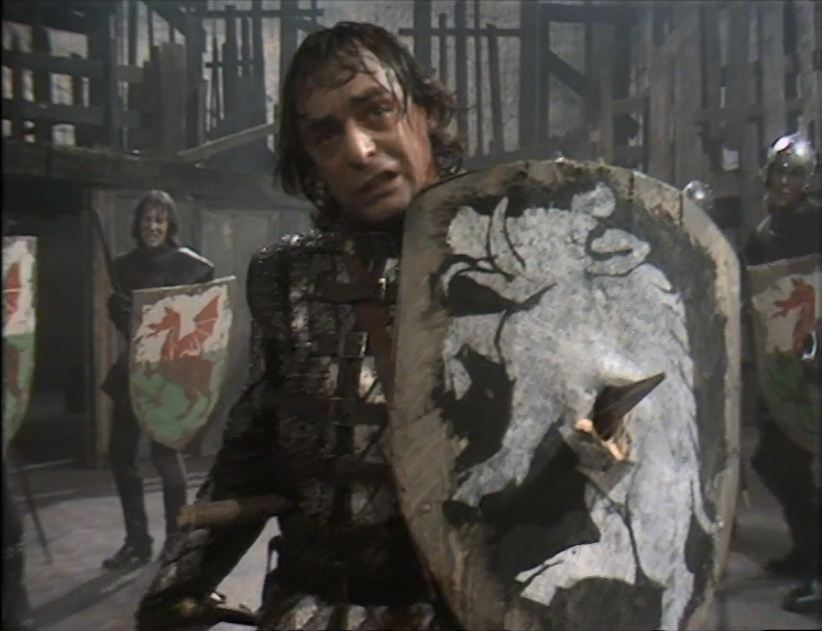
But its largely long takes and shots that work – effective especially in the final “boar hunt” sequence of Richard by Richmond’s soldiers. In a long fluid take, Richard is surrounded by soldiers and fights desperately – furiously – to survive, striking enemies down before he is slowly, inevitably wounded, slowed and then killed – many of these wounds coming from spears, the final of which punctures through his body and out of his shield, skewering him like a sacrificed pig. Even that is not the end as the mortally wounded Richard is lined up to be given the coup-de-grace by Richmond, his furious and impotent pain and anger all over his face as he sinks down to death. This sequence also ends with a particularly neat shot, with a collapsed and dead Richard left skewered and kneeling at the feet of Richmond – a lifeless supplicant in the back of frame throughout Richmond’s victory speech. In a neat touch, one shot even shows the crown held in the foreground as if on Richard’s head – a final insult to the man who could have ruled the world.
Richard kneels to Richmond in death - note the placement of the camera

A further tour-de-force of impressionistic film making is the nightmare scene in A5. Skilfully, jump cuts are used throughout the build up to this sequence – Richmond hears a sound, but we see a cut to Richard’s head turn, Richmond walks into a tent, the shot cuts straight entering into a tent. Richmond sleeps and turns his head from us, a sudden cut and Richard appears looking back to us asleep. Slowly the camera zooms slowly in on his eye, overlaid with an image of Richard as we enter his subconscious and see his nightmare play out with a series of expressionistic images of his victims throughout the series, all of them in nightmarish parodies of their final moments. From the snowy landscape that saw Prince Edward murdered, we see Richmond sleeping peacefully (unaware) of the ghosts praising him – and in a sign that this is all Richard’s nightmare, he sits at first on the throne. Then we see Henry (with the candle that sat on the table as he died), Clarence soaked in wine (water which flows over the lens as he praises Richmond), the River faction praising sitting waiting their fates, Hastings at a blooded table, the sheet of which Richard grabs only for it turn into the bloodied pillow that smothered the Princes, its feathers raining down on their ghosts. His attempt to clean up the mess (after watching the Princes crown Richmond) is then interrupted by Anne on her death bed (who he attempts to smother), before throwing himself on the absent throne, trembling as Buckingham adds his curse to the list, the shock sending him tumbling from the throne – and out of his nightmare. Not only is this an impressive display of film making, it also offers a distinct interpretation of the dream as something very much happening only to Richard himself, something in his mind (and from his guilt?), much more than a divinely powered visit to both rivals. It’s an interesting and unique a staging as we’ve seen in the series so far – and strikingly filmic.
The progression of images through Richard's nightmare

All the design and mood of the play however is building towards the final sequence, a creative coup and imaginative flourish from Jane Howell that brings the entire cycle of plays thematically together. In the final shot, the camera slowly tracks along a pile of dead bodies – among them all the actors we have seen in the previous four plays, dressed as their most prominent characters. We hear laughter on the soundtrack as the camera pans slowly across and then up what is clearly a mountain of bodies before it finally rests on a laughing, wild haired Margaret, hugging to her the bloodied and broken body of Richard. The camera pans back to reveal the entire image – a mountain of the dead, a punctuation point of death, finally showing the end – and visually summarising the destruction – that the Roses of the Wars have let rip on the Kingdom of England. As a final image it summarises all that has been best about this magnificent sequence of productions: the finest example so far in the series of marrying the cinematic with the theatrical.

The final image of what has been a brilliant series

Conclusion
The series wraps up with a stunning final episode that brings all the weight and depth of the previous three productions to bear to add a new level of depth to the play, as it is placed in its proper context. From its opening shot of the bare ruined stage to its final shot of the space littered with a mountain of corpses, this dark, gloomy, overbearing and sinister production stands out as a truly unique interpretation of the play and a perfect summation of the 13 hours of drama that preceded it. The ensemble cast are so experienced in their roles that they offer superb performances, led by an intelligent and redefining Richard from Ron Cook. Terrific stuff, and a clear sign of Jane Howell’s artistic imagination. The final image is almost worth the price of admission alone. Excellent stuff!


NEXT TIME: Helen Mirren and Robert Lindsay return to the series in the late Shakespeare work Cymbeline.

Friday, 4 December 2015

Henry VI Part 3 (Series 5 Episode 5)

First transmitted 16th January 1983

The York faction celebrate (but it's short lived) as Henry VI enters its third part


Cast: John Benfield (Northumberland/Hunstman), Peter Benson (Henry VI), Antony Brown (King Lewis/Sir John Montgomery/Lieutenant of the Towe), Michael Byrne (Montague/Father That Kills His Son), Paul Chapman (Rivers), Ron Cook (Richard of Gloucester), Rowena Cooper (Queen Elizabeth), Arthur Cox (Somerset/Sir John Mortimer), David Daker (Hastings), Brian Deacon (Oxford), Tenniel Evans (Messenger/Keeper/First Watchman/Sir William Stanley), Derek Farr (Exeter/Mayor of York/Rutland’s Tutor/Second Watchman), Julia Foster (Queen Margaret), Derek Fuke (Westmoreland/Post/Third Watchman), Alex Guard (Son That Kills His Father/Dorset), Bernard Hill (York), Paul Jesson (George of Clarence), Melinda Kendall (Lady Bona), Oengus MacNamara (Young Clifford/Messenger), Brian Protheroe (Edward IV), Nick Reding (Prince Edward), Mark Wing-Davey (Warwick), Peter Wyatt (Norfolk/Second Keeper)
Director: Jane Howell

Well it’s been quite a journey – and quite a pleasure! I loved seeing these productions years ago, and it’s been great to sit down and enjoy all 13 hours (count ‘em!) again this time. So let me say it again – this is a major artistic achievement, and if these productions had been delivered on stage rather than through the box, they would have been talked about as landmarks. The best news is Richard III is still to come. I should probably also name-check at this moment my wife Cate, who succumbed to my pleading to watch this trilogy with me. Perhaps because I ran out of superlatives, you can hear what she thought of the whole thing in her Guest blog post here!

Needless to say this is another excellent episode in this ongoing drama of a country folk tearing each other apart. After the calmer pace of the Part Two, this returns to the frentic style with each battle (of which there are many) rolling inexorably into the next. The difference from the first half – which now seems a bit of jolly hockeysticks compared to the slaughter here – is this play drips with blood, violence and sadism and the humour is pitch black. It’s enough to make you wonder how nihilistic the final part of this series, Richard III, is going to be – particularly knowing that will see the demise of nearly all the characters left alive at the conclusion of this one.

It’s that grim “butcher’s toll” that really keeps this play moving. Stylistic echoes of death stretch throughout the plays. How many times now have we seen a leading character, his body broken, slumped and looking up at the camera, reflecting on the futility of war? Just as Talbot in Part One and Cade in Part Two, so York, Clifford (a great performance of menace and blind hatred from Oengus MacNamara) and Warwick here, their blooded bodies a witness to the emptiness of the cause that has consumed them. York in particular finally signs off on his long campaign for the crown, hunted, assaulted, mocked and lynched in an extended scene of humiliation and pain. And those are only the most prominent of the deaths here, as extras aplenty meet graphic and brutal ends.

Contrasts with the previous chapters of the trilogy are used throughout to heighten the sense of violence. Where Part Two begins with a ceremonial entrance into the court, Part Three opens with the same courtroom, but this time with Yorkist axes caving the door in. Similarly, while the first shot of Part One is a state funeral, here the camera pans over a series of mangled bodies from the Battle of St Albans. The fast pace of Part One is replicated throughout the second part of the play, this time with a far darker mood and atmosphere. There are also interesting stylistic flourishes in the play around the number three and framing of groups of three: most clearly of course in the three sons of York, artfully arranged to watch the rising of three sons, but echoed as well in the framing of Warwick, Margaret and Edward in A3 S5, and several other characters throughout – which is both a nice in joke, but also a comment on the uneasy alliances at the heart of this play. There is also a welcome return of the “straight to camera address” here used with dark effect, as characters appeal to the camera for sympathy, relief or to let off steam – only Richard tips the odd sly wink (though not as many as you would think!).


The battle scenes have increased in scale. All attempts to distinguish between the sides have been largely abandoned, everyone instead consumed in some hellish melee. The costumes are now so similar, that each side blends into each other in a series of brutal skirmishes, with camera angles switching from wide angles to tight angles (to capture the violence), and frequent use of slow-mo and reduced sound to accentuate each blow being delivered. Two battles stand out in particular. In A2 S2 at the Battle of Towton, mirrors create seemingly never ending rows of soldiers moving towards each other, ranks of impersonal figures moving in sequence. In A5 S5 an apocalyptic Battle of Tewkesbury takes place in the snow, like a destructive ash spread over the combatants. What works particularly well here is the build-up to this battle, as a battered Lancastrian army assembles – the faces of every character clearly shows they know they can’t win, with Margaret’s pep talk doing little more than stir their courage – and the off-camera sound of the approach of the Yorkist sounds like some medieval WMD, about to wipe the Lancastrians off the face of the earth.

All this of course takes place within a darkened, faded and extremely damaged set, now only a distant relative of the bright and colourful location of Part One. Doors are rotten and stained with fire. All colour has disappeared from the wood. Fabrics and clothes are darkened and militaristic – Warwick and York still wear the same armour as in Part One but the colours have decayed and faded beyond recognition. The contrast is really noticed when the French characters appear in A3 S3, still in their blues and brightness – even their slightly camp attitude and demeanour – which really causes them to stand out from the increasingly serious and grim English characters. It’s an explosion of everything that has been building throughout the previous plays.

We now live in a world where it is everyman for himself, and factions promote their own interests with no interest in the realm at large. Howell constantly frames the various factions, and factions within factions, together – a series of confrontational group line-ups, facing down all attempts at reason and negotiation. The characters are all totally unprincipled about alliances for fortune – Oxford and Margaret may meet Warwick coldly on his defection, but they are have no doubts about working with him. Paul Jesson’s excellent performance as Clarence as a naked opportunist and mercenary, rolling from alliance to alliance with no sense of loyalty or affection for others is in many ways an even better expression of this, than Ron Cook’s disillusioned and angry Richard. No wonder they are all so ruthless – Margaret’s cruel taunting and near lynching of York (Bernard Hill bowing out on a real high with a performance of arrogance and ruthlessness collapsing into furious, emotional defiance), is just one of several brutal ends – among them Clifford and Warwick.

Both these deaths pale however against the brutal murder of Prince Edward, whose stabbing is so shocking and cruel (and the reaction of Margaret so pained) that the assembled Yorkist lords seem hardly able to watch. Edward in particular seems appalled that he has behaved so violently – so clearly against his self-image as the “Good King”, while Hastings and the Grey family are shocked into horrified silence (Hastings even crouching impotently behind a grieving Margaret). This is particularly striking as Prince Edward himself is portrayed as fearful but bravely facing his end. The stark single shot here – and the framing of the violence against the snow white background – lend a real emotional force and bleakness to this final brutal murder that will secure Edward’s throne – and seems to lay the emotional groundwork for the nightmare that will be Richard III - it’s easy to see why this one murder will resonate so strongly within that play - particularly as it is so rarely seen in the context of the three previous plays.

The final slaughter is the murder of Henry VI himself, who meets his end in a darkened room in the tower. Benson’s soft spoken Henry is as gloriously ineffectual here, as he has been throughout the trilogy, from weakly confronting York in A1 S1 (and actually trying to run away rather than confront Margaret) to walking shell shocked across Towton in A2 S5, listening with a heartbroken tenderness to the Father and the Son, utterly unable to understand or comprehend man’s violence, a wistful sadness as he sees the dead around him – the same emotions he will display in A4 S6 when talking with Exeter, a complete lack of comprehension about why he is not loved and respected as a king. By contrast, in his final moments he displays more strength of purpose and defiance than he has in the rest of his life. The scene itself uses some subtle Christian imagery – light cast on bars to form a cross, bread and wine on the table where Henry sits – although the final crucifixation pose of Henry himself is less subtle.

Most of the action of Part Three is increasingly driven by Richard of Gloucester, here representing the embodiment of a “new world order” of violence and deceit. Ron Cook’s performance is perhaps most notable because it is delivered in a very low-key style, a bitter man, who has spent a lifetime being demeaned and insulted by those around him. This is clear in A5 S5, where in his murder of Henry he seems at least as motivated by the insults and “home truths” Henry gives him, culminating in a frenzied stabbing and a bitter mission statement of future villainy. Aside from this moment, it’s his calm intelligence that really stands out, mixed in with a genuine sense of melancholy and even depression in his major speech in A3 S2. Cook’s Richard cannot gain pleasure from anything: it is suggested his idolisation of his father is his one tether to the real world (he cuddles up to him like a baby in A1 S3) – once that is gone, everything is open season.

If Richard is the new world, then Warwick is the old world. Mark Wing-Davey comes into his own in this Part, as the last man standing of the major lords introduced in Part One. What is particularly effectively in his performance is the sense that Warwick himself is deliberately altering and adjusting his personality to fit his new self-perception as an elder statesman. He is noticeably calmer and cooler, his pride and ambition now clearly central parts of his personality – his fury in A3 S3 is all based around his intense anger at being humiliated by Edward. With the death of York, Warwick’s primary aim – and you can see it in the framing and body language in A2 S1 – is to establish himself as the true leader of the Yorkist faction (helped by the fact that he treats Edward and George like children – they even literally sit at his feet to hear his instruction on what they should do next). He may have an emotional core – as seen in his reaction to the death of his father in A2 S3 and his pain at York’s loss – but it is pride that drives him on here and leads to the destructive Acts 4 and 5 of the play. It’s a subtle and effective way of making Warwick both an antagonist and a protagonist.

By contrast Brian Protheroe’s Edward is far more of a playboy figure, a man elevated into a leadership role but clearly unsuited to it, lacking any moral authority. After the death of York, he seems lost – flinging himself into Warwick’s arms like a child – seating himself subseviently at Warwick’s feet, practically asking to be told what to do. Later, when faced with defections in response to his marriage, he seems like a horny, stroppy teenager. What balances this really well though is the flashes of self-doubt and fear – before battles, when facing Warwick – that subtly suggest a man out of his depth. The importance to him of his self-image is clear in the aftermath of Prince Edward’s murder, where he seems barely able to believe he has committed the crime – let alone actually look at the consequences of his actions.

The one performer in the cycle that I have struggled with has been Julia Foster as Margaret. Foster, for me, has often been too one-note, to sharp tongued and hard in tone for her to be really convincing as anything other than the “she-wolf” of France she becomes in this play (it hardly seems much of a journey since she is a pretty harsh person from day one). So this Part does at least play more to her strengths – even though it effectively means that she hits the same notes she had been delivering in Parts One and Two, just even harder (her mocking of York is only a few degrees harsher than her mocking of Gloucester in Part Two). 

The point where she really nails it though – and it may be because she changes the pace rather than her performance – is Act 5. Her tearful disbelief turning to acceptance of certain defeat in the build-up to the final battle is strangely moving (considering she has expressed no doubt at all in the previous 12 hours of action), as is her desperate attempts to rouse the courage of her men despite her own fear. This then feeds wonderfully into her almost elemental pain at the death of her son, her agony as hard for the viewer to watch as the Yorkists find it. She’s never been, really, the right choice for the part – imagine what Eileen Atkins, Helen Mirren or any other of the wonderful actors in this cycle could have done with the part and its mixture of sensuality and macho aggression – but she makes her best shot at here.

And so that is it for Henry VI! After thirteen hours it’s hard not to feel like breaking out into a celebratory jig, as the triumphant Yorkists do at the end (with a dance sequence inspired by Shakespearean performance, but also stressing their triumphalist relief and their lack of awareness of the destructive force among them). The “trilogy” however continues with Richard III – next up with an uncut four hours of revenge – and the seeds for that have been triumphantly sown here, not only with Richard’s growing anger, but also with the murder of Prince Edward, the development of Margaret and the collapse of any sense of moral force or obligation among the characters. We’ve seen England move from a land where the Royal family rule in the interest of the people to one where our new Royal family are more interested in helping themselves than they are in the people. Compelling material, brilliantly done.

Conclusion
The trilogy comes to a gripping end with a grim parade of battles and violence, as many of the most prominent characters from the previous plays face their end in a bloodbath that makes Game of Thrones look timid. Directorial flourishes are very effectively done, and the acting remains of a very high standard indeed, with Cook, Protheroe, Wing-Davey, Hill and Benson all making strong contributions, while Foster does her best work so far. Some moments here carry an extraordinary power and some sequences are chilling – in particular the murder of Prince Edward. It’s going to be fascinating to see how much of Richard III is repositioned after seeing this – particularly as that murder of Prince Edward is so central to the unedited text. Terrific, terrific stuff – make the effort to see this!

NEXT TIME: No spoilers but it's Ron Cook's time to take the spotlight as Richard III approaches.