First transmitted 9th January 1983
 |
Bernard Hill's revolt causes chaos at the court in Henry VI Part Two
|
Cast: John Benfield (1st Murderer/Ship’s Master),
Peter Benson (Henry VI/Priest), Antony Brown (Walter Whitmore/Alexander Iden),
David Burke (Gloucester/Dick the Butcher), Michael Byrne (John Hume/Pirate
Captain), Anne Carroll (Duchess of Gloucester) Paul Chapman (Suffolk), Ron Cook
(Richard Plantagenet/Peasant), Arthur Cox (Thomas Horner/Lord Clifford), David
Daker (Buckingham), Brian Deacon (Somerset/Smith the Weaver), Tenniel Evans (Salisbury/Clerk),
Derek Farr (Lord Say), Julia Foster (Queen Margaret), Derek Fuke (Simpcox/George
Bovis), Alex Guard (Second Prentice/Michael), Bernard Hill (York), Paul Jesson
(John Holland/George Plantagenet), Pat Keen (Margery Jourdain), Gabrielle Lloyd
(Simpcox’s Wife), Oengus MacNamara (Young Clifford), Frank Middlemass (Cardinal
Beaufort), Trevor Peacock (Sheriff/Jack Cade), Brian Protheroe (Edward
Plantagenet), David Pugh (Peter Thump/2nd Murderer), Mark Wing-Davey
(Warwick), Peter Wyatt (Sir Humphrey Stafford)
Director: Jane Howell
The great thing about the Henry VI plays is they really lend themselves to being produced as
a complete series, in a way that the more stand alone Richard II, Henry IV Part 1
and Henry V don’t. Not only do they
have a consistent cast throughout (and reasonably consistent characterisation),
but the plotlines of each play feed naturally into the next. Precisely because
these plays lack the thematic complexity and structure of the later (greater)
plays, which build to satisfying conclusions within their running times, these
epic dramas create a single twelve hour sweep. So while the plays would make
little sense performed alone, as a whole they can pack quite a wallop.
 Which is definitely what happens here as this second episode
in the “series” picks up almost exactly where the previous episode left off:
Suffolk has arrived with Margaret, Beaufort and Gloucester still hate each
other, York is still planning nationwide domination and Henry is still
painfully useless. Our setting remains the same, but (not surprising,
considering the slaughter that ended Part
One) the playground location is now distinctly bashed and faded, the
colours a shadow of what they were before, the wood and paintwork chipped and
fading. It’s still the exact same set, but darker, grimier and more imposing,
as if with the death of the noble Talbot and his son some of the light and hope
has gone out of the world.
Which is definitely what happens here as this second episode
in the “series” picks up almost exactly where the previous episode left off:
Suffolk has arrived with Margaret, Beaufort and Gloucester still hate each
other, York is still planning nationwide domination and Henry is still
painfully useless. Our setting remains the same, but (not surprising,
considering the slaughter that ended Part
One) the playground location is now distinctly bashed and faded, the
colours a shadow of what they were before, the wood and paintwork chipped and
fading. It’s still the exact same set, but darker, grimier and more imposing,
as if with the death of the noble Talbot and his son some of the light and hope
has gone out of the world.

The costuming of is also darker, with the bright colours and
decorative medieval flourishes of the armour and cloaks largely gone in favour
of a browner, more muted colour pallet that gets darker as the play progresses.
By the end of the play, as York’s army arrives dressed in stormtrooper black
costumes, it’s clear the long night is coming to the world of the play. This
faded effect masterfully contrasts the atmosphere of both the production and
the play, with this middle chapter of the trilogy being the sudden breath
before the deep plummet into civil war. There are some lovely hints of this
destruction to come: not least in a scene where York’s young children (two of
them future kings) gleefully knock over skittles decorated to resemble the
lords at Henry’s court.

The atmosphere of the first half of this production is
markedly different from the proceeding part. Alongside the subdued colours, the
performance style of the actors is similarly calmer, cooler and more
restrained. The glances towards the camera are considerably reduced, with the
actors going for a far straighter style, avoiding many of the little touches of
comedy that were seen in Part One.
This is partly as well due to the enormous sense of dignity that David Burke
brings to essentially well-meaning Gloucester, but also an attempt by Howell to
give the production a change of pace – a relax from the frenticism of Part One and a contrast to the violence
to come – to allow the audience to breathe, but also to give a sense of
foreboding over the kingdom itself. It is a bit of a jerk after the fast pace
of the previous play – and partly driven by the nature of the writing of the
play itself, with its longer court sequences – but it works very effectively
once seen as part of the overall piece.

The other element that Howell brings out extremely well in
the play is the growing sense of menace from the people themselves – a menace
that will explode once Jack Cade fills the leadership void left by Henry and
the other lords. The first half has moments of darkness and corruption
simmering throughout. Michael Byrne is central to these moments (another
inspired piece of doubling). First he appears as corrupt priest John Hume,
chairing a perverse and twisted witch ceremony for Gloucester’s wife (an
entertainment he gleefully confides to the camera is all a set-up anyway).
Later he appears again as the leader of a punkish group of pirates, like the
lost boys on speed, presiding over a mock-trial of Suffolk like a minister of
Hell.

But that’s nothing compared to the people themselves. Throughout
the opening half of the production, the people are quick to follow a convincing
leader and always ready to resort to violence at the slightest prompting. The
groundwork is laid with the Simpcox scenes, with the people blindly following “the
miracle”, totally lacking the ability to appreciate the deception practised
upon them. The violence at the heart of the ordinary man grows from there: in
A2 S3 the meek Peter snaps in the “duel” with his master and beats him to
death. At the end of A2 S4, as the Duchess of Gloucester is led away, the
camera cranes up to focus on the unruly mob sadistically rejoicing in her
despair. In A3 S2 the mob charges on following Warwick and Salisbury’s lead,
even chanting their single lines in unison together – comic yes, but also
showing their essentially sheeplike nature. But the ferocity of their
aggression towards Suffolk – the atmosphere of a lynch mob shocks even him –
immediately shows their danger if harnessed. Harnessing that no-one in Henry’s
circle seem interesting in doing.
 All this explodes with the arrival of Jack Cade. Trevor
Peacock plays Cade as a sadistic, grotesque version of Talbot, with all his
nobility and selfless love for England replaced with greed and a fiendish
delight in death and destruction. His Cade has all the leadership skills and rabble-rousing
abilities of Talbot – but horribly misapplied. Howell even stages his scenes as
parodies of Talbot’s inspiring speeches, with Peacock lazily clambering
monkey-like up to the heights of the stage, legs swinging down as he encourages
his men. As the violence promoted by Cade grows, Howell transposes Cade’s
grinning face over the shots of looting, murder and devastation. The violence
Cade unleashes is shockingly real – fires, book burnings, soldiers rocked back
and forth and then speared on swords, bodies mutilated, lynchings – which
serves as a real contrast to the black comedy of Cade’s attitudes (jokes about
killing lawyers and the evils of writing etc.).
All this explodes with the arrival of Jack Cade. Trevor
Peacock plays Cade as a sadistic, grotesque version of Talbot, with all his
nobility and selfless love for England replaced with greed and a fiendish
delight in death and destruction. His Cade has all the leadership skills and rabble-rousing
abilities of Talbot – but horribly misapplied. Howell even stages his scenes as
parodies of Talbot’s inspiring speeches, with Peacock lazily clambering
monkey-like up to the heights of the stage, legs swinging down as he encourages
his men. As the violence promoted by Cade grows, Howell transposes Cade’s
grinning face over the shots of looting, murder and devastation. The violence
Cade unleashes is shockingly real – fires, book burnings, soldiers rocked back
and forth and then speared on swords, bodies mutilated, lynchings – which
serves as a real contrast to the black comedy of Cade’s attitudes (jokes about
killing lawyers and the evils of writing etc.).

This serves to stress the bubbling current of violence that is
running throughout the kingdom, from top to bottom. Just as the lords are
brutally planning to murder each other, so the people need only the slightest
encouragement and endorsement before they are happily ripping bodies apart,
burning towns and laughingly beating a man to death. Cade’s lines acknowledging
he himself is trapped by the forward momentum of violence ring particularly
true here. Howell’s direction shows that Cade is just an opportunist at the
right place at the right time – the swiftness with which he is abandoned, yet
another indicator of the mob’s lack of loyalty and their readiness to follow
the rising sun. But it's violence from top to bottom - numerous severed heads litter scenes, like grim bookmarks.

The violence exploded by Cade is both a continuation and an
expansion of the growing reality of death from Part One. All the lords eagerly plan violent deaths for each other,
and (with the exception of a horrified Beaufort when confronted with
Gloucester’s corpse) all seem very comfortable with the consequences of their
actions. So devoid are they of any sense of loyalty and decency, that they
constantly ally themselves with long-term enemies to dispose of short-term
ones: in particular York, who happily colludes in the destruction of Gloucester
with Buckingham and Suffolk. Poor Gloucester, at the centre of much of this
conspiracy of the first half, looks as pained and bewildered by this joint
enterprise as you would expect – in particular a pained shock crosses David
Burke’s face when York (who he previously championed) turns upon him, matched
only by his pain when Henry strips him of his staff. Like sharks, the lords turn
on anyone displaying weakness – Somerset coolly avoids a fallen Suffolk,
Margaret further savages a struggling Gloucester. Is it any wonder the people
they rule over are the same? The destruction these attitudes will lead to
culminates in the final image of the play: a triumphant York and his sons
celebrate their victory in battle, leaving a depressed Salisbury – the one
decent man at court – to turn back and (in a POV shot) see the mangled corpses
littering the field of battle.

The impact of the violence and chaos Cade and later York
bring to the kingdom, seems earned precisely because the first half of the play
is delivered in a far more controlled and formal way (both in the playing and
the more traditional film making
decisions, avoiding the unusual like direct camera address). By allowing the
earlier courtroom scenes to take on a more sombre, foreboding mood – with
simmering arguments, political manoeuvrings but a slower tempo in delivery –
and encouraging the actors to stage their arguments in a more overtly
“Shakespearean” manner, with the threat of violence running underneath each
scene but only rarely allowed to escape, the tension has been effectively
screwed tight, ready to burst in Part Three.
And the violence in the final battle of St Albans is grotesque here, with
soldiers brutally murdering each other. A decision to reinforce blows
(particularly in the one-on-one battles between key characters) with slo-mo
editing and camera work does seem more than a little dated today, but the
essential impact of the brutality after the restraint of the opening (and in
contrast to the more cartoony tone of Part
One) is hugely effective.

Alongside all this excellent thematic material, Howell again
uses doubling to great effect. Antony Brown plays the destroyer of the
antagonist of the both the first half (Suffolk) and the second (Cade) as first
a scowling sinister Whitmore, then an urbane middle-class Iden. David Burke –
triumphant as the noble Gloucester in the first half – returns as Dick the
Butcher, Cade’s lieutenant, a man as cynical and destructive as Gloucester was
old fashioned and principled as Henry’s lieutenant. Arthur Cox plays the
bragging Horner who pompously boasts of York’s ascendancy, then returns as the
rigidly proud Clifford, preaching the inevitability of Henry’s permanent
ascendancy. Trevor Peacock is the most obvious doubling, his performance as
Cade a skilful “mirror universe” version of Talbot, as a charismatic thug and
murderer. Most of the rest of the cast can be spotted filling out the crowd of
Cade’s supporters. The sense of the ensemble is not only really refreshing, but
continues to allow excellent opportunities for sly commentaries on roles.
 Among the rest of the cast, Peter Benson comes into his own
in this part as an outrageously weak and passive Henry, his soft-toned, almost
melodic, verse speaking perfect for a man who practically lies down like a
doormat for the rest of the court. Often filmed from above or at tight angles that zoom in and out to stress his isolation from the others, Benson is a hand-wringing child throughout this play. From his vacant smiles in A1 S1 at the loss
of France, through his starting at a trumpet call in A1 S3, he is consistently
ignored or fobbed off by his lords (Beaufort and Gloucester in A2 S1
practically talk over his peace-making attempts) he is man unable to impose
himself on anything, who only stares balefully as Gloucester is arrested. Even
in his rage against Suffolk, he comes across as a weak man, hopelessly out of
his depth. Benson is perfect at embodying this weakness with an air of sympathy
and Howell effectively places him often at the back of the frame, a puny
childlike man sitting on a throne, dwarfed by the powerful characters around
him.
Among the rest of the cast, Peter Benson comes into his own
in this part as an outrageously weak and passive Henry, his soft-toned, almost
melodic, verse speaking perfect for a man who practically lies down like a
doormat for the rest of the court. Often filmed from above or at tight angles that zoom in and out to stress his isolation from the others, Benson is a hand-wringing child throughout this play. From his vacant smiles in A1 S1 at the loss
of France, through his starting at a trumpet call in A1 S3, he is consistently
ignored or fobbed off by his lords (Beaufort and Gloucester in A2 S1
practically talk over his peace-making attempts) he is man unable to impose
himself on anything, who only stares balefully as Gloucester is arrested. Even
in his rage against Suffolk, he comes across as a weak man, hopelessly out of
his depth. Benson is perfect at embodying this weakness with an air of sympathy
and Howell effectively places him often at the back of the frame, a puny
childlike man sitting on a throne, dwarfed by the powerful characters around
him.
 The real “lead” though of Part Two is probably York, brought to life as a quiet, calm,
scheming Machiavel by Bernard Hill. Hill brings a brutish, earthy authority to
York’s “man of the people stance” while simultaneously presenting the
would-be-king as a cold snake, seething with rage and bitterness. What he also
does well is explore some of the doubt in York – a man who several times halts
and doubts the wisdom of his actions. Although on the surface a man who says
what he means, he is also full of low cunning – scheming at the destruction of
Gloucester in A1 S4 – even openly grinning to the camera at his own lack of
principle. His authoritarian air is also clear in his brow beating of Salisbury
(with physical force, at points) into siding with his plan to destroy
Gloucester.
The real “lead” though of Part Two is probably York, brought to life as a quiet, calm,
scheming Machiavel by Bernard Hill. Hill brings a brutish, earthy authority to
York’s “man of the people stance” while simultaneously presenting the
would-be-king as a cold snake, seething with rage and bitterness. What he also
does well is explore some of the doubt in York – a man who several times halts
and doubts the wisdom of his actions. Although on the surface a man who says
what he means, he is also full of low cunning – scheming at the destruction of
Gloucester in A1 S4 – even openly grinning to the camera at his own lack of
principle. His authoritarian air is also clear in his brow beating of Salisbury
(with physical force, at points) into siding with his plan to destroy
Gloucester.
 There are of course other strong performers. Tenniel Evans
excels as Salisbury, possibly the last decent man left at court but one who is
too weak to actually stick to his principles. Frank Middlemass’ Beaufort is so
full of puffed-up pride, it’s a shock to see him deflate so quickly when
actually confronted with the results of his murderous wishes. Mark Wing-Davey’s
Warwick grows in authority and confidence. The one performance that doesn’t
quite work is Julia Foster as Queen Margaret, who comes across far too harsh,
angry and one-note throughout the opening half of the play (particularly in the
scenes where she is required to flirt with Paul Chapman’s slimy Suffolk), like
a shrill housewife rather than a woman who will dominate the war to come with
her force of personality. There is not enough softness there, and scenes such
as Suffolk’s departure suffer slightly as a result. It’s a performance that
just feels too stagy. However, it is a style that works far better for the
scenes of battle and fury that occupy the second half of the play.
There are of course other strong performers. Tenniel Evans
excels as Salisbury, possibly the last decent man left at court but one who is
too weak to actually stick to his principles. Frank Middlemass’ Beaufort is so
full of puffed-up pride, it’s a shock to see him deflate so quickly when
actually confronted with the results of his murderous wishes. Mark Wing-Davey’s
Warwick grows in authority and confidence. The one performance that doesn’t
quite work is Julia Foster as Queen Margaret, who comes across far too harsh,
angry and one-note throughout the opening half of the play (particularly in the
scenes where she is required to flirt with Paul Chapman’s slimy Suffolk), like
a shrill housewife rather than a woman who will dominate the war to come with
her force of personality. There is not enough softness there, and scenes such
as Suffolk’s departure suffer slightly as a result. It’s a performance that
just feels too stagy. However, it is a style that works far better for the
scenes of battle and fury that occupy the second half of the play.
 But that’s one very small criticism of another outstanding
production in this sequence, which continues to bravely reinvent the rules of
the series and to shed new, and fascinating, light on these overlooked plays. Civil war is the hell ahead of the country now - Alexander Iden's horrified look at the camera speaks volumes for the deaths and destruction that this war will unleash. It's a horror that hangs over the whole production - the grip anticipation of what will come in Part Three.
But that’s one very small criticism of another outstanding
production in this sequence, which continues to bravely reinvent the rules of
the series and to shed new, and fascinating, light on these overlooked plays. Civil war is the hell ahead of the country now - Alexander Iden's horrified look at the camera speaks volumes for the deaths and destruction that this war will unleash. It's a horror that hangs over the whole production - the grip anticipation of what will come in Part Three.
Conclusion
Not quite as fun
as Part One, but packed with great
ideas, skilled performances and some wonderful moments, this both expands and
deepens the world Howell has created for this production and again draws
outstanding performances from its ensemble cast. The gear shift in tone from Part One is jarring at first (and a bit
of a shame) but an essential pause for breath in the long term scheme for the
series, and serves to highlight and give depth to the bubbling resentments that
are set to explode in the second half of the play and in the rest of the series. Definitely keeping the game up!
NEXT TIME: One
final part of Henry VI to come, this time with Ron Cook moving to the
foreground as the sinister Richard in Henry
VI Part Three.


 But it’s precisely that force of personality – the great man
theory of history if you will – that Jane Howell’s productions have been
pushing against. Again and again Henry VI
had reminded us that, bad or good, rich or poor, lord or peasant, we all meet
death in the same way – with a frustrated monologue at the futileness of war
and death. Henry VI time and again
saw characters believe they were the masters of their destiny only to be chewed
up and spat out by the meat grinder of the War of the Roses. So it’s those same
themes that are carried through (highly successfully) in this production of Richard III, a striking re-imagining of
the play – not least because it is presented uncut (a very rare first) and
positively luxuriates in all the references back to the preceeding three plays
in the cycle (references nearly always cut from stand-alone productions).
But it’s precisely that force of personality – the great man
theory of history if you will – that Jane Howell’s productions have been
pushing against. Again and again Henry VI
had reminded us that, bad or good, rich or poor, lord or peasant, we all meet
death in the same way – with a frustrated monologue at the futileness of war
and death. Henry VI time and again
saw characters believe they were the masters of their destiny only to be chewed
up and spat out by the meat grinder of the War of the Roses. So it’s those same
themes that are carried through (highly successfully) in this production of Richard III, a striking re-imagining of
the play – not least because it is presented uncut (a very rare first) and
positively luxuriates in all the references back to the preceeding three plays
in the cycle (references nearly always cut from stand-alone productions).  This is clear most of all in the characterisation of Richard
himself. Even today the role is almost synonymous in people’s minds with
Olivier’s 1955 performance. Olivier virtually wrote the book on the character –
and defines what people expect when they watch the play. It’s quite something
then for Ron Cook and Howell to fly in the face of this and present a softly
spoken, quietly bitter, in many ways weak-willed and indecisive Richard, willing
to play second-fiddle to Buckingham. From his opening speech this low-key
bitter wryness is key, with little attempt to woo the audience (something he is
reluctant to do throughout). He is a man in a hurry – he often turns to the
audience to repeat one extra point, like a homicidal Columbo. His wooing of
Anne is the closest we get to a virtuoso performance – but even then the
counterfeit of pain feels more like redirected anger against the world –
particularly his vicious condemnation of Anne’s (perceived) shallowness. Cook
is no seducer here – his frustration (and inability to hide this) are all too
clear when later trying to win Elizabeth to his cause. Although he starts the
play by chalking its title on the wall like some sort of executive mission
statement, he gradually throughout feels less and less the master of his own
destiny.
This is clear most of all in the characterisation of Richard
himself. Even today the role is almost synonymous in people’s minds with
Olivier’s 1955 performance. Olivier virtually wrote the book on the character –
and defines what people expect when they watch the play. It’s quite something
then for Ron Cook and Howell to fly in the face of this and present a softly
spoken, quietly bitter, in many ways weak-willed and indecisive Richard, willing
to play second-fiddle to Buckingham. From his opening speech this low-key
bitter wryness is key, with little attempt to woo the audience (something he is
reluctant to do throughout). He is a man in a hurry – he often turns to the
audience to repeat one extra point, like a homicidal Columbo. His wooing of
Anne is the closest we get to a virtuoso performance – but even then the
counterfeit of pain feels more like redirected anger against the world –
particularly his vicious condemnation of Anne’s (perceived) shallowness. Cook
is no seducer here – his frustration (and inability to hide this) are all too
clear when later trying to win Elizabeth to his cause. Although he starts the
play by chalking its title on the wall like some sort of executive mission
statement, he gradually throughout feels less and less the master of his own
destiny. Cook’s Richard also has an interesting relationship with
Buckingham. In A2 S1 Richard easily enforces his dominance over the other
anti-Rivers lords and in A2 S2 brazenly embraces his nephew and niece (fresh
from ordering the murder of their father Clarence). But he seems to allow
Buckingham to drive the conspiracy, following (or giving the impression he is
following) this ambitious fixer’s lead. In A3 S5 he plays the tearful victim of
Hastings, comforted and steered by an elder brother Buckingham (although
Buckingham and Richard are united in amusement at the pompous and cowardly
Mayor, barely able to repress their satisfied laughter). Cook’s Richard is
willing to be the tool, far from the domineering force of nature he is often
portrayed as. It’s only in A3 S7 where – in a wonderfully stage managed scene –
he throws Buckingham off by waiting longer than expected to accept the Crown (notably
irritating Buckingham at this deviation from the script). Perhaps, Cook’s
performance suggests, he then throws Buckingham aside out of an insecurity and complicated
lack of self-esteem – he almost can’t keep people close to him, so terrified is
he of being rejected by them. Richard hates to be a figure of fun – he is
furious and unsmiling when teased by the young York in A3 S1 (particularly in
the amusement of the lords) and seems totally incapable of forming
relationships with either his followers or his peers – his cold and abrupt
manner from the start of A3 S4 before sending Hastings to his death is all about
establishing himself as the alpha male and has no connection to building feelings
of loyalty.
Cook’s Richard also has an interesting relationship with
Buckingham. In A2 S1 Richard easily enforces his dominance over the other
anti-Rivers lords and in A2 S2 brazenly embraces his nephew and niece (fresh
from ordering the murder of their father Clarence). But he seems to allow
Buckingham to drive the conspiracy, following (or giving the impression he is
following) this ambitious fixer’s lead. In A3 S5 he plays the tearful victim of
Hastings, comforted and steered by an elder brother Buckingham (although
Buckingham and Richard are united in amusement at the pompous and cowardly
Mayor, barely able to repress their satisfied laughter). Cook’s Richard is
willing to be the tool, far from the domineering force of nature he is often
portrayed as. It’s only in A3 S7 where – in a wonderfully stage managed scene –
he throws Buckingham off by waiting longer than expected to accept the Crown (notably
irritating Buckingham at this deviation from the script). Perhaps, Cook’s
performance suggests, he then throws Buckingham aside out of an insecurity and complicated
lack of self-esteem – he almost can’t keep people close to him, so terrified is
he of being rejected by them. Richard hates to be a figure of fun – he is
furious and unsmiling when teased by the young York in A3 S1 (particularly in
the amusement of the lords) and seems totally incapable of forming
relationships with either his followers or his peers – his cold and abrupt
manner from the start of A3 S4 before sending Hastings to his death is all about
establishing himself as the alpha male and has no connection to building feelings
of loyalty.  More than any other Richard I’ve seen, this one falls apart
as soon as the diadem sits on his head. As king he is a nervous wreck. We’ve
already talked about his inability to handle Queen Elizabeth with anything but
impatience, but already in that scene he’s been shocked and crushed by a tongue
lashing from his mother, and follows it with a tension-filled over-reaction to
the messengers. By A5 he is twitchy, peppering his speech with awkward pauses
as if uncertain what to say – lost in the double isolation of power and being
hated by everyone. Camera angles repeatedly accentuate his shortness. Contrasted
with Richmond’s coolness, his wild-eyed, sweaty unsettledness infects his
followers, finally collapsing into a near-schizophrenic conversation with
himself after his nightmare, almost unable to look at the camera. Going into
Bosworth, he clearly lacks confidence and has nothing left but the same chippy
anger at the world that, Howell and Cook suggest, was his main motivation in
the first place. This makes Richard almost a tragic “hero” – he seems as much
blown and buffeted by the winds of fortune and nature as his victims in this
play, and finally seems to find himself locked into a familiar pattern (as
King) of rebellion, overthrow and death that affected his three predecessors.
We’ve literally seen this story before and, like Richard, know exactly how it’s
going to end.
More than any other Richard I’ve seen, this one falls apart
as soon as the diadem sits on his head. As king he is a nervous wreck. We’ve
already talked about his inability to handle Queen Elizabeth with anything but
impatience, but already in that scene he’s been shocked and crushed by a tongue
lashing from his mother, and follows it with a tension-filled over-reaction to
the messengers. By A5 he is twitchy, peppering his speech with awkward pauses
as if uncertain what to say – lost in the double isolation of power and being
hated by everyone. Camera angles repeatedly accentuate his shortness. Contrasted
with Richmond’s coolness, his wild-eyed, sweaty unsettledness infects his
followers, finally collapsing into a near-schizophrenic conversation with
himself after his nightmare, almost unable to look at the camera. Going into
Bosworth, he clearly lacks confidence and has nothing left but the same chippy
anger at the world that, Howell and Cook suggest, was his main motivation in
the first place. This makes Richard almost a tragic “hero” – he seems as much
blown and buffeted by the winds of fortune and nature as his victims in this
play, and finally seems to find himself locked into a familiar pattern (as
King) of rebellion, overthrow and death that affected his three predecessors.
We’ve literally seen this story before and, like Richard, know exactly how it’s
going to end. If I dwell on Richard, it’s because this play is carried
forward so heavily by its main character – unlike Hamlet for instance, there are few other memorable characters in
the play. What works in this production when we watch it is that we gain a
different understanding of the characters themselves from seeing their actions
over the previous three plays. For example, Clarence seems less a dupe and a
victim and more an arrogant and proud man getting his comeuppance. It’s no
great surprise to see Edward IV riddled with STDs and foolishly interpreting
death-bed small talk for heartfelt assurances to keep the peace. There is also more than enough material for new characters to shine, with Zoe Wanamaker and Annette Crosbie (both new additions to the ensemble) outstanding as Lady Anne and the Duchess of York respectively.
If I dwell on Richard, it’s because this play is carried
forward so heavily by its main character – unlike Hamlet for instance, there are few other memorable characters in
the play. What works in this production when we watch it is that we gain a
different understanding of the characters themselves from seeing their actions
over the previous three plays. For example, Clarence seems less a dupe and a
victim and more an arrogant and proud man getting his comeuppance. It’s no
great surprise to see Edward IV riddled with STDs and foolishly interpreting
death-bed small talk for heartfelt assurances to keep the peace. There is also more than enough material for new characters to shine, with Zoe Wanamaker and Annette Crosbie (both new additions to the ensemble) outstanding as Lady Anne and the Duchess of York respectively. The other character who really gains from this production
rolling straight on from the previous three is Queen Margaret. As the only
character who appears in all four plays, Julia Foster has had the opportunity
here few Margarets get of going from naïve young Queen to bitter hag. Now, as
you know, both Cate and I have had our doubts about Foster’s performance here,
but as in Henry VI Part III this
plays to her strengths, with her Margaret here a stumpy, black coated ball of
bitterness and poison, like an enraged nun, scowling at the edge of frame,
appearing from the side of the shot as if to lean into the action as a visual
blast from the past. Foster is at her best with this vengeance-laced material,
and really makes use of the added heft the whole delivery receives from the
preceding three films – the production lingers on the many lines reminding us
of the atrocity-laced past that we have emerged from.
The other character who really gains from this production
rolling straight on from the previous three is Queen Margaret. As the only
character who appears in all four plays, Julia Foster has had the opportunity
here few Margarets get of going from naïve young Queen to bitter hag. Now, as
you know, both Cate and I have had our doubts about Foster’s performance here,
but as in Henry VI Part III this
plays to her strengths, with her Margaret here a stumpy, black coated ball of
bitterness and poison, like an enraged nun, scowling at the edge of frame,
appearing from the side of the shot as if to lean into the action as a visual
blast from the past. Foster is at her best with this vengeance-laced material,
and really makes use of the added heft the whole delivery receives from the
preceding three films – the production lingers on the many lines reminding us
of the atrocity-laced past that we have emerged from. This production is also a thematic finale to the Henry VI cycle. Just as those plays saw
England collapse into a realm where every man works for himself, so we see the
final expression of that – not only in the destructive nature of Richard, but
in his lieutenants. Antony Brown’s Eichmannesque Ratcliffe, David Burke’s
heartless Catesby and Michael Byrne’s ruthless Buckingham are as much an
expression of the times as Richard is – these guys have no loyalty to Richard
let alone the realm, they are simply looking out for the main chance. Even
Brian Deacon’s Richmond in A5 has more than a little of the politician’s
self-absorption about him. No one in the play really seems to care for anyone
else – with the possible exception of Elizabeth and Edward’s concern for their
children.
This production is also a thematic finale to the Henry VI cycle. Just as those plays saw
England collapse into a realm where every man works for himself, so we see the
final expression of that – not only in the destructive nature of Richard, but
in his lieutenants. Antony Brown’s Eichmannesque Ratcliffe, David Burke’s
heartless Catesby and Michael Byrne’s ruthless Buckingham are as much an
expression of the times as Richard is – these guys have no loyalty to Richard
let alone the realm, they are simply looking out for the main chance. Even
Brian Deacon’s Richmond in A5 has more than a little of the politician’s
self-absorption about him. No one in the play really seems to care for anyone
else – with the possible exception of Elizabeth and Edward’s concern for their
children.  England in this production become a land with more than a
whiff of some South American military junta. Brutality has become such a part
of everyday life that it no longer even seems worth talking about. As a result
this is probably the least bloody of all the films. Bar Richard’s death no-one
dies onscreen – they are merely led away to death off-screen, murder and
destruction having become so institutionalised it is like some state-wide
Fordian machine. Arthur Cox’s Lord Mayor is clearly terrified throughout of
this ruthless meat-grinder that drives politics in England. The regular feeding
of this machine has become such a completely accepted fact of life that it’s
almost logical that Richard decides the best way to deal with his nephews is to
murder them – if no-one really bats an eye about him lopping off Hastings’ head
in the middle of a Council meeting, who is going to mind about an ex-King (and Buckingham
– after a breather – is happy to get behind this plan). No wonder Edward on his
death bed has plastered a large and prominent statue of Jesus bleeding on the
cross behind him – he really needs to have some hope of forgiveness.
England in this production become a land with more than a
whiff of some South American military junta. Brutality has become such a part
of everyday life that it no longer even seems worth talking about. As a result
this is probably the least bloody of all the films. Bar Richard’s death no-one
dies onscreen – they are merely led away to death off-screen, murder and
destruction having become so institutionalised it is like some state-wide
Fordian machine. Arthur Cox’s Lord Mayor is clearly terrified throughout of
this ruthless meat-grinder that drives politics in England. The regular feeding
of this machine has become such a completely accepted fact of life that it’s
almost logical that Richard decides the best way to deal with his nephews is to
murder them – if no-one really bats an eye about him lopping off Hastings’ head
in the middle of a Council meeting, who is going to mind about an ex-King (and Buckingham
– after a breather – is happy to get behind this plan). No wonder Edward on his
death bed has plastered a large and prominent statue of Jesus bleeding on the
cross behind him – he really needs to have some hope of forgiveness. The colour palette of the play totally reflects this hellish
afterworld that England has become. There is barely a colour in this that isn’t
black or grey – it’s actually a shock to see the old togs of Part One with their bright primary
colours wheeled out in A3 S5. Even more so than before all the soldiers seem
almost indistinguishable from each other – even some of the minor lords are
starting to blur into each other. Richmond does bring some colour in A5 – but his
soldiers (and the man himself) prove to be as violent, cruel and brutal as the
very worst excesses of Young Clifford and his ilk. Our wooden playground is a
rotted nightmare backdrop to this parade of death. Howell’s sustained spiral of
destruction has finally reached its apotheosis here in production that in terms
of mood, colour and pace seems a million miles away from Part One. In case you were left in any doubt, the fascistic entry
of Richard’s men into the throne-room in A4 S2 tells us straight away we are in
a very different state than the colourful early days of Henry VI. It’s a
suitable backdrop to the doom-laden feeling that runs through the whole
production.
The colour palette of the play totally reflects this hellish
afterworld that England has become. There is barely a colour in this that isn’t
black or grey – it’s actually a shock to see the old togs of Part One with their bright primary
colours wheeled out in A3 S5. Even more so than before all the soldiers seem
almost indistinguishable from each other – even some of the minor lords are
starting to blur into each other. Richmond does bring some colour in A5 – but his
soldiers (and the man himself) prove to be as violent, cruel and brutal as the
very worst excesses of Young Clifford and his ilk. Our wooden playground is a
rotted nightmare backdrop to this parade of death. Howell’s sustained spiral of
destruction has finally reached its apotheosis here in production that in terms
of mood, colour and pace seems a million miles away from Part One. In case you were left in any doubt, the fascistic entry
of Richard’s men into the throne-room in A4 S2 tells us straight away we are in
a very different state than the colourful early days of Henry VI. It’s a
suitable backdrop to the doom-laden feeling that runs through the whole
production. The other major strength that Howell brings out here is the
doubling of parts, which once again is beautifully done. I’ve mentioned David
Burke, again playing an inversion of his Gloucester persona as a Catesby devoid
of any integrity. But it’s the little doubles that really work. Why is Richard
so drawn to the first murderer (and Clarence fears him?) – perhaps because he
is played by Bernard Hill, so is identical to their father. Tyrell’s
self-important justification of brutal acts reminds us even more of Warwick,
because Wing-Davey plays the same part. Hastings really should be aware he is
in danger as he heads to court – not least because he is halted by a Priest
played by Peter Benson (Henry VI). Paul Chapman’s would-be fixer Rivers is a
pale shadow of Suffolk. Tennial Evans’ fundamental (but ignored) integrity as
Salisbury is replayed here as fundamental greed and self-interest as Stanley.
That’s only the most obvious of a series of beautifully done doublings and
return performers, subtly pointing up contrasts and mirror images throughout –
and enforcing the feeling that we are on history’s whirligig of destruction here
and that no amount of bell ringing is ever going to allow us to stop and get
off.
The other major strength that Howell brings out here is the
doubling of parts, which once again is beautifully done. I’ve mentioned David
Burke, again playing an inversion of his Gloucester persona as a Catesby devoid
of any integrity. But it’s the little doubles that really work. Why is Richard
so drawn to the first murderer (and Clarence fears him?) – perhaps because he
is played by Bernard Hill, so is identical to their father. Tyrell’s
self-important justification of brutal acts reminds us even more of Warwick,
because Wing-Davey plays the same part. Hastings really should be aware he is
in danger as he heads to court – not least because he is halted by a Priest
played by Peter Benson (Henry VI). Paul Chapman’s would-be fixer Rivers is a
pale shadow of Suffolk. Tennial Evans’ fundamental (but ignored) integrity as
Salisbury is replayed here as fundamental greed and self-interest as Stanley.
That’s only the most obvious of a series of beautifully done doublings and
return performers, subtly pointing up contrasts and mirror images throughout –
and enforcing the feeling that we are on history’s whirligig of destruction here
and that no amount of bell ringing is ever going to allow us to stop and get
off.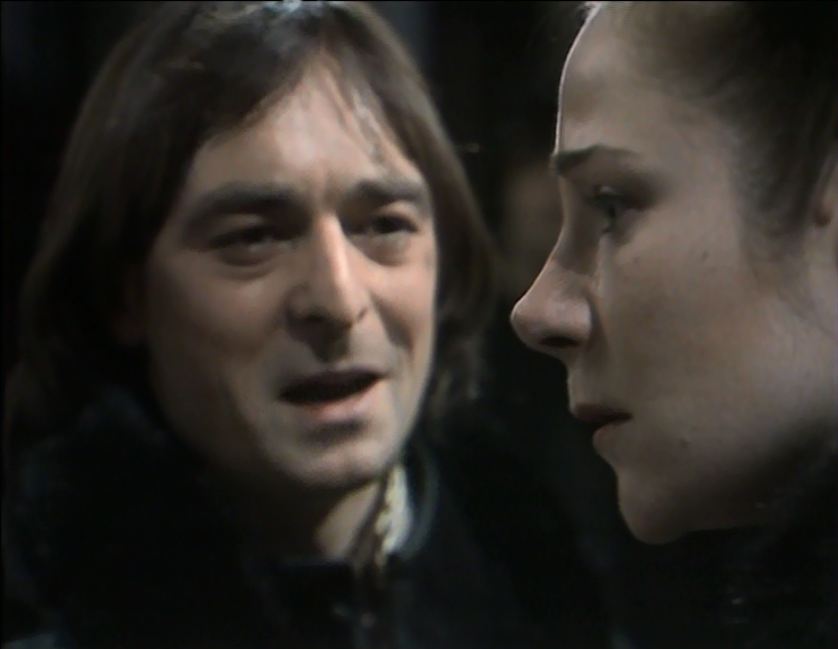 Howell also uses a range of camera techniques to get the
message of the play across. Long takes are prominent throughout, with Howell
using a fluid and roving camera to great effect here, immediately establishing
us a roving and vulnerable part of this world. This allows the camera to linger
on those left behind after Richard’s exit – twice Stanley and others stare with
inscrutable faces across the lens towards lords left doomed by Richard. The
major scene where editing is used, as well as shot cutting, is in the seducing
of Lady Anne. The camera alternates between close-ups of Richard and Lady Anne
as they bat lines at each other, carefully avoiding them getting into shot
together until after Anne’s spitting. This is then replaced with a shot of Anne
in the foreground looking away from Richard in the background of the shot. It
is only at the end that they face each other sharing the shot – a nice visual representation
of Richard drawing them visually closer together. Snap edits are used well
throughout – for example, as the door closes in A2 S5, the shot immediately cuts
to Richard and Buckingham opening the door to Edward V in A3 S1.
Howell also uses a range of camera techniques to get the
message of the play across. Long takes are prominent throughout, with Howell
using a fluid and roving camera to great effect here, immediately establishing
us a roving and vulnerable part of this world. This allows the camera to linger
on those left behind after Richard’s exit – twice Stanley and others stare with
inscrutable faces across the lens towards lords left doomed by Richard. The
major scene where editing is used, as well as shot cutting, is in the seducing
of Lady Anne. The camera alternates between close-ups of Richard and Lady Anne
as they bat lines at each other, carefully avoiding them getting into shot
together until after Anne’s spitting. This is then replaced with a shot of Anne
in the foreground looking away from Richard in the background of the shot. It
is only at the end that they face each other sharing the shot – a nice visual representation
of Richard drawing them visually closer together. Snap edits are used well
throughout – for example, as the door closes in A2 S5, the shot immediately cuts
to Richard and Buckingham opening the door to Edward V in A3 S1.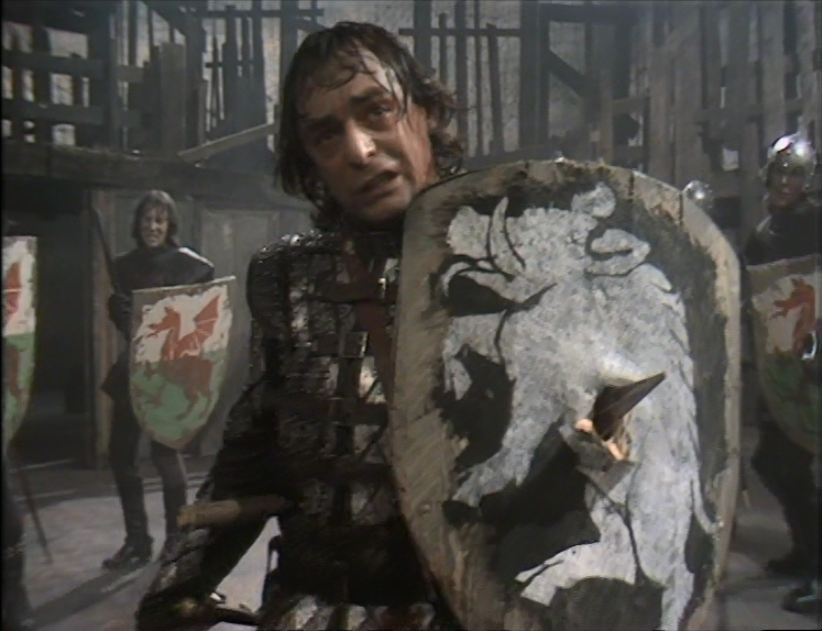 But its largely long takes and shots that work – effective especially
in the final “boar hunt” sequence of Richard by Richmond’s soldiers. In a long
fluid take, Richard is surrounded by soldiers and fights desperately –
furiously – to survive, striking enemies down before he is slowly, inevitably
wounded, slowed and then killed – many of these wounds coming from spears, the
final of which punctures through his body and out of his shield, skewering him
like a sacrificed pig. Even that is not the end as the mortally wounded Richard
is lined up to be given the coup-de-grace by Richmond, his furious and impotent
pain and anger all over his face as he sinks down to death. This sequence also
ends with a particularly neat shot, with a collapsed and dead Richard left
skewered and kneeling at the feet of Richmond – a lifeless supplicant in the back
of frame throughout Richmond’s victory speech. In a neat touch, one shot even shows
the crown held in the foreground as if on Richard’s head – a final insult to
the man who could have ruled the world.
But its largely long takes and shots that work – effective especially
in the final “boar hunt” sequence of Richard by Richmond’s soldiers. In a long
fluid take, Richard is surrounded by soldiers and fights desperately –
furiously – to survive, striking enemies down before he is slowly, inevitably
wounded, slowed and then killed – many of these wounds coming from spears, the
final of which punctures through his body and out of his shield, skewering him
like a sacrificed pig. Even that is not the end as the mortally wounded Richard
is lined up to be given the coup-de-grace by Richmond, his furious and impotent
pain and anger all over his face as he sinks down to death. This sequence also
ends with a particularly neat shot, with a collapsed and dead Richard left
skewered and kneeling at the feet of Richmond – a lifeless supplicant in the back
of frame throughout Richmond’s victory speech. In a neat touch, one shot even shows
the crown held in the foreground as if on Richard’s head – a final insult to
the man who could have ruled the world.
 A further tour-de-force of impressionistic film making is
the nightmare scene in A5. Skilfully, jump cuts are used throughout the build
up to this sequence – Richmond hears a sound, but we see a cut to Richard’s
head turn, Richmond walks into a tent, the shot cuts straight entering into a
tent. Richmond sleeps and turns his head from us, a sudden cut and Richard
appears looking back to us asleep. Slowly the camera zooms slowly in on his
eye, overlaid with an image of Richard as we enter his subconscious and see his
nightmare play out with a series of expressionistic images of his victims throughout
the series, all of them in nightmarish parodies of their final moments. From
the snowy landscape that saw Prince Edward murdered, we see Richmond sleeping
peacefully (unaware) of the ghosts praising him – and in a sign that this is
all Richard’s nightmare, he sits at first on the throne. Then we see Henry
(with the candle that sat on the table as he died), Clarence soaked in wine
(water which flows over the lens as he praises Richmond), the River faction
praising sitting waiting their fates, Hastings at a blooded table, the sheet of
which Richard grabs only for it turn into the bloodied pillow that smothered
the Princes, its feathers raining down on their ghosts. His attempt to clean up
the mess (after watching the Princes crown Richmond) is then interrupted by
Anne on her death bed (who he attempts to smother), before throwing himself on
the absent throne, trembling as Buckingham adds his curse to the list, the
shock sending him tumbling from the throne – and out of his nightmare. Not only
is this an impressive display of film making, it also offers a distinct
interpretation of the dream as something very much happening only to Richard
himself, something in his mind (and from his guilt?), much more than a divinely
powered visit to both rivals. It’s an interesting and unique a staging as we’ve
seen in the series so far – and strikingly filmic.
A further tour-de-force of impressionistic film making is
the nightmare scene in A5. Skilfully, jump cuts are used throughout the build
up to this sequence – Richmond hears a sound, but we see a cut to Richard’s
head turn, Richmond walks into a tent, the shot cuts straight entering into a
tent. Richmond sleeps and turns his head from us, a sudden cut and Richard
appears looking back to us asleep. Slowly the camera zooms slowly in on his
eye, overlaid with an image of Richard as we enter his subconscious and see his
nightmare play out with a series of expressionistic images of his victims throughout
the series, all of them in nightmarish parodies of their final moments. From
the snowy landscape that saw Prince Edward murdered, we see Richmond sleeping
peacefully (unaware) of the ghosts praising him – and in a sign that this is
all Richard’s nightmare, he sits at first on the throne. Then we see Henry
(with the candle that sat on the table as he died), Clarence soaked in wine
(water which flows over the lens as he praises Richmond), the River faction
praising sitting waiting their fates, Hastings at a blooded table, the sheet of
which Richard grabs only for it turn into the bloodied pillow that smothered
the Princes, its feathers raining down on their ghosts. His attempt to clean up
the mess (after watching the Princes crown Richmond) is then interrupted by
Anne on her death bed (who he attempts to smother), before throwing himself on
the absent throne, trembling as Buckingham adds his curse to the list, the
shock sending him tumbling from the throne – and out of his nightmare. Not only
is this an impressive display of film making, it also offers a distinct
interpretation of the dream as something very much happening only to Richard
himself, something in his mind (and from his guilt?), much more than a divinely
powered visit to both rivals. It’s an interesting and unique a staging as we’ve
seen in the series so far – and strikingly filmic.
 All the design and mood of the play however is building towards
the final sequence, a creative coup and imaginative flourish from Jane Howell
that brings the entire cycle of plays thematically together. In the final shot,
the camera slowly tracks along a pile of dead bodies – among them all the
actors we have seen in the previous four plays, dressed as their most prominent
characters. We hear laughter on the soundtrack as the camera pans slowly across
and then up what is clearly a mountain of bodies before it finally rests on a
laughing, wild haired Margaret, hugging to her the bloodied and broken body of
Richard. The camera pans back to reveal the entire image – a mountain of the
dead, a punctuation point of death, finally showing the end – and visually
summarising the destruction – that the Roses of the Wars have let rip on the
Kingdom of England. As a final image it summarises all that has been best about
this magnificent sequence of productions: the finest example so far in the
series of marrying the cinematic with the theatrical.
All the design and mood of the play however is building towards
the final sequence, a creative coup and imaginative flourish from Jane Howell
that brings the entire cycle of plays thematically together. In the final shot,
the camera slowly tracks along a pile of dead bodies – among them all the
actors we have seen in the previous four plays, dressed as their most prominent
characters. We hear laughter on the soundtrack as the camera pans slowly across
and then up what is clearly a mountain of bodies before it finally rests on a
laughing, wild haired Margaret, hugging to her the bloodied and broken body of
Richard. The camera pans back to reveal the entire image – a mountain of the
dead, a punctuation point of death, finally showing the end – and visually
summarising the destruction – that the Roses of the Wars have let rip on the
Kingdom of England. As a final image it summarises all that has been best about
this magnificent sequence of productions: the finest example so far in the
series of marrying the cinematic with the theatrical.
 The series wraps up with a stunning final episode that
brings all the weight and depth of the previous three productions to bear to
add a new level of depth to the play, as it is placed in its proper context. From
its opening shot of the bare ruined stage to its final shot of the space
littered with a mountain of corpses, this dark, gloomy, overbearing and sinister
production stands out as a truly unique interpretation of the play and a
perfect summation of the 13 hours of drama that preceded it. The ensemble cast
are so experienced in their roles that they offer superb performances, led by
an intelligent and redefining Richard from Ron Cook. Terrific stuff, and a
clear sign of Jane Howell’s artistic imagination. The final image is almost
worth the price of admission alone. Excellent stuff!
The series wraps up with a stunning final episode that
brings all the weight and depth of the previous three productions to bear to
add a new level of depth to the play, as it is placed in its proper context. From
its opening shot of the bare ruined stage to its final shot of the space
littered with a mountain of corpses, this dark, gloomy, overbearing and sinister
production stands out as a truly unique interpretation of the play and a
perfect summation of the 13 hours of drama that preceded it. The ensemble cast
are so experienced in their roles that they offer superb performances, led by
an intelligent and redefining Richard from Ron Cook. Terrific stuff, and a
clear sign of Jane Howell’s artistic imagination. The final image is almost
worth the price of admission alone. Excellent stuff!


